In this biography
Quick facts
- Born
- 2 August 1968
- Birthplace
- Peace River, Alberta
- Country
- Canada
- Nationality
- Canadian
- Known for
- Trade negotiations, service as Canada’s first woman finance minister and writing on economic power
- Education
- Harvard University and University of Oxford; Rhodes Scholar
- Deputy prime minister
- 2019–2024
- Finance minister
- 2020–2024
- Rhodes Trust appointment
- Warden and CEO from 1 July 2026
Why this life matters
Freeland’s career connects reporting on concentrated wealth with the practical responsibilities and conflicts of trade, diplomacy and federal economic policy.
Timeline
Key moments
Alberta and university study
Born in Peace River; studies at Harvard and arrives at Oxford as a Rhodes Scholar in 1991.
Reporting, editing and books
Works internationally in journalism and publishes Sale of the Century and Plutocrats before entering politics.
Parliament and international trade
Wins Toronto Centre, later represents University—Rosedale, and serves as international trade minister during CETA’s final stages.
Foreign affairs and deputy leadership
Leads Canada’s NAFTA renegotiation work, then becomes deputy prime minister and intergovernmental affairs minister.
Finance ministry
Becomes the first woman finance minister and presents pandemic recovery budgets; announces her cabinet resignation in December 2024.
A transition beyond Parliament
Serves in Carney’s cabinet, leaves Parliament in January 2026, joins the Rhodes Trust in July and publishes Unreliable Boyfriend in October.
Alberta roots led to study and reporting overseas
Chrystia Freeland was born in Peace River, Alberta, on 2 August 1968. She studied at Harvard University and continued at Oxford on a Rhodes Scholarship, arriving there in 1991. Her academic background included Russian history, an interest that became central to her early reporting and first book.
Freeland began as a freelance journalist based in Ukraine, writing for the Financial Times, The Washington Post and The Economist. The dissolution of the Soviet system and the struggles over its economic future provided a setting in which reporting required attention to institutions, business interests and political power. This international experience preceded her later work as a Canadian elected representative.
Newsrooms and books established a public voice before politics
Her journalism career included senior posts at the Financial Times, The Globe and Mail and Thomson Reuters. She served as the Globe’s deputy editor, the Financial Times’ United States managing editor and a managing director at Thomson Reuters. These were editorial and organizational responsibilities as well as opportunities to report.
Sale of the Century examined the struggle over Russia’s post-Soviet economic transformation. Plutocrats turned to the global concentration of wealth and the distance between an increasingly powerful elite and everyone else. The books helped establish the economic themes associated with her public career. They were works of reporting and argument, not a record of policies she had yet implemented in government.
Parliament brought the responsibilities of negotiating trade
Freeland entered the Commons after winning Toronto Centre in a November 2013 by-election. From 2015 she represented University—Rosedale and served as international trade minister in Justin Trudeau’s government. The Canada–European Union trade agreement, CETA, had been negotiated over several years before her appointment; her responsibility included its difficult final political stages.
Canada and the EU signed CETA in Brussels in October 2016. The next day Freeland tabled the treaty and introduced implementing legislation in Ottawa. Those were distinct steps in a process involving negotiators, other ministers, provinces, EU institutions and member states. Describing her role as sole authorship would erase that wider institutional work.
Foreign affairs expanded her work with the United States
As foreign affairs minister from 2017 to 2019, Freeland led Canada’s work in renegotiating the North American Free Trade Agreement with the United States and Mexico. The successor agreement is known in Canada as CUSMA. The negotiations combined diplomacy with the defence of economic interests in a politically strained relationship.
After the 2019 election, she became deputy prime minister and minister of intergovernmental affairs. Those responsibilities brought negotiations with provincial governments and coordination during the COVID-19 emergency. Her move between portfolios illustrates how a minister could retain a central Canada–U.S. role while taking on different domestic responsibilities; the titles should not be treated as interchangeable.
Finance office ended with a public disagreement over policy
On 18 August 2020 Freeland became Canada’s first woman finance minister while remaining deputy prime minister. Her April 2021 budget proposed continued emergency supports and a major investment in a Canada-wide early learning and child-care system. These were government plans requiring legislation and partnerships, rather than proof that every announced target had been achieved.
She announced her resignation from cabinet on 16 December 2024. In her letter, she said Trudeau had offered another portfolio and that they disagreed over the country’s direction, particularly preparations for threatened U.S. tariffs. That document states her reasons; it does not establish that every criticism she made was uncontested. She remained a Liberal MP after leaving those cabinet roles.
A new institutional role followed the end of parliamentary service
Freeland lost the 2025 Liberal leadership contest to Mark Carney, then served as his transport and internal trade minister. She left cabinet that September for reconstruction-related work concerning Ukraine. Her Commons service ended on 9 January 2026. Leaving the finance ministry, later leaving cabinet again and leaving Parliament were separate events.
After a spring fellowship at Harvard, she became Warden of Rhodes House and CEO of the Rhodes Trust on 1 July 2026. The publisher lists her memoir Unreliable Boyfriend as published on 13 October 2026. It returns to questions of economic power, democracy and Canada’s relationship with the United States, extending themes from her earlier writing through the experience of public office.
Quick answers
Frequently asked questions about Chrystia Freeland
- Was Freeland a journalist before entering Parliament?
- Yes. She worked for major international news organizations and published Sale of the Century and Plutocrats before her 2013 election.
- Was she Canada’s first woman finance minister?
- Yes. She was appointed on 18 August 2020 and served in the portfolio until December 2024.
- Is Chrystia Freeland still an MP?
- No. The Commons record ends her parliamentary service on 9 January 2026. She began as Warden of Rhodes House and CEO of the Rhodes Trust in July 2026.
- What is her 2026 book?
- Unreliable Boyfriend is a political memoir and argument about power, democracy and the United States. Simon & Schuster Canada lists publication on 13 October 2026.
Keep exploring
Lives connected to this story
- Justin Trudeau
Read the prime minister’s wider career and the government in which Freeland held several senior portfolios.
- Brian Mulroney
Compare the earlier prime minister’s Canada–U.S. trade negotiations with the later renegotiation of NAFTA.
- Jean Charest
Explore provincial advocacy for closer Canada–EU economic relations through Charest’s career.
Sources and further reading
Explore the evidence
These references support the biography and offer further reading. Official records, first-person accounts and independent reporting provide different perspectives; image records document attribution and licensing.
- 1. iPoliticsChrystia Freeland: parliamentary profile, indexed date-of-birth field
The indexed iPolitics date-of-birth field was read. Direct full-page access returned 403; no claim to have read its complete profile.
- 2. Harvard University Institute of PoliticsChrystia Freeland: Spring 2026 Resident Fellow biography
The actual Spring 2026 profile was retrieved and read. Its incoming-Rhodes wording is superseded by the Trust’s 1 July start announcement. Promotional assessments of economic performance are not adopted as independent findings.
- 3. Rhodes TrustChrystia Freeland starts as new Warden and CEO, 1 July 2026
- 4. House of Commons of CanadaChrystia Freeland: parliamentary roles and service ending 9 January 2026
The indexed Commons roles table establishes the 9 January 2026 MP endpoint. Its formal ministerial service table ends the finance and deputy roles on 15 December 2024, while the public resignation letter is dated 16 December. This account distinguishes the announcement from administrative table dating.
- 5. Simon & Schuster CanadaUnreliable Boyfriend: official publisher description, author biography and 13 October 2026 publication
Actual author biography, book description and product details were read, not the memoir itself. Publisher date is 13 October 2026; a conflicting secondary 19 October date is not used.
- 6. Prime Minister of CanadaChanges to the Ministry: Freeland appointed finance minister, 18 August 2020
- 7. The Canadian Press / CityNewsMia Rabson: Cabinet glass ceiling shattered as Freeland named finance minister, 18 August 2020
- 8. Department of Finance CanadaBudget 2021: A Recovery Plan for Jobs, Growth, and Resilience, 19 April 2021
- 9. Reuters / Investing.comFull text of Freeland’s resignation letter to Trudeau, 16 December 2024
- 10. Associated PressFreeland exits Carney’s cabinet to become special envoy to Ukraine, 16 September 2025
- 11. Global Affairs CanadaCETA timeline: 2009 launch, 2014 text, 2016 signature and 2017 provisional application
- 12. Global Affairs CanadaInternational Trade Minister introduces legislation to implement CETA, 31 October 2016
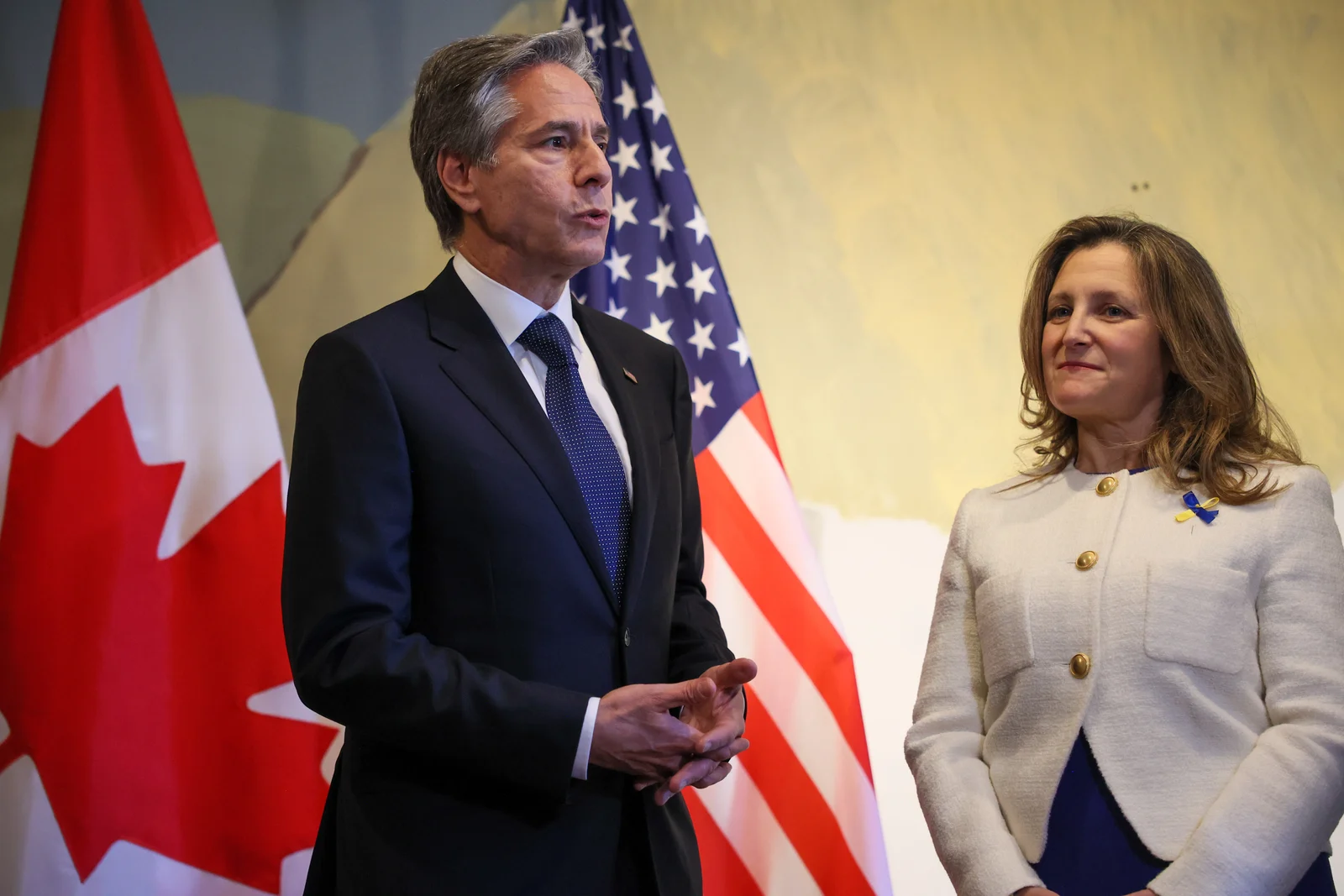
- 13. Wikimedia Commons / U.S. Embassy and Consulates in CanadaSecretary of State Antony Blinken at Café Ukraine: complete 27 October 2022 photograph
- 14. Flickr / U.S. Embassy and Consulates in CanadaSecretary of State Antony Blinken at Café Ukraine: official publisher’s Public Domain Work mark