
The short answer
The krama is a traditional Cambodian woven cloth with uses that range from daily work to ceremonial exchange. UNESCO's 2024 entry follows the practices associated with the textile: how people make it, how they wear and use it, and how one generation passes those skills to the next.
Compare the records
Follow the cloth from a loom into ordinary life
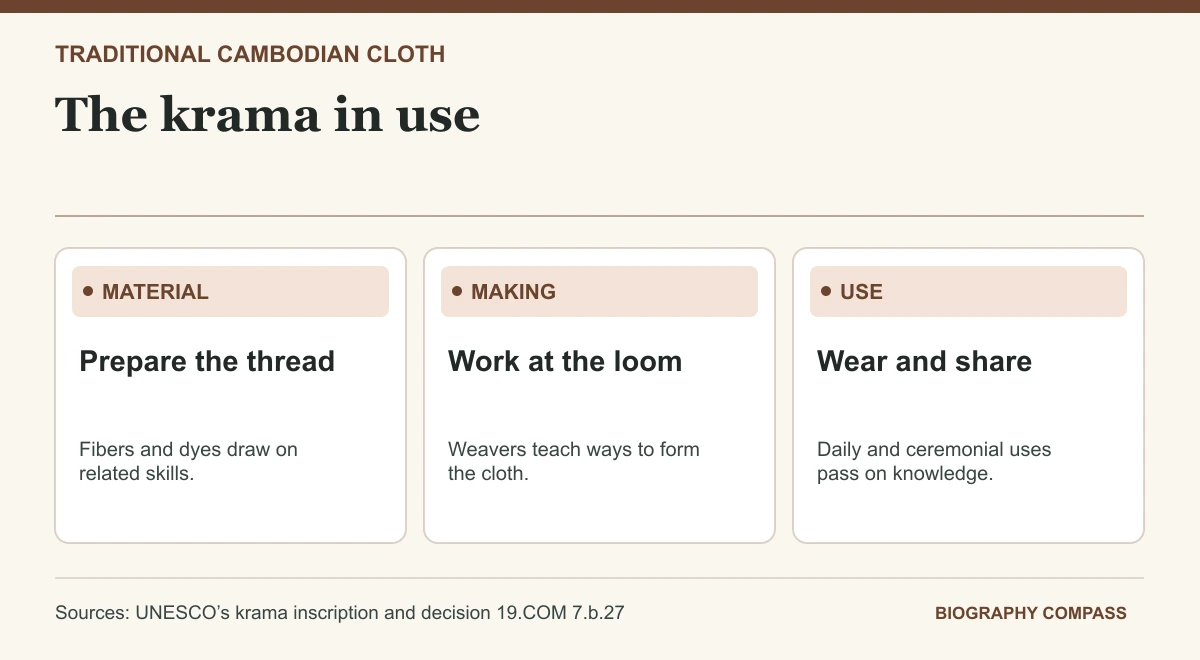
The UNESCO record describes the textile through several activities that can be observed and taught.
| Stage | Example | What it can tell a researcher |
|---|---|---|
| Prepare | Process fibers and obtain dyes | Which materials and linked occupations support weaving? |
| Make | Weave thread on a loom | How are patterns formed and skills taught? |
| Use | Wear, carry or exchange the cloth | Where does the krama appear in daily and ceremonial life? |
| Teach | Pass on weaving and related practices | What knowledge can be learned by working with an experienced weaver? |
Chronology
A timeline of the turning points
Weavers develop and share skills
Making and using the cloth connects households with weaving communities.
UNESCO considers the nomination
The file documents how the textile is made, used and taught.
UNESCO inscribes the element
The Representative List records practices and expressions linked to the krama.
Why a textile has more than one use
A krama can serve as a scarf or head covering and can be adapted to other tasks such as carrying objects. Its shape and the way it can be folded make it practical. The same form can take on particular meanings when it is given or used during a ceremony. A photograph gives a view of a pattern or of a person wearing it. Interviewing weavers and users adds information about why a particular textile was made and where people expect it to be used.
What a weaver has to know
The cloth depends on decisions about materials, thread and pattern. UNESCO's account includes the people who prepare fibers and make dyes as well as the people operating a loom. A learner may first follow the hand movements of an experienced weaver and then practice making an even fabric. The decision highlights women's contribution to passing on this knowledge. That transmission gives the finished cloth a social history that its visible pattern conveys only in part.
How the 2024 inscription describes the element
The committee recognized cultural practices and expressions associated with the textile. Its decision gives readers evidence about the people involved in safeguarding and about efforts to document the practice with community representatives. The Representative List entry can serve as a guide to questions about training, local production and customary use. Those questions are distinct from dating or authenticating an individual cloth.
Continue the chronology
Related history guides
Lao Naga Motif Weaving: How the Pattern Enters the Cloth
Read how a distinctive textile motif is made and transmitted in Laos.
Read the timeline2016–2025Chapei Dang Veng: Cambodia’s Lute and Improvised Song
Compare transmission through weaving with the teaching of a musical tradition.
Read the timeline2018 onwardLkhon Khol Wat Svay Andet: Cambodia’s Masked Theatre
Read how a different Cambodian safeguarding record is linked to a named monastery community.
Read the timelineConnected biographies
People connected to this history
Quick answers
Common questions
- What is a Cambodian krama?
- It is a traditional woven cloth with practical uses and roles in community and ceremonial life.
- When did UNESCO recognize krama practices?
- The committee inscribed the practices and expressions linked to the textile on the Representative List in December 2024.
Primary and institutional sources
How this history was checked
Dates, legal milestones and historical claims are checked against the official and institutional records below. This article was reviewed on 19 November 2026.