
The short answer
Lao weavers use traditional wooden looms to work serpent figures known as Naga into textiles. The figure carries meanings associated with rivers, protection and ancestry. UNESCO considered the craft in 2021 and inscribed it in 2023 after a further nomination.
Compare the records
Read the textile through its making
The design, materials and occasions of use give a reader three places to look for evidence.
| Feature | What the records describe | Question to ask |
|---|---|---|
| Use of the loom | The figure is formed while the cloth is woven | How does the design relate to the threads that hold the fabric together? |
| Fiber and color | Silk, silk organza and cotton can carry the design | Which choices make the crest or body easier to distinguish? |
| Cultural use | A figure linked to local beliefs and occasions | What could the cloth communicate to the people using it? |
| Transmission | Households and training settings teach the skill | Who can show a learner how to produce the figure? |
Chronology
A timeline of the turning points
Naga motifs appear in Lao textiles
Weavers develop and pass on ways of producing the figure in cloth.
UNESCO committee refers the nomination back
The decision invites Lao PDR to submit it again in a later cycle.
The committee inscribes the craft
The new decision recognizes hand weaving, use and transmission.
How the figure enters the structure of the cloth
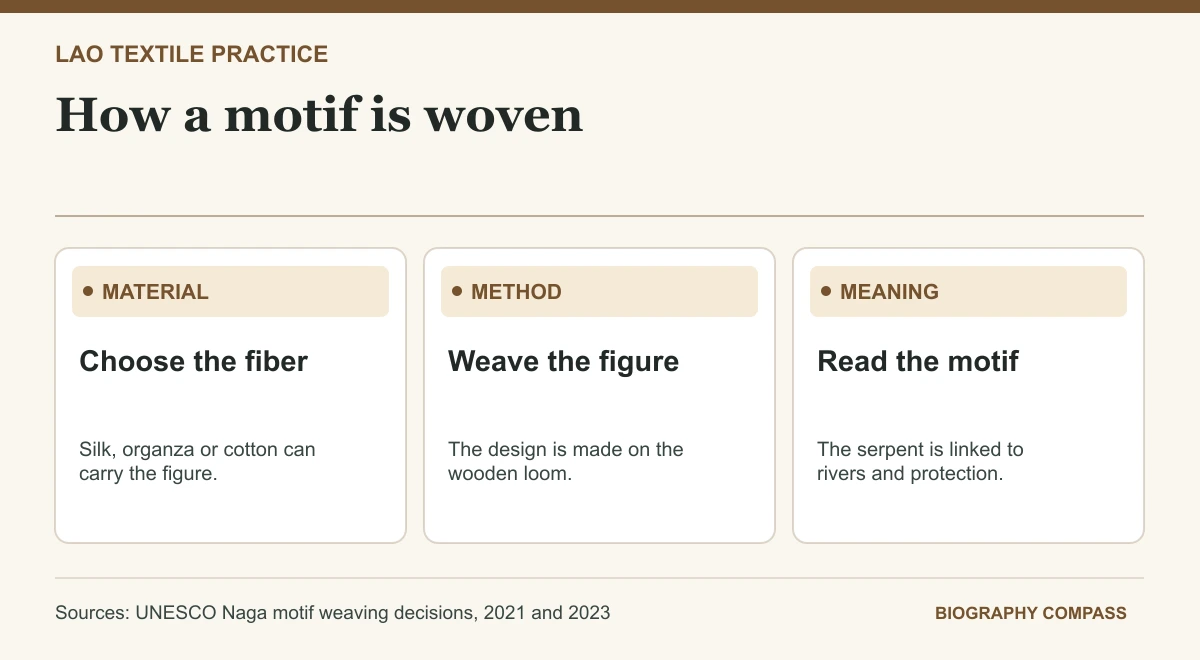
A weaver forms a Naga as part of producing the fabric on the loom. The listing describes silk, silk organza and cotton, and notes one approach in which the crest uses brighter colours than the body. Looking closely at a cloth lets a reader ask whether the motif was made in the weave or added by another technique. The answer connects the appearance of the figure to decisions made while the threads were being worked.
Why a serpent belongs in more than one setting
The Naga is described as a serpent associated with rivers and protection. Woven forms appear in different settings, and their meaning depends in part on how a textile is made and used. Knowledge of the motif includes where people expect to encounter it and who teaches its use. A textile from a museum collection can show a pattern clearly, while accounts from weavers help identify what people associate with it.
What the two decisions establish
In 2021 the committee referred the earlier nomination to Lao PDR. It questioned whether the submitted inventory listed the practice and its communities in enough detail, or mainly listed motif designs. The 2023 decision accepted the inventory criterion after considering the later file and information supplied through dialogue. Inscription followed that year. The two decisions show that a heritage nomination needs evidence about the people and practice behind a recognizable pattern.
Continue the chronology
Related history guides
How Luang Prabang Opened Its Ethnology Museum in 2007
See how a Luang Prabang museum interprets textiles and craft in community settings.
Read the timeline2024The Cambodian Krama: Weaving, Daily Use and UNESCO Listing
Compare a Cambodian textile inscription centered on the making and uses of a different cloth.
Read the timelineConnected biographies
People connected to this history
Quick answers
Common questions
- Is the Naga motif stitched onto a finished textile?
- The practice described in the UNESCO record forms the figure while the textile is being woven.
- When did Naga motif weaving enter the Representative List?
- It was inscribed in 2023 after an earlier nomination was referred back in 2021.
Primary and institutional sources
How this history was checked
Dates, legal milestones and historical claims are checked against the official and institutional records below. This article was reviewed on 19 November 2026.