
The short answer
Lkhon Khol Wat Svay Andet is a masked theatre practice maintained by communities around a Buddhist monastery on the Mekong east of Phnom Penh. Men perform in masks with an orchestra and reciters. The performance also serves a local ritual purpose, asking the guardian spirits of the place for protection and prosperity.
Compare the records
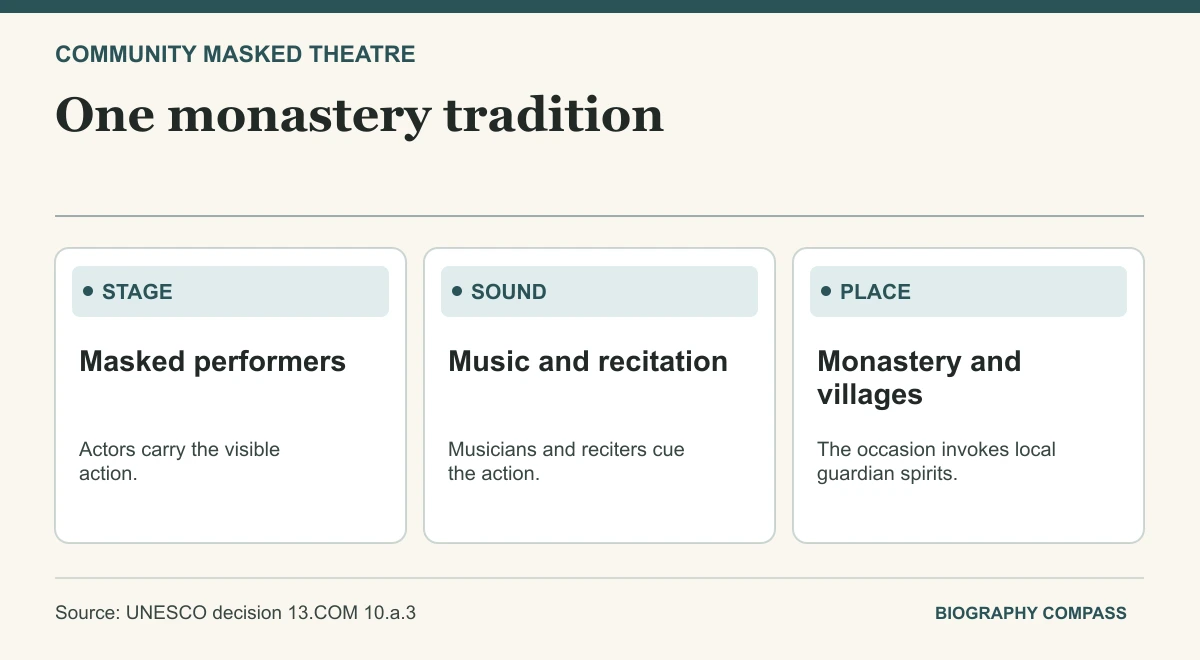
How the parts of the performance fit together
The roles explain why safeguarding a masked performance concerns a community as well as a set of objects.
| Participant | Contribution | What needs to be transmitted |
|---|---|---|
| Masked performers | Stage the visible action | Movement, choreography and role knowledge |
| Musicians and reciters | Supply music and narrative | Ensemble cues and the text |
| Monastery and surrounding villages | Sustain the occasion and its ritual meaning | Coordination of the performance and local practice |
Chronology
A timeline of the turning points
The monastery and surrounding villages sustain a ritual
Masked acting, music and recitation require shared preparation.
Conflict interrupts transmission
The form survives through efforts to revive a local repertoire.
UNESCO names the monastery tradition
The committee inscribes Lkhon Khol Wat Svay Andet on the Urgent Safeguarding List.
Why the name includes a monastery
The UNESCO entry names Wat Svay Andet, a particular community of practice. The committee's decision associates the performance with a Buddhist monastery and with residents of the surrounding villages of Ta Skor and Peam Ta Ek. The named site tells readers who maintains the practice and how it is anchored in the area. It also keeps the listing distinct from descriptions of Khmer masked theatre in other places.
How performance and ritual come together
Masked performers provide the visible action, with reciters and musicians supplying voices, cues and accompaniment. The occasion also brings the local guardian spirits, known as Neak Ta, into the account of why the performance is held. The committee records prayers for rain and a good harvest among its purposes. The masks make one feature readily recognizable in pictures, while the musicians, reciters and ritual context explain why performance cannot be understood from the objects alone.
What urgent safeguarding means here
The 2018 decision treats transmission as a continuing issue. A new group of performers needs to learn movement and acting, and an occasion brings the various participants together to practice them. The nomination and committee decision supply a record of the risks and proposed measures. Later reports help a reader ask whether younger participants are learning the role, whether performances take place and whether people in the community can continue organizing them.
Continue the chronology
Related history guides
Royal Ballet of Cambodia: Roles, Music and UNESCO Listing
Compare an ensemble historically associated with the royal court.
Read the timeline2005–2008Sbek Thom: Cambodia’s Large-Scale Khmer Shadow Theatre
Compare masked acting on stage with the figures of Sbek Thom.
Read the timeline2024The Cambodian Krama: Weaving, Daily Use and UNESCO Listing
Compare Cambodia’s later Representative List recognition for a textile practice.
Read the timelineConnected biographies
People connected to this history
Quick answers
Common questions
- What does UNESCO’s 2018 inscription name?
- It names Lkhon Khol Wat Svay Andet, the masked theatre practice of the community around that monastery.
- Why is the performance held?
- The record describes a ritual seeking protection and prosperity from the local guardian spirits, including prayers for rain and a good harvest.
Primary and institutional sources
How this history was checked
Dates, legal milestones and historical claims are checked against the official and institutional records below. This article was reviewed on 19 November 2026.