
The short answer
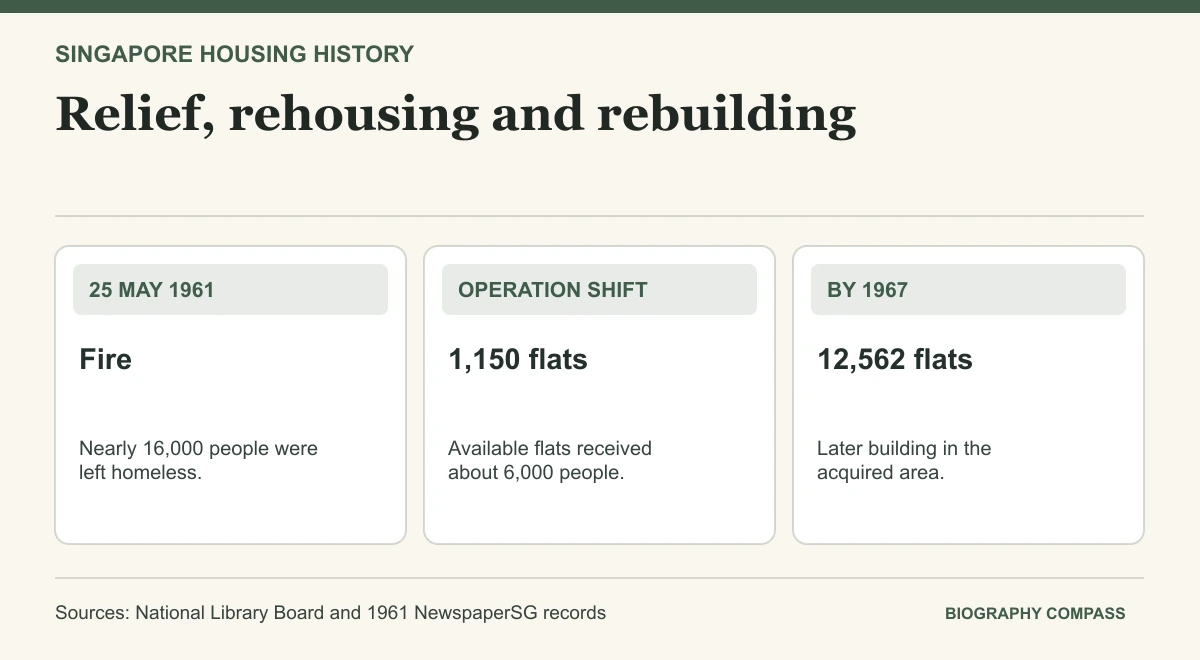
The fire that spread through Bukit Ho Swee on 25 May 1961 left nearly 16,000 people homeless. The emergency response had several stages. Contemporary reporting records the proposed land acquisition, while the National Library Board chronology separates immediate relocation from permanent building work on and around the site.
Singapore housing history
Relief, rehousing and rebuilding
The numbers cover people, temporary rehousing and the eventual building programme.
| Stage | Evidence | Population or area described |
|---|---|---|
| Displacement | About 16,000 people | People left homeless after the fire |
| Operation Shift | 1,150 flats and about 6,000 people | Initial movement into available public flats |
| Building programme | 12,562 flats by 1967 | New housing on the site and in adjacent lands |
Chronology
A timeline of the turning points
Fire displaced thousands
Relief began before new homes could be completed.
Rehousing pledge and Operation Shift
Families moved to available flats in several districts.
Remaining families rehoused
The National Library Board chronology marks completion of this stage.
Building continued
HDB completed 12,562 flats in the area.
The fire and the first response
The National Library Board describes a fire that damaged homes as well as workplaces, workshops and a school. Contemporary coverage records the government’s intention to acquire part of the devastated area for housing. In that issue the announcement concerns what the government planned. The much later building total records what had been completed by 1967. Separate the contemporary report of the disaster from the later count of flats built under the housing programme.
The emergency move relied on flats elsewhere
Operation Shift used available flats in Queenstown, Tiong Bahru, Alexandra and Kallang. According to the NLB, around 6,000 people moved into 1,150 flats in that phase, with remaining affected families housed by February 1962. Separate the count of flats from the count of people and retain the area and date attached to each measure.
Sources for this section: [1]
The archive also records what families experienced
A survivor’s account can describe how belongings were saved, where people waited or how neighbours made contact. BiblioAsia’s oral history study provides another way to examine the fire alongside the newspaper and rehousing totals. The official numbers establish the scale and timetable. Individual recollections recover actions and decisions that a tally cannot identify.
Continue the chronology
Related history guides
How Tiong Bahru’s SIT Flats Became a Conservation Area
Read the history of one estate that had available flats for Operation Shift.
Read the timeline1952–1970Queenstown: How Singapore Built Its First Satellite Town
See how the first satellite town became part of the emergency housing network.
Read the timeline1927–presentSingapore Public Housing History
Put the fire and rebuilding in the timeline of Singapore public housing.
Read the timelineConnected biographies
People in this history
Quick answers
Common questions
- When was the Bukit Ho Swee fire?
- 25 May 1961.
- Were the 12,562 flats built immediately after the fire?
- That is the total completed in the area by 1967. Earlier rehousing used available flats in several estates.
Primary and institutional sources
How this history was checked
Dates, legal milestones and historical claims are checked against the official and institutional records below. This article was reviewed on 19 November 2026.