
The short answer
Why did a new museum building require a separate staff-training programme?
Compare the records
What the sources allow us to say
Read the object record alongside the contextual account.
| Record | Evidence | Reading limit |
|---|---|---|
| 1967 museum report | Records staffing and training priorities before the building opened. | A planned action is not proof of its completion. |
| 1972 opening record | Documents the museum’s later public opening. | Opening a building differs from founding its organisation. |
A building plan is also a staffing problem
The 1967 Pelita Brunei article reports plans for a museum at Kota Batu while describing staff studying abroad. It names specialisms including taxidermy, library and archival work, and anthropology. These fields address different parts of a collection’s life. A building provides rooms, but trained staff preserve specimens, organise information and develop interpretation. Reading the training programme beside the construction plan reveals the several kinds of work required before a museum can function as a continuing public institution.
Sources for this section: [1]
Keep a forecast separate from an opening
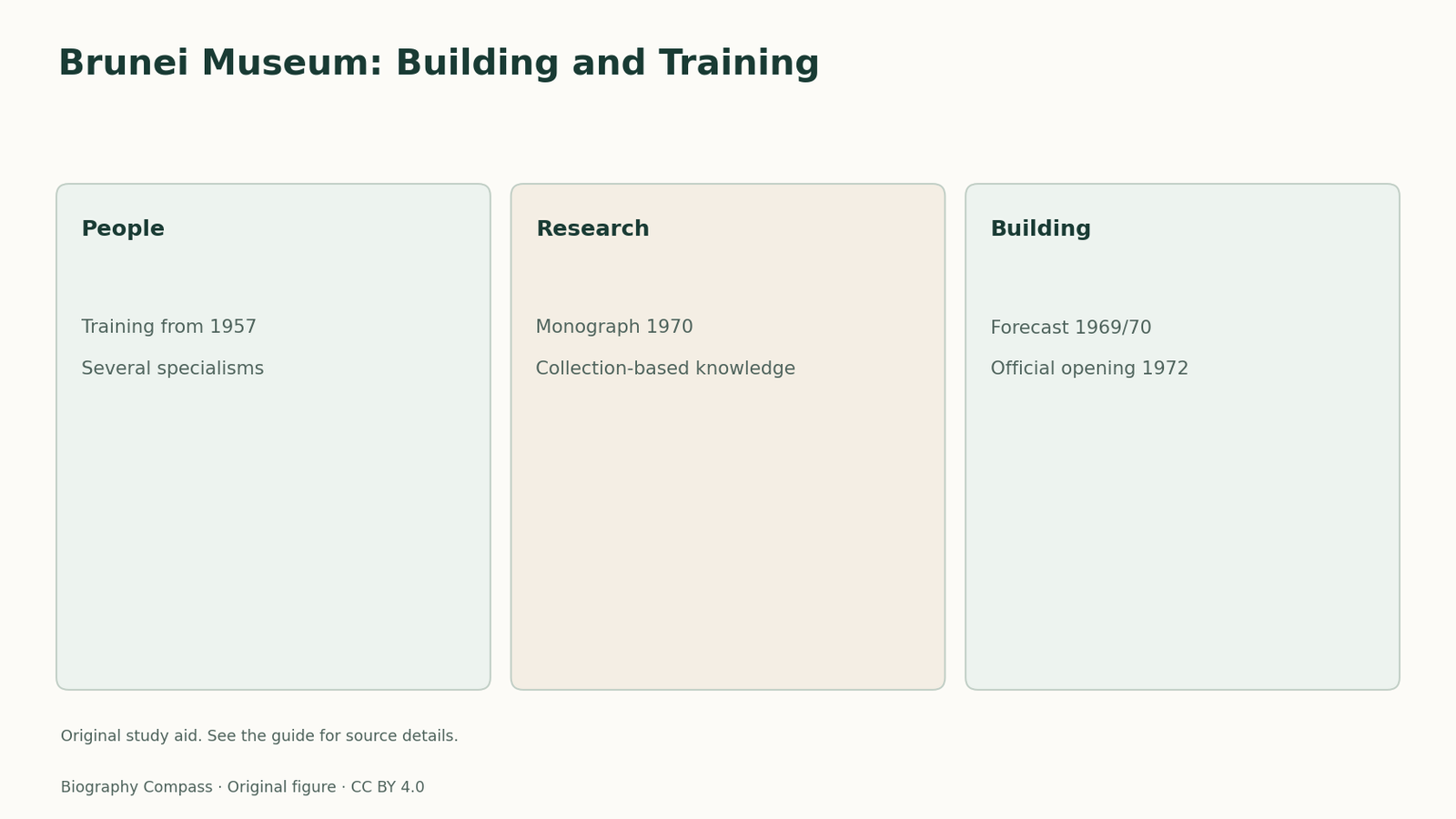
The contemporary report expected the new building to be ready in 1969 or 1970. The later scholarly account identifies the official opening in 1972. These statements describe a forecast and an eventual event, so they need not be forced into agreement. A timeline should label the first as an expectation at the time. This distinction preserves the value of the 1967 report as evidence of planning while allowing a later source to establish when the formal public milestone actually occurred.
Collections, skills and research develop together
Shariffuddin’s own training began in Kuching in 1957, and the museum published Brown’s historical monograph in 1970. Those events show institutional activity extending before the permanent building’s opening. Draw three parallel tracks for staff development, publishing and construction. A useful answer explains that a museum can prepare expertise and produce research before inaugurating its final premises. It also identifies how these tracks later support one another. Trained specialists maintain collections, collections support investigation, and published research gives visitors and future scholars ways to question and extend what the institution knows.
Continue the chronology
Related history guides
Biography context
Explore Brunei through connected lives
Connected biographies
Read the artist’s biography
1936–2018
Pengiran Shariffuddin
Museum director and historianA Bruneian museum leader and historian who helped build the institutions and skills needed to preserve a national collection.Read biographyQuick answers
Common questions
- Did all museum activity begin with the 1972 opening?
- No. The sources document earlier staff training, planning and the publication of a historical monograph in 1970.
Primary and institutional sources
How this history was checked
The listed records support the facts. Observation exercises and arguments are Biography Compass editorial interpretations. This article was reviewed on 7 November 2026.