
The short answer
How did a shared stained-glass workshop balance individual design and collective production?
Compare the records
What the sources allow us to say
Read the object record alongside the contextual account.
| Record | Evidence | Reading limit |
|---|---|---|
| National Gallery foundation account | 1903 studio, individual control and international commissions. | A cooperative name does not identify one uniform style. |
| Archive and gallery records | Training purpose, surviving designs and Purser’s institution building. | A paper design does not reproduce an installed window’s light. |
The studio addressed a practical problem
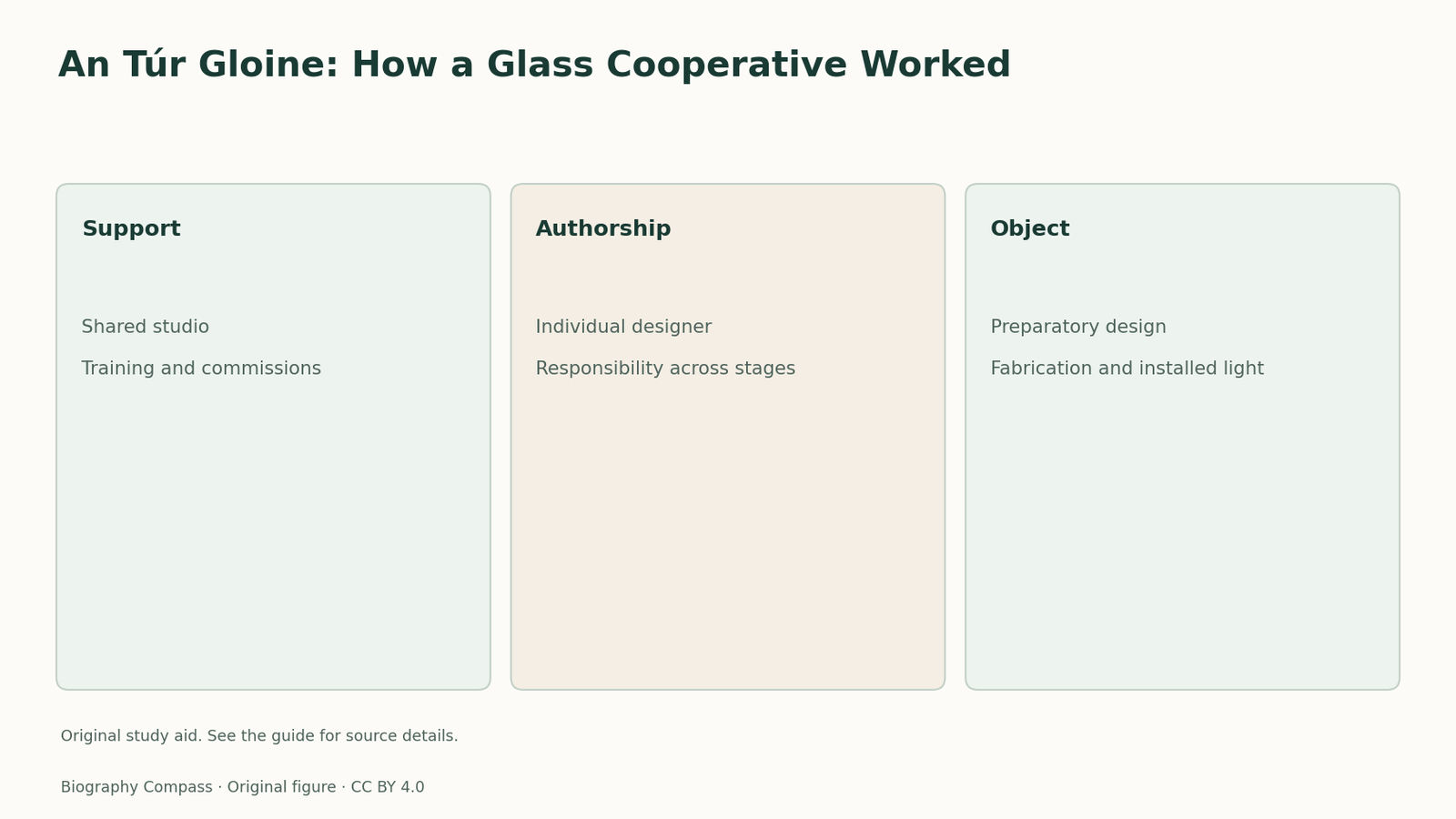
The National Gallery describes An Túr Gloine as a studio and collective founded in 1903 by Sarah Purser with help from Edward Martyn andA. E. Child. Its purpose included improving Irish stained-glass practice and offering an alternative to commercially imported windows. This was an organisational response involving training, workspace and commissions. It should be distinguished from an account of one finished window. The studio created conditions in which several artists could develop and deliver work rather than requiring every project to share a single anonymous identity.
Responsibility across stages supports difference
The gallery’s account stresses that individual artists took responsibility for the stages of their own work. That arrangement helped preserve personal styles within a shared organisation. Cooperation therefore did not necessarily mean dividing every window into the same industrial sequence or suppressing the designer’s role. Compare a studio-level credit with an object-level credit. The first identifies a setting of production and support; the second should name the artist responsible for that particular commission. Both matter, but they answer different questions about authorship.
Sources for this section: [2]
Designs preserve part of a longer process
The gallery’s exhibition brought surviving designs into view and noted commissions reaching countries well beyond Ireland. A design can document planning and composition, while a finished window adds glass, light and an architectural site. Draw a chain linking cooperative, individual designer, preparatory design, fabrication and installed window. A supported answer identifies the institution’s enabling role without assigning every task to Purser or treating a paper design as materially identical to the completed glass. This model makes it possible to study both an artist’s decisions and the cooperative structure that allowed those decisions to become public objects.
Continue the chronology
Related history guides
Biography context
Explore Ireland through connected lives
Connected biographies
Read the artist’s biography
1848–1943
Sarah Purser
Painter and cultural organiserAn Irish portrait painter and organiser who helped build stained-glass practice and public art institutions.Read biographyQuick answers
Common questions
- Did Sarah Purser personally design every An Túr Gloine window?
- No. She founded and supported a cooperative whose individual artists retained distinct styles and responsibility for their commissions.
Primary and institutional sources
How this history was checked
The listed records support the facts. Observation exercises and arguments are Biography Compass editorial interpretations. This article was reviewed on 7 November 2026.