
The short answer
A movement for a wider vote and a statute defining eligibility answer different questions about political change.
Evidence comparison
Read the records together
The records were created for different purposes and support different kinds of claims.
| Record | What it establishes | Question to keep open |
|---|---|---|
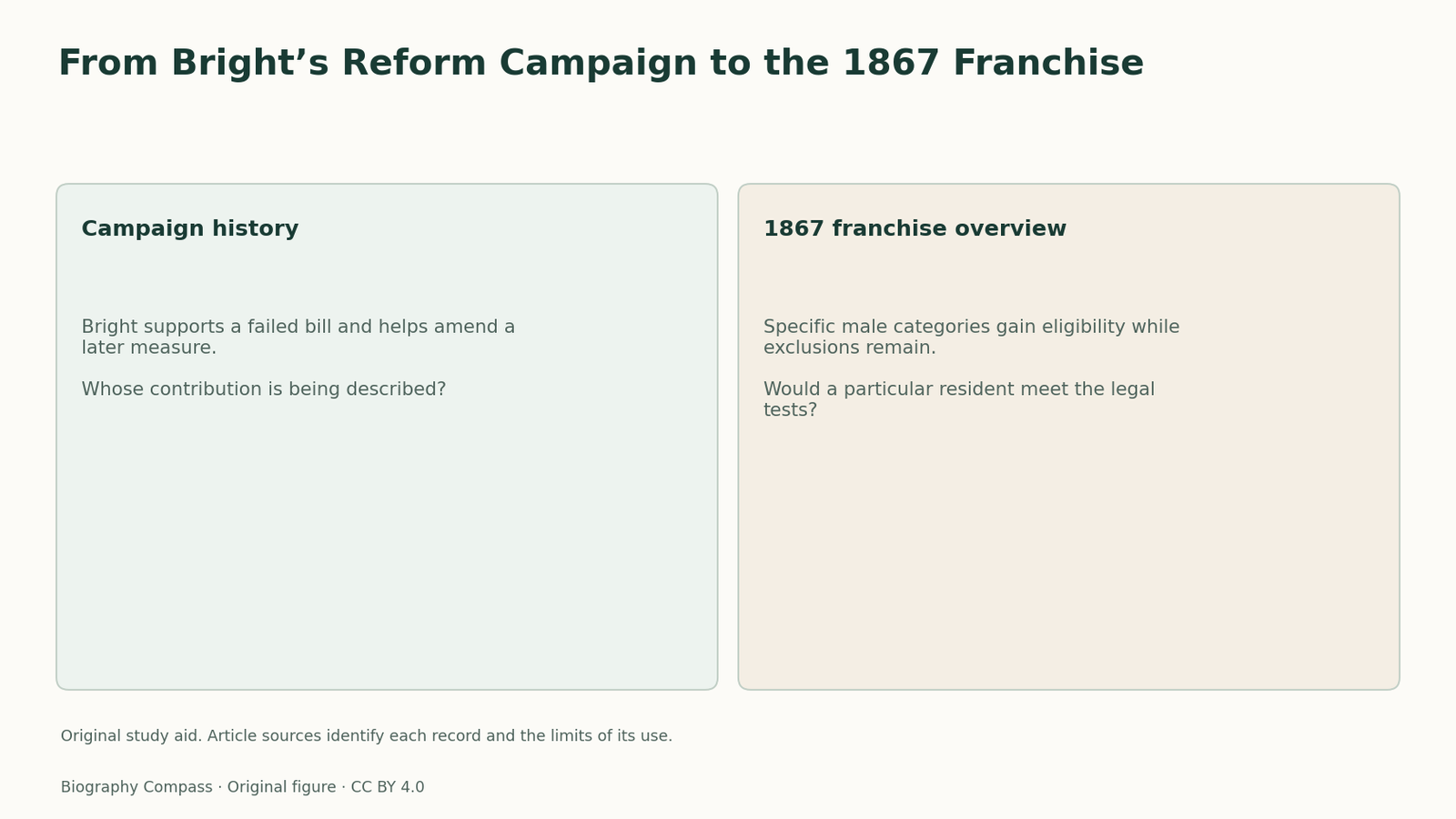
| Campaign history | Bright supports a failed bill and helps amend a later measure. | Whose contribution is being described? |
| 1867 franchise overview | Specific male categories gain eligibility while exclusions remain. | Would a particular resident meet the legal tests? |
Chronology
A timeline of the turning points
Bill fails
Bright supports Gladstone’s unsuccessful measure.
Reform passes
A later measure expands the male franchise.
Keep the failed bill on the timeline
Bright supported Gladstone’s reform measure in 1866, but it failed. The next year’s legislation came through a different government and a further sequence of amendments. Removing the failed bill from a short history makes the final Act appear inevitable. Preserve it as evidence that public support and parliamentary passage were separate problems, and that the wording reaching the statute book was shaped through an additional political contest.
Sources for this section: [2]
Read eligibility as several tests
Parliament’s history describes borough householders and lodgers paying at least ten pounds a year, together with changed county qualifications. These categories should not be compressed into a claim that every adult could vote. A reader needs to know the locality, sex and qualifying circumstances of a hypothetical voter. The Act expanded the electorate substantially while continuing to organise eligibility through legal categories that excluded other residents.
Sources for this section: [3]
Distinguish influence and formal authorship
Bright was a powerful advocate and participated in amending the legislation, but the 1867 measure was introduced by Disraeli. Both statements can be true. The campaign biography explains one contributor’s influence, whereas the legislative history identifies institutional steps and the actors formally responsible for them. Keeping those tasks separate allows credit to be shared without replacing the political process with a single-author account of the reform.
Try three voter descriptions
Write short descriptions of a qualifying male borough householder, a male lodger below the stated rent threshold and a woman living in the same street. Mark which details must be checked before deciding eligibility. The expected result is not a general vote for everyone in the street. It is a set of different legal positions. Add the failed 1866 proposal above the exercise to show how political demands and enacted categories occupied different stages.
Continue the chronology
Related history guides
Biography context
Explore United Kingdom through connected lives
Connected biographies
People behind the records
1811–1889
John Bright
Liberal reformer and parliamentarianBright joined national speaking campaigns to detailed parliamentary work on economic and electoral reform.Read biographyQuick answers
Common questions
- Did the 1867 Act introduce universal adult suffrage?
- No. It expanded male eligibility through defined qualifications, while women remained excluded.
Primary and institutional sources
How this history was checked
Sources support the chronology and the record comparison. The reading exercise is original. This article was reviewed on 7 November 2026.