
The short answer
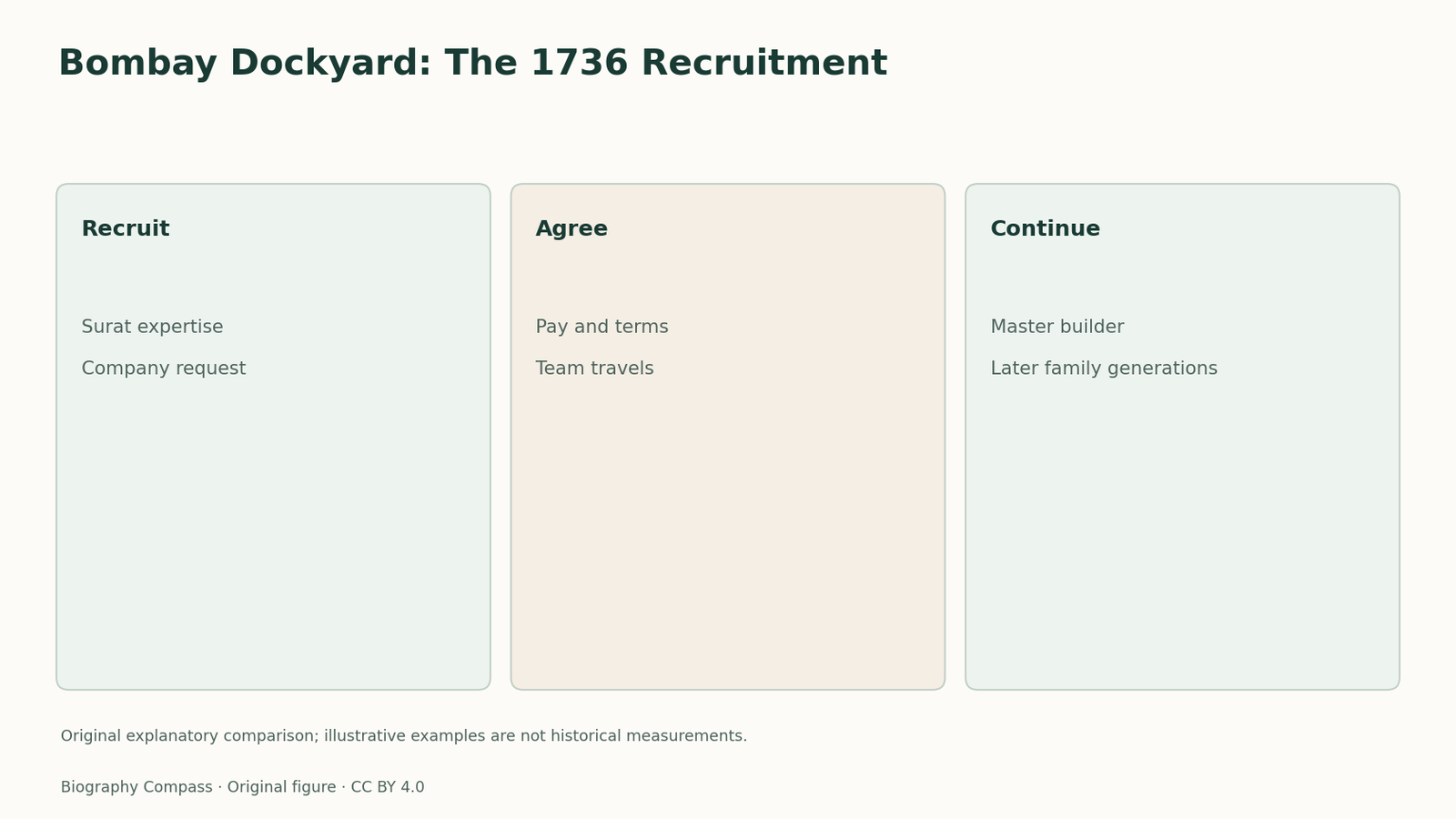
The often repeated date 1736 marks Lowjee Wadia’s move from Surat to Bombay, but it should not be made to prove every later claim about the dockyard. Ruttonjee Ardeshir Wadia’s historical compilation reproduces dated Company correspondence. A modern technical history independently discusses the same recruitment. The useful question is what those documents actually establish: a request for skilled labour, negotiation over terms and arrival of a team. They do not describe a modern conglomerate already possessing all the businesses later associated with the Wadia name.
A worked comparison
What each part contributes
Use the specific distinctions developed in the study.
| Part or record | What it establishes | Why the distinction matters |
|---|---|---|
| 1736 | Recruitment and arrival | Team and negotiated terms |
| 1740 | Master-builder designation | Different from arrival |
| After 1774 | Later generations | Do not credit their ships personally to Lowjee |
What happened in 1736?
The often repeated date 1736 marks Lowjee Wadia’s move from Surat to Bombay, but it should not be made to prove every later claim about the dockyard. Ruttonjee Ardeshir Wadia’s historical compilation reproduces dated Company correspondence. A modern technical history independently discusses the same recruitment. The useful question is what those documents actually establish: a request for skilled labour, negotiation over terms and arrival of a team. They do not describe a modern conglomerate already possessing all the businesses later associated with the Wadia name.
A request for existing expertise
The January 1736 letter from Bombay sought a good carpenter and named Lowjee in Surat. This was an employer trying to attract someone already known for relevant abilities. The distinction matters because a founder legend can erase the prior craft community from which expertise came. Shipbuilding required knowledge of materials, hull construction and coordinated labour. The correspondence’s practical request is evidence of that demand, even though it does not provide a complete technical manual for the vessels Lowjee subsequently helped build.
Pay and the recruited group
The reproduced March correspondence says the carpenters would not come on other terms, while the Bombay Council considered their pay high and hoped their work would justify it. The 27 Marchreport confirms arrival aboard the Cowan. This is concrete evidence of negotiation, movement and expectation. It is not an actual productivity measurement. Nor does naming Lowjee mean the accompanying carpenters lacked importance. Their collective arrival makes clear that a yard’s capacity depended on assembling a team, rather than transporting only one celebrated individual.
Arrival, appointment and later output
The technical history dates Lowjee’s master-builder designation to 1740, so arrival and title should remain separate milestones. His death in 1774 provides another boundary: early-nineteenth-century ships credited to later Wadia builders belong to a subsequent generation. This is a useful check on claims that combine a family’s cumulative output with the founder’s personal work. A precise account can recognise the long continuity of Wadia skill while still asking who held responsibility when a particular hull was designed, laid down or launched.
An attribution exercise
Classify three statements: “a team arrived in 1736,” “Lowjee was designated master builder in 1740,” and “a Wadia-built vessel launched in 1817 was Lowjee’s personal work.” The first two refer to distinct milestones supported by the inspected records. The third cannot be correct because he died in 1774. Subtracting 1774 from 1817 gives 43 years after his death. The arithmetic does not identify the later builder; that requires the vessel’s own record. It does show why family continuity is not a licence to assign all later products to the first well-known name.
Continue the chronology
Related history guides
Harland: Hull Form and Yard Production
Compare Harland’s hull proportions, dock constraints and production decisions using his 1884 account, with an original length-to-beam exercise.
Read the timeline1839–1841Cunard 1839: A Shipbuilding Contract
Read the 1839 Cunard–Napier agreement through ship scope, staged payments, delivery and guarantees, distinguishing contractual promises from completed service.
Read the timelineBiography context
Explore India through connected lives
Connected biographies
People and wider context
1702–1774
Lovji Nusserwanjee Wadia
master shipbuilderLovji Nusserwanjee Wadia was a master shipbuilder, known for Wadia shipbuilding at Bombay Dockyard.Read biographyQuick answers
Common questions
- Can an 1817 Wadia-built vessel be described as Lowjee’s personal construction?
- No. He died in 1774. The family continued the work, but the later vessel needs its own builder and project record.
Primary and institutional sources
How this history was checked
Read the cited original records, institutional accounts and later interpretations. The comparison and exercise explain the specific evidence used in this study. This article was reviewed on 8 November 2026.
- Ruttonjee Ardeshir Wadia,1955The Bombay Dockyard and the Wadia Master Builders
- Indian Institute of Astrophysics repositoryShipbuilding at Bombay: historical commentary
- Northwestern University working-paper repositoryThe Benefits and Costs of Diversity
- East India Company Council records, reproduced in Wadia 1955Bombay–Surat recruitment correspondence,1736