
The short answer
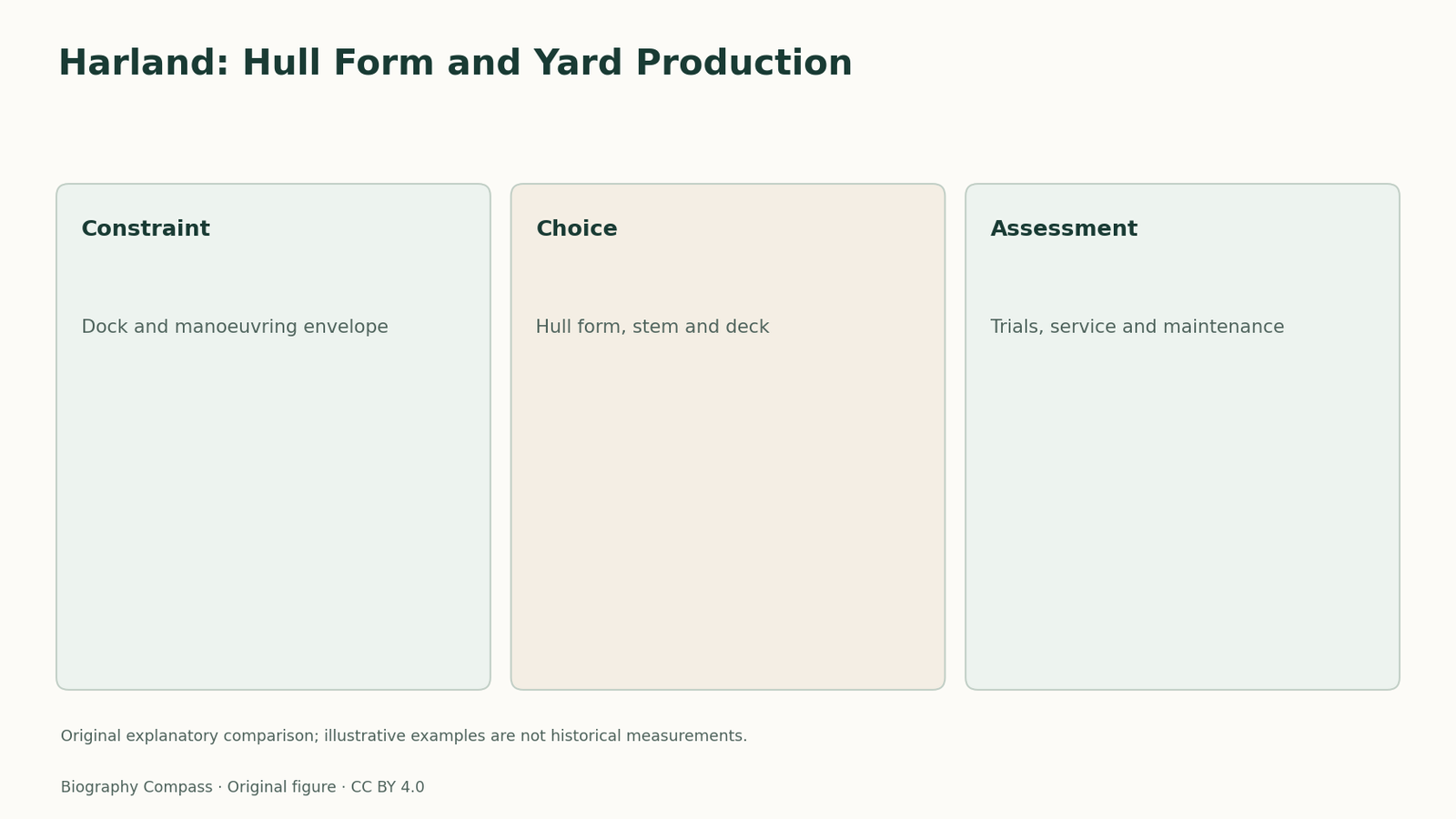
Harland’s published account describes pressure to lengthen vessels while some docks limited the space available for turning. Overhanging cutwaters, figureheads and bowsprits occupied room beyond the useful hull. His response was to remove those features and adopt a more upright stem, allowing greater hull length within the available manoeuvring envelope. This is a specific relationship between a ship and its operating infrastructure. It explains a design decision more precisely than treating a long hull as an improvement without asking where and how it would be handled.
A worked comparison
What each part contributes
Use the specific distinctions developed in the study.
| Part or record | What it establishes | Why the distinction matters |
|---|---|---|
| Hull length | Useful part of the ship | Different from the full overhanging envelope |
| Material arrangement | Strength and maintenance choices | Not one universal construction recipe |
| Trial or service | Tests the resulting vessel | Not established by a ratio alone |
Why could a bow shape limit usable hull length?
Harland’s published account describes pressure to lengthen vessels while some docks limited the space available for turning. Overhanging cutwaters, figureheads and bowsprits occupied room beyond the useful hull. His response was to remove those features and adopt a more upright stem, allowing greater hull length within the available manoeuvring envelope. This is a specific relationship between a ship and its operating infrastructure. It explains a design decision more precisely than treating a long hull as an improvement without asking where and how it would be handled.
Sources for this section: [2]
A hull form served more than one requirement
The account links flatter bottoms and squarer bilges with carrying capacity and stability. These are the builder’s explanations of his design programme, not a complete hydrodynamic proof for every ship. A vessel still had to be propelled, steered and operated at suitable loading conditions. The useful distinction is among a stated design aim, the geometry chosen to pursue it and results established by trials or service. Holding those categories apart permits the actual construction choices to be studied without turning a retrospective success story into an unlimited engineering law.
Sources for this section: [2]
Deck material affected joints and cargo protection
Harland describes the use of iron decks and related fittings, connecting them with the problems of combining materials differently affected by moisture and temperature. A deck was not merely a surface on which people stood. Its construction belonged to the vessel’s strength and the protection of the spaces below. His discussion includes cement in places where wood packing had been used. The account records an industrial approach to materials and maintenance; it does not establish that all later ships adopted identical details or that every conceivable leak was eliminated.
Sources for this section: [2]
Lengthening an existing vessel differed from building a new one
The same narrative names vessels lengthened at Belfast, alongside newly constructed ships. Alteration required the existing structure and machinery to remain compatible with the changed hull. A new design offered a different set of constraints. Both kinds of work supplied experience, customers and employment, but their records answer different questions about the yard’s development. The company chronology also separates the original purchase, partnership and later expansion. A construction history becomes clearer when these transactions and physical operations retain their own dates and purposes.
Dimension-and-constraint exercise and checked answer
For two fictional designs of equal thirty-foot beam, increasing hull length from three hundred to three hundred and sixty feet changes the length-to-beam ratio from ten to twelve. Does that ratio alone prove a faster ship? No: resistance, displacement, propulsion and operating conditions also matter. A second question asks whether removing an overhanging bow and adding useful hull length necessarily increases the overall space needed in exactly the same proportion. Again, no: overall envelope and useful hull dimensions differ. The checked answers explain Harland’s actual dock-related trade-off while supplying no invented trial result for one of his ships.
Sources for this section: [2]
Continue the chronology
Related history guides
White Star: Shipowner and Builder Roles
Explore White Star’s shipbuilding relationship with Harland, engine suppliers and transport arrangements, using the builder’s own 1884 recollection.
Read the timeline1881–1884Denny’s Tank: Models and Full-Ship Trials
Explore Denny’s 1883 tank, model-making, instrument records and full-ship trials, preserving the separate responsibilities of designers and experimenters.
Read the timelineBiography context
Explore United Kingdom through connected lives
Connected biographies
People and wider context
1831–1895
Edward Harland
engineer, shipbuilder and politicianEdward Harland was a engineer, shipbuilder and politician, known for developing Belfast shipbuilding through industrial partnerships and revised hull construction.Read biographyQuick answers
Common questions
- Does a greater length-to-beam ratio alone prove that a ship is faster?
- No. The ratio describes geometry; performance also depends on displacement, resistance, propulsion and operating conditions.
Primary and institutional sources
How this history was checked
Read the cited original records, institutional accounts and later interpretations. The comparison and exercise explain the specific evidence used in this study. This article was reviewed on 8 November 2026.