
The short answer
How did a serum antigen become a clue to hepatitis B?
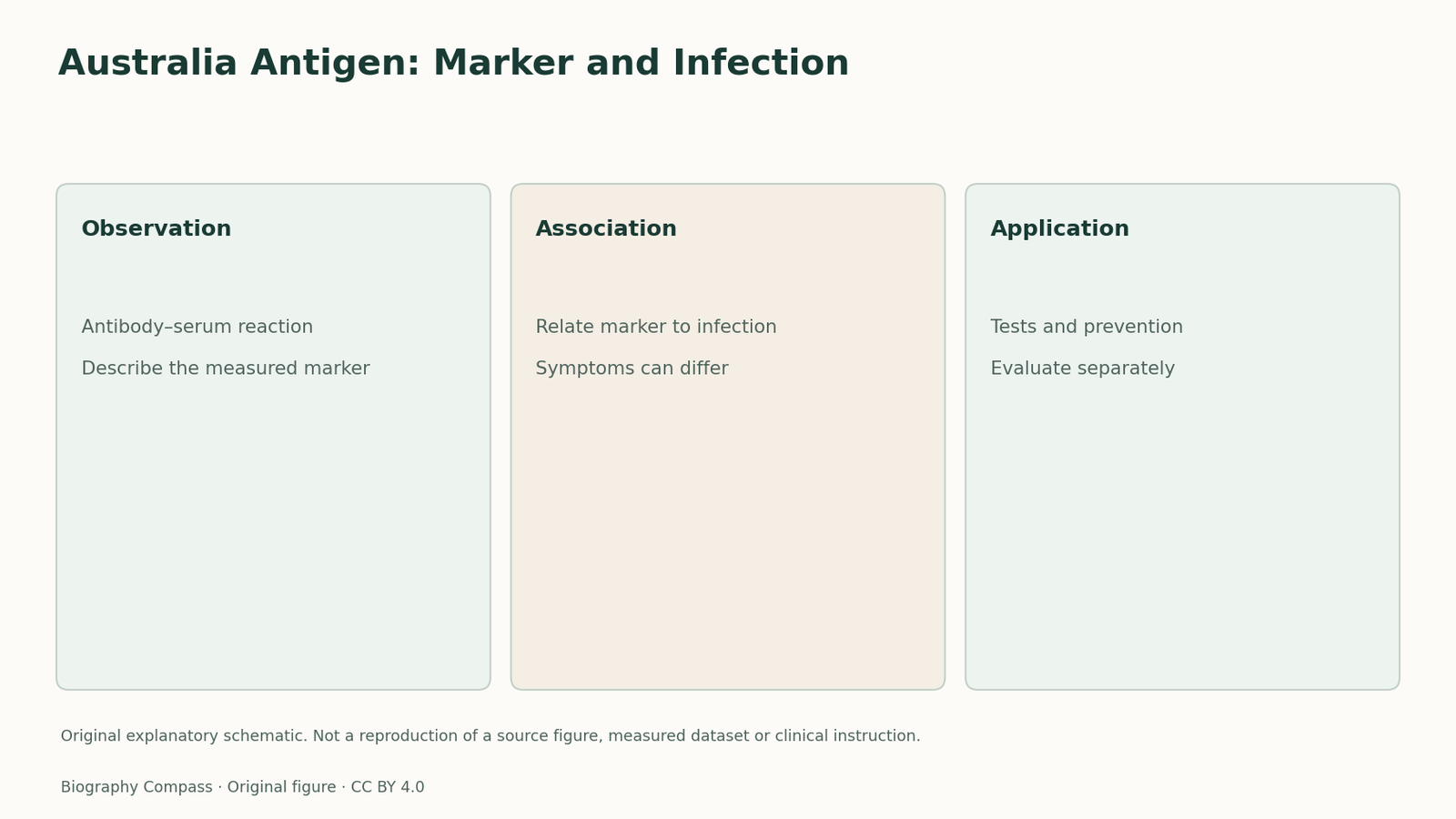
Evidence comparison
Australia Antigen: Marker and Infection
Compare the observations with the narrower conclusions they support.
| Record or observation | What it supports | What remains separate |
|---|---|---|
| Serum antigen reaction | Detects a reacting component under assay conditions | Is not automatically a complete virus or visible illness |
| Association with hepatitis B | Connects the marker to an infectious process | Prevention and test performance need further evidence |
An antigen is an experimental object
Blumberg's Nobel lecture describes a search for reacting components in human serum. The observation that became Australia antigen emerged from antibody reactions in a programme studying biological variation. An antigen detected in a serum test is not the same thing as an entire infectious particle observed directly. To read the discovery history carefully, first identify the material being tested and what the reaction actually measures.
A new association changed the question
The Nobel facts record connects Blumberg's work with the identification of hepatitis B and with prevention through tests and vaccines. Those applications depended on more than finding a striking precipitin band. Investigators had to connect the marker with infection, including people who could carry the agent without obvious illness. A marker's presence can therefore be informative without being interchangeable with a person's visible symptoms.
Build a two-by-two reasoning exercise
Draw a hypothetical table with marker present or absent across the top and symptoms present or absent down the side. Leave all four cells blank. Ask whether a positive marker result logically requires visible symptoms. The answer is no: the historical account explicitly includes carriage without illness. Next ask whether the table alone supplies numerical test sensitivity. It does not; no counts, reference definition or comparison population have been provided. The empty table is an interpretive exercise rather than clinical data.
Sources for this section: [3]
Keep discovery history separate from personal testing
Follow three distinct questions: what reacts in the assay, what biological process the reaction indicates, and how the finding can support prevention. Each requires evidence at a different scale. This guide explains that historical transition and does not interpret an individual's blood test or recommend a medical decision.
Sources for this section: [3]
Continue the chronology
Related history guides
Biography context
Explore United States through connected lives
Connected biographies
Researchers and related questions
1925–2011
Baruch S. Blumberg
Physician, geneticist and hepatitis-B researcherBlumberg's group examined antibodies in the serum of people who had received multiple transfusions.Read biography
1942–
Stanley B. Prusiner
Neurologist and prion researcherIn 1982 Prusiner introduced the term prion for a proteinaceous infectious particle.Read biography1919–2012
Joseph E. Murray
Reconstructive and transplant surgeonOn 23 December 1954, the Peter Bent Brigham team transplanted a kidney from Ronald Herrick to his identical twin Richard.Read biographyQuick answers
Common questions
- How did a serum antigen become a clue to hepatitis B?
- Detects a reacting component under assay conditions. Is not automatically a complete virus or visible illness.
- Are the classroom examples historical measurements?
- No. Invented examples are labelled as classroom models; the source-based discussion identifies the historical evidence separately.
Primary and institutional sources
How this history was checked
Official biographical and award records are read alongside the researcher’s technical account. Source scope and hypothetical examples remain distinct. This article was reviewed on 7 November 2026.