
The short answer
What evidence distinguished a prion hypothesis from an ordinary virus?
Evidence comparison
Prions: Sequence, Shape and Infectivity
Compare the observations with the narrower conclusions they support.
| Record or observation | What it supports | What remains separate |
|---|---|---|
| Same encoded protein sequence | Compatible with different conformations | Does not alone establish equal biological behaviour |
| A transmissible conversion claim | Concerns propagation of a protein state | Needs transmission evidence beyond a drawing of two shapes |
Separate a protein from its conformation
Prusiner's published Nobel lecture distinguishes the normal cellular prion protein from a disease-associated form. The distinction is not simply the presence of a protein that healthy animals entirely lack. A protein chain can adopt different spatial arrangements, and a change in conformation can alter biological behaviour. In the prion account, this made protein shape part of an explanation of transmission rather than merely a descriptive feature of a damaged tissue.
A protein gene is not an infectious genome
The host's chromosome contains a gene encoding prion protein. That observation is compatible with a protein-based infectious agent: it does not require a separate nucleic-acid genome to be packaged in each transmissible particle. Prusiner's account discusses experimental evidence for conversion of the normal protein into a disease-associated form. The historical question is therefore how the protein's production, conformation and transmissibility were connected, rather than whether genes have disappeared from biology.
Sources for this section: [3]
Use a labelled string without claiming a mechanism
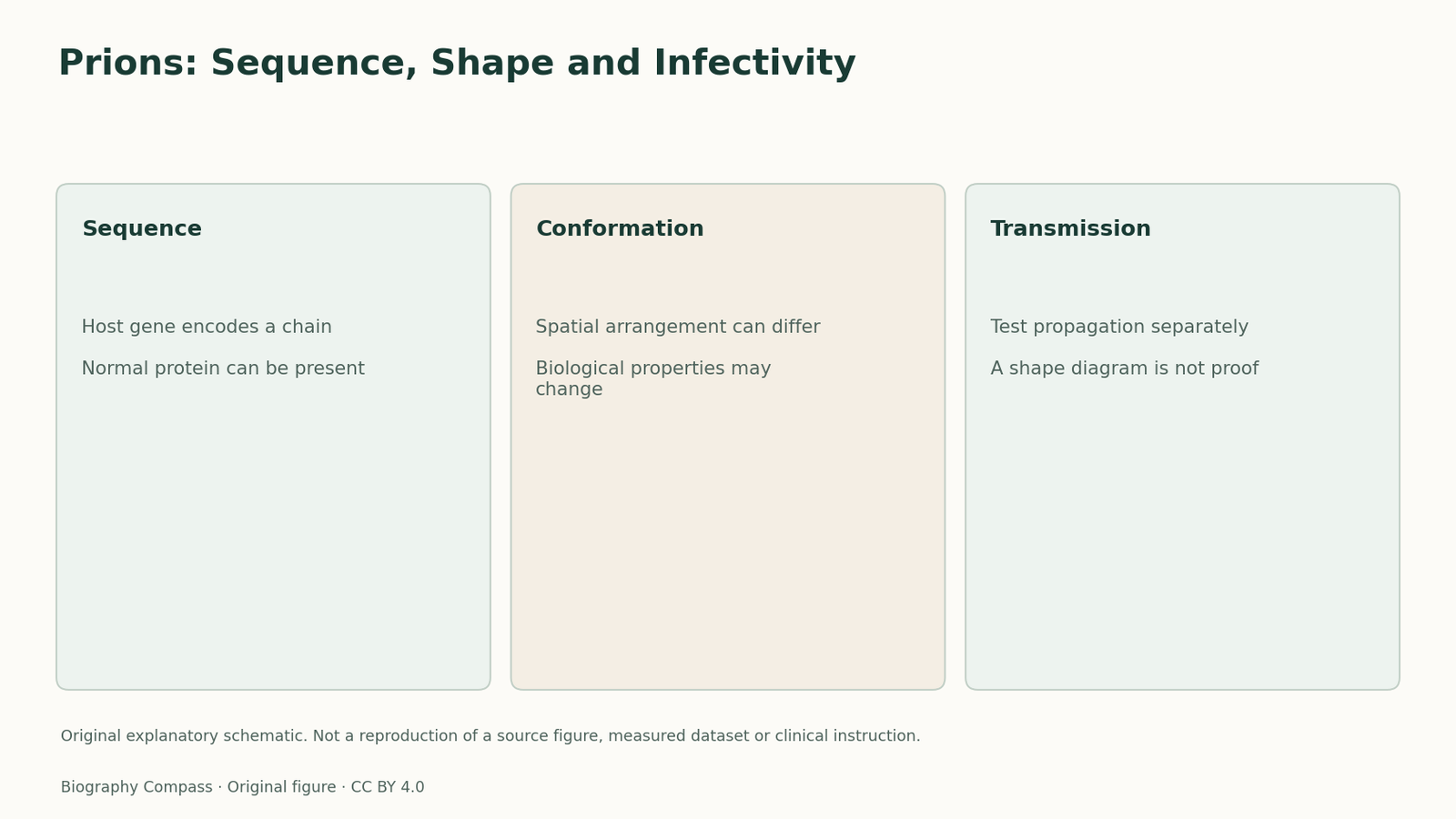
Write the same invented letter sequence on two paper strips and arrange one straight and one folded. Ask what remained identical and what changed. The answer is sequence versus arrangement. Then ask whether the demonstration proves that the folded strip can convert another strip into its shape. It does not. A second strip does nothing unless a person manipulates it. This deliberately limited model explains why evidence of different conformations is not alone evidence for a transmissible conversion mechanism.
Sources for this section: [3]
State what the model cannot predict
The diagram provides no estimate of infectivity, exposure risk or treatment. It also cannot decide which protein aggregates in unrelated diseases behave like prions. Those questions require additional experimental evidence. Its purpose is narrower: to make three claims—sequence, conformation and transmission—visible without treating any one as sufficient proof of the other two.
Sources for this section: [3]
Continue the chronology
Related history guides
Biography context
Explore United States through connected lives
Connected biographies
Researchers and related questions
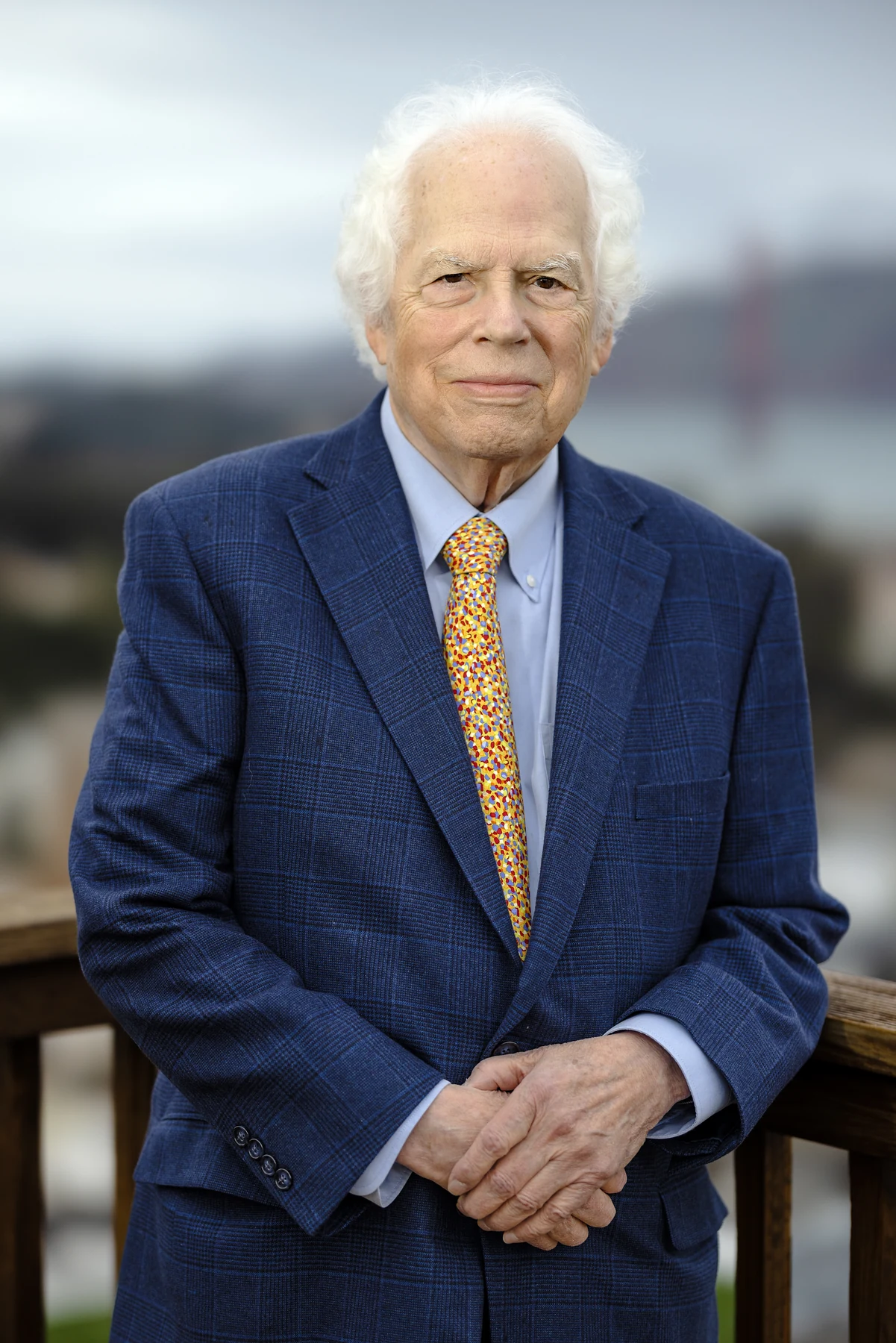
1942–
Stanley B. Prusiner
Neurologist and prion researcherIn 1982 Prusiner introduced the term prion for a proteinaceous infectious particle.Read biography1925–2011
Baruch S. Blumberg
Physician, geneticist and hepatitis-B researcherBlumberg's group examined antibodies in the serum of people who had received multiple transfusions.Read biography
1947–
Thomas R. Cech
Biochemist and RNA-catalysis researcherCech's group found that an intervening RNA sequence could be removed and the remaining RNA joined without an added protein catalyst.Read biographyQuick answers
Common questions
- What evidence distinguished a prion hypothesis from an ordinary virus?
- Compatible with different conformations. Does not alone establish equal biological behaviour.
- Are the classroom examples historical measurements?
- No. Invented examples are labelled as classroom models; the source-based discussion identifies the historical evidence separately.
Primary and institutional sources
How this history was checked
Official biographical and award records are read alongside the researcher’s technical account. Source scope and hypothetical examples remain distinct. This article was reviewed on 7 November 2026.