
The short answer
What turns rotating nuclear magnetization into a voltage an instrument can register?
Read the evidence
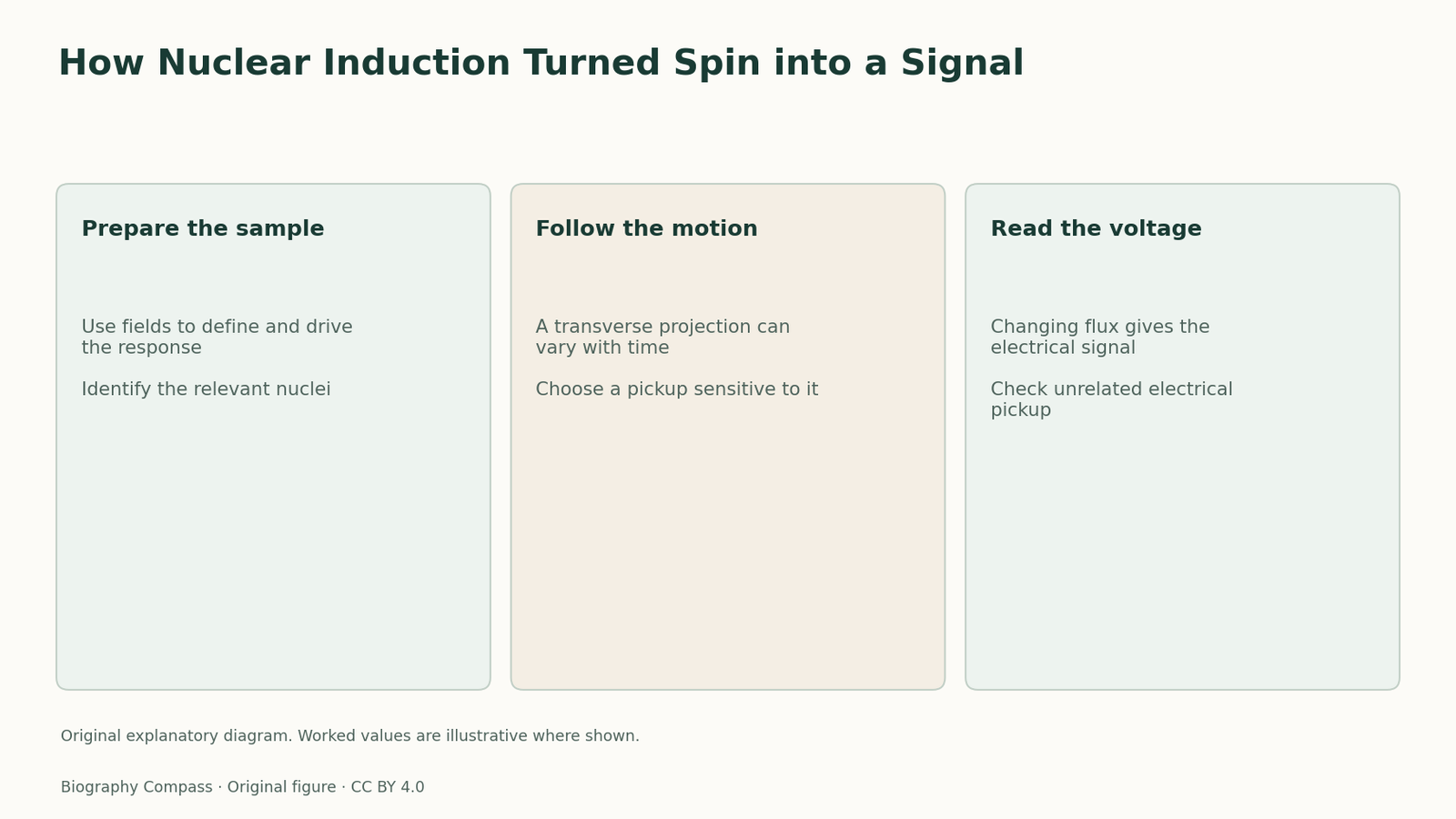
How motion becomes a readout
The source, excitation and detector each supply a different part of the signal.
| Stage | Physical quantity | Question |
|---|---|---|
| Apply fields | Preferred axis and resonance drive | Does the sample respond near the expected frequency? |
| Precession | Time-dependent nuclear magnetization | Which component changes? |
| Pickup coil | Changing magnetic flux produces voltage | Can the response be distinguished from direct coupling? |
A static moment is not a changing flux
A coil produces a voltage when the magnetic flux through it changes. Magnetization held steady in a sample may therefore exist without generating a continuously changing voltage in a stationary pickup. Nuclear induction makes use of a component of magnetization that changes direction with time. In a magnetic field, nuclear moments can precess. A radio-frequency field can drive an observable response near the characteristic resonance. If the resulting magnetization has a component that changes the flux through the pickup coil, it can be measured electrically. The detector’s geometry is part of what turns physical motion into a signal.
Drive and detection have different roles
The applied radio-frequency field supplies a way to perturb the system. The receiving circuit is intended to register the response, which must be distinguished from direct pickup of the drive. Changing the orientation of the coil changes which component of the rotating magnetization contributes to its flux. The 1946 work used water and associated the detected effect with proton moments. A reader should distinguish the material containing the nuclei, the applied field that brings them near resonance and the electrical observation that tests whether the predicted response is present.
An invented comparison of pickup orientations
Imagine a rotating transverse magnetization whose projection onto one direction changes from plus one to zero to minus one. A pickup that is sensitive to that projection sees a changing flux. A second ideal pickup that responds only to a constant longitudinal component sees no change from that component. The invented units are not detector readings. The example shows why the absence of a signal in a particular coil need not mean the magnetization is absent. The coil may be insensitive to the component that carries the motion. That distinction can guide an independent check of the measurement.
Sources for this section: [1]
Signal strength is a separate question
The amount of induced voltage depends on how the response couples to the detector, as well as on the number and behaviour of the contributing nuclei. A line at the expected frequency supplies important evidence, but its amplitude cannot be interpreted without information about the sample and apparatus. The longer experimental report belongs beside the first notice for that reason. The initial result announced an observable effect. A detailed account supports interpretation of how the recorded signal arises, how unwanted pickup is handled and which conditions make the result reproducible.
Read induction beside absorption
Related resonance experiments can observe either an electrical signal induced by the precessing magnetization or a change associated with energy absorbed from an applied radio-frequency field. Both depend on a resonance, yet their readouts and background questions differ. Keeping them separate helps explain why different research groups could demonstrate related physics independently. For the induction result, the simplest reading follows a chain: a field defines a characteristic motion, a drive produces a time-dependent response, and a coil registers the changing flux. Each step identifies a distinct physical quantity and clarifies what the experiment actually measured.
Continue the chronology
Related history guides
Why Some Paramagnetism Barely Changes with Temperature
Read Van Vleck’s distinction between aligning existing moments and mixing quantum states, with an original example of their different temperature trends.
Read the timeline1947–1948How Kusch and Foley Measured the Electron Moment
Read how different atomic states weight spin and orbital contributions, and see why comparing resonance frequencies helped isolate the electron anomaly.
Read the timeline1951The First Galactic 21-Centimetre Hydrogen Detection
Read Ewen and Purcell’s 1951 radio detection, and see why frequency-selective evidence for neutral hydrogen differs from mapping Galactic rotation.
Read the timelineBiography context
Explore Stanford, California, United States through connected lives
Connected biographies
Researchers and collaborators
1905–1983
Felix Bloch
Theoretical and experimental physicistFollow Felix Bloch from Zurich and Leipzig to Stanford, including his collaboration with Hansen and Packard on detecting magnetic resonance by induction.Read biography1912–1997
Edward Purcell
Experimental physicist of magnetic resonance and radio astronomyFollow Edward Purcell from Purdue and Harvard to magnetic resonance and the 1951 detection of neutral hydrogen radiation with Harold Ewen.Read biography1898–1988
Isidor Isaac Rabi
Experimental physicistMolecular-beam and resonance researcher.Read biographyQuick answers
Common questions
- Why does constant flux give no induced voltage?
- Induction depends on the time variation of flux through the coil.
- Are absorption and induction identical measurements?
- They can probe related nuclear transitions through different readouts.
Primary and institutional sources
How this history was checked
Dates, legal milestones and historical claims are checked against the official and institutional records below. This article was reviewed on 13 November 2026.