
The short answer
The BJP’s formation was a response to the breakdown of a political experiment. Former Jana Sangh leaders had joined Janata to oppose Congress, but disagreements about ideology, organisation and RSS association survived their time in government. The new party inherited a network without inheriting an assured route to national power.
Chronology
A timeline of the turning points
Jana Sangh joins the Janata experiment
Formerly separate opposition organisations unite against Congress and enter government.
Desai government falls
Rivalries and disagreements destroy the government’s parliamentary support.
Congress returns to government
The election leaves Janata’s factions confronting defeat as well as organisational conflict.
Separation and new party
The dual-membership dispute culminates in separation; Vajpayee is elected president of the new BJP.
Advani becomes president
A later leadership change precedes the party’s more assertive mobilisation in the late 1980s.
Janata had united parties with different histories
The Bharatiya Jana Sangh, established in 1951, supplied one organisational current to the Janata formation of 1977. Other participants came from socialist, agrarian and Congress opposition traditions. Defeating Congress gave these groups a common electoral purpose without removing their disagreements.
Vajpayee and Advani became ministers in the government headed by Morarji Desai. They consequently had two sets of relationships to manage: cooperation with their government colleagues and continuing connections with the organisational world from which they had emerged. The problem was built into the alliance’s composition.
The RSS connection became a dispute about political loyalty
The “dual membership” controversy concerned whether Janata members from the former Jana Sangh could retain their RSS association. Critics regarded that connection as incompatible with the unified party’s identity. Former Jana Sangh politicians defended the RSS and resisted demands to sever the relationship.
Advani’s later account presents the split as a consequence of exclusion and argues for the legitimacy of the RSS connection. It is valuable testimony from a participant, but it is also an argument for his political position. It should be read alongside independent chronology rather than treated as a neutral verdict on all the protagonists.
The new party followed the collapse of a government
Desai’s administration fell in 1979, before the BJP’s formal establishment. Congress returned to power in the 1980 election. The founding therefore belongs to a period of opposition regrouping rather than an uninterrupted transfer from Janata government into BJP government.
On 6 April 1980 the new organisation chose Vajpayee as president. The contemporary account, reproduced from the next day’s newspaper, also identifies Advani, Sikandar Bakht and Murli Manohar Joshi as general secretaries. The founding was collective and had an explicit distribution of organisational offices.
Vajpayee’s presidency did not make Advani a bystander
Vajpayee provided the new party’s first presidential leadership and a nationally recognisable parliamentary voice. Advani’s organisational position placed him in the work of building and maintaining the party. The distinction helps explain how both men could be central without holding the same office.
The early BJP adopted Gandhian socialism as part of its public positioning. Its institutional inheritance from Jana Sangh nevertheless remained significant. A new name and programme could broaden the appeal being attempted while old networks, loyalties and ideological debates continued to shape its work.
Later success should not be read back into the founding
The BJP’s later growth followed electoral setbacks, leadership changes and strategic choices. Advani’s accession to the presidency in 1986 belongs to that subsequent history. It would be misleading to describe the founding convention as if it already contained the eventual scale or governing strategy of the party.
The useful question is what changed in 1980: leaders leaving an unsuccessful unified opposition experiment created a separate organisation, chose officeholders and defined a public position. The later consequences were substantial, but they required additional political work and generated disputes of their own.
Continue the chronology
Related history guides
Biography context
Explore New Delhi, India through connected lives
Connected biographies
Two leaders in the new party’s formation
1927–
L. K. Advani
BJP organiser, Union home minister and deputy prime ministerL. K. Advani helped turn the Bharatiya Janata Party into a major national force. His organisational partnership with Atal Bihari Vajpayee, leadership of the Ram temple campaign and later ministerial offices reshaped Indian politics. That influence is inseparable from disputes over communal mobilisation and the destruction of the Babri Masjid.Read biography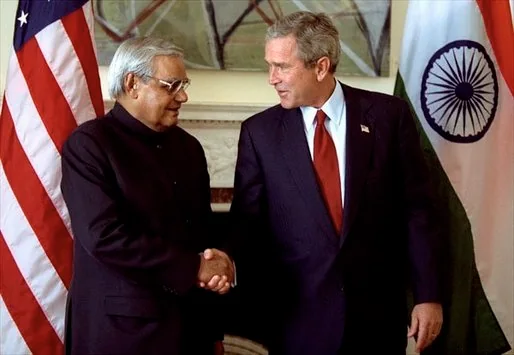
1924–2018
Atal Bihari Vajpayee
BJP leader, foreign minister and prime ministerAtal Bihari Vajpayee helped turn the Hindu nationalist parliamentary opposition into a governing coalition. His career connected Jana Sangh organisation and foreign-ministry service with brief office in 1996 and longer governments from 1998 to 2004.Read biographyQuick answers
Common questions
- Was the BJP founded in 1951 or 1980?
- The BJP was founded in April 1980. The Bharatiya Jana Sangh, an important predecessor, was established in 1951.
- Did Advani become the first BJP president?
- No. Vajpayee was the first president. Advani was an early general secretary and became president in 1986.
- What was dual membership?
- It was the dispute over former Jana Sangh politicians retaining an RSS association while belonging to Janata. The conflict concerned the identity and loyalties of the united party.
- Was the BJP already in national government at its founding?
- No. The Janata government had fallen in 1979 and Congress returned to power in 1980. The new party was an opposition organisation.
Primary and institutional sources
How this history was checked
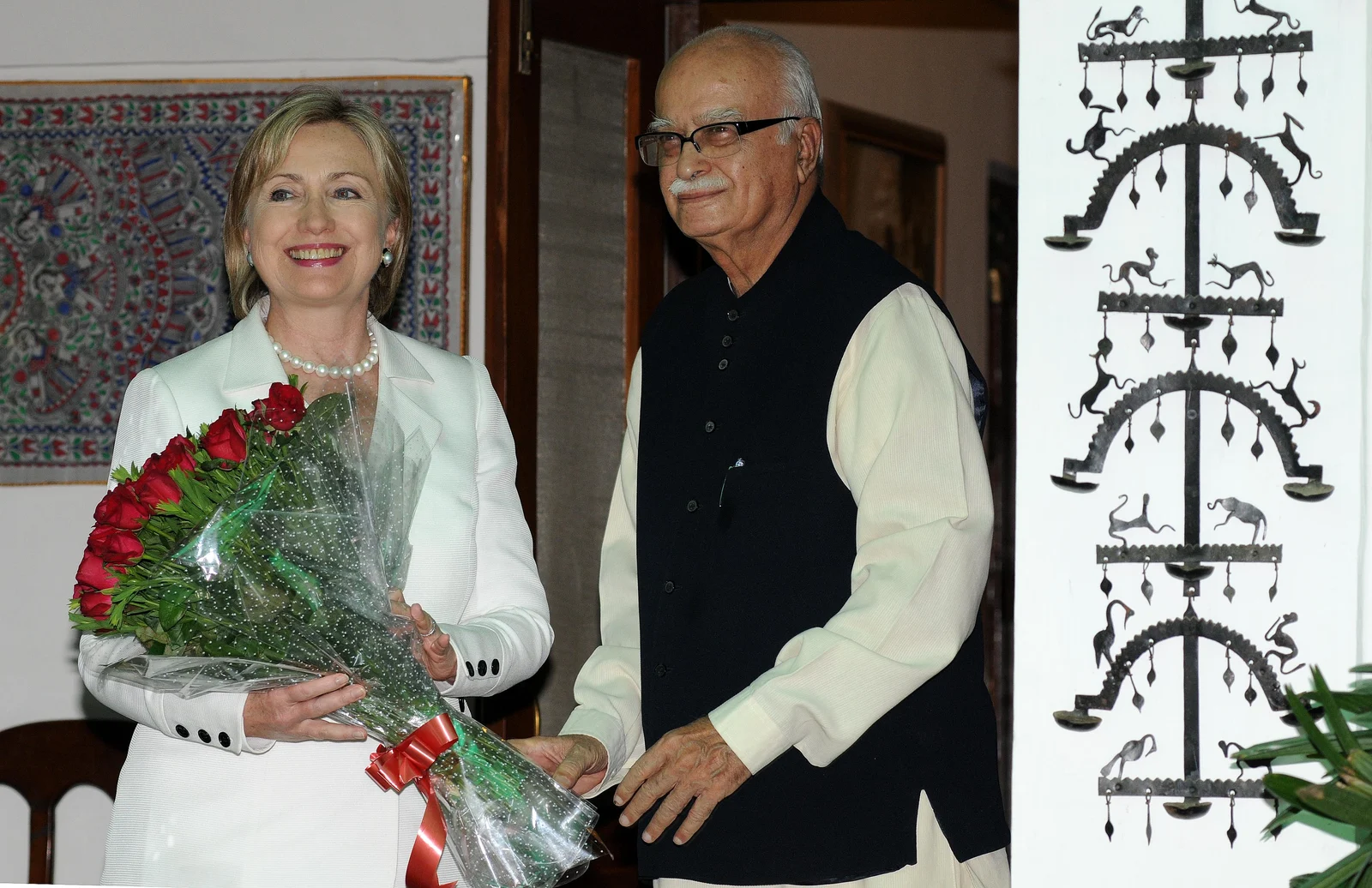
The contemporary newspaper extract records the first offices. Advani’s speech and the BJP documentary history are participant and party perspectives, not independent adjudications of the split. Selected indexed passages of the documentary PDF were consulted. The illustration shows a later 2009 meeting, not the 1980 convention. This article was reviewed on 31 August 2026.
- The Indian Express archive7 April 1980: the new BJP and its first officeholders
- The Indian ExpressVia Vajpayee: party history from Jana Sangh to BJP, 2018
- L. K. Advani / NDTVFull text of Advani’s BJP National Executive speech, 2009
- Bharatiya Janata Party e-LibraryEvolution of BJP: selected passages on Janata and the new party
- Mira Patel / The Indian Express1977 general election: party labels, regional results and Janata, 2024
- Sciences Po, Mass Violence and Resistance Research NetworkMorarji Desai: political career and Janata government, 2012
- Bharatiya Janata Party, GujaratL. K. Advani: historical parliamentary and organisational profile
- Vikas Pathak / The Indian ExpressLong arc of Advani’s journey, 3–4 February 2024
- US Department of State / Wikimedia CommonsAdvani greets Hillary Clinton, 20 July 2009: complete photograph and rights
- Creative CommonsPublic Domain Mark 1.0