In this biography
Quick facts
- Born
- 25 December 1924
- Died
- 16 August 2018
- Birthplace
- Gwalior, Gwalior State, British India (now Madhya Pradesh, India)
- Country
- India
- Nationality
- Indian
- Known for
- NDA coalition leadership, the 1998 nuclear tests, Lahore diplomacy and the Kargil War
- Prime minister
- Briefly in 1996; again from 1998 to 2004
- Foreign minister
- Served in the Janata government, 1977–1979
- Political background
- Bharatiya Jana Sangh and Bharatiya Janata Party
- Other writing
- Hindi poetry and political journalism
Why this life matters
Vajpayee’s governments combined nuclear assertion, diplomatic outreach, coalition negotiation and infrastructure investment. His response to the 2002 Gujarat violence remains central to evaluating the limits of his reputation for moderation.
Timeline
Key moments
Born in Gwalior
Born on 25 December into a schoolteacher’s family.
Jana Sangh organiser
Joined the party that preceded the BJP.
Foreign minister
Served in the Janata government after the Emergency.
Short first government
Took office on 16 May and resigned on 28 May when a majority proved unavailable; the official tenure includes the caretaker interval to 1 June.
Returned to office and authorised tests
Led a coalition and oversaw nuclear tests on 11 and 13 May.
Lahore, Kargil and a renewed coalition
Diplomatic outreach was followed by war; a new NDA government took office in October.
Gujarat and electoral defeat
His handling of communal violence drew criticism; the NDA lost the 2004 general election.
Died in New Delhi
Died on 16 August aged 93.
A parliamentary career grew out of Hindu nationalist organisation
Atal Bihari Vajpayee was born on 25 December 1924 in Gwalior, then a princely state. His father was a schoolteacher. Study, journalism and Hindi poetry accompanied his early political development, and he joined the Bharatiya Jana Sangh in 1951. The party provided a parliamentary vehicle for a wider Hindu nationalist movement in which he had become involved.
He built a reputation as a speaker and opposition parliamentarian over several decades. The combination mattered: ideological commitment connected him to a durable organisation, while parliamentary debate required communication with people outside it. His later image as a conciliatory figure emerged within that political tradition, rather than from an absence of strong ideological loyalties.
Foreign-ministry experience preceded the premiership
The Janata government formed after the Emergency brought Vajpayee into the foreign ministry in 1977. His career consequently included both opposition to Congress rule and direct responsibility for national diplomacy. After that governing experiment fractured, the BJP became the principal party through which he continued his political work.
In May 1996 he first became prime minister, but could not assemble a parliamentary majority. He resigned on 28 May rather than complete a confidence vote he could not win. The familiar description of a thirteen-day government refers to that political episode; official office lists include the ensuing caretaker period through 1 June. It should not be confused with his later years in power.
Coalition government changed the BJP’s route to power
Vajpayee returned as prime minister in 1998 at the head of a coalition. A further election in 1999 produced the National Democratic Alliance government that took office in October and lasted until 2004. The contrast with 1996 shows that being the largest party and being able to sustain a majority are different parliamentary achievements.
Allied parties brought regional priorities and bargaining power. A government could pursue shared measures while leaving divisive parts of individual parties’ programmes aside. Vajpayee’s significance as a coalition leader lay in managing these relationships, although the existence of an alliance did not dissolve disagreement over the BJP’s ideology or the conduct of governments it led.
Nuclear assertion and Lahore diplomacy were followed by Kargil
His government authorised underground nuclear tests at Pokhran on 11 and 13 May 1998. Pakistan tested later that month, and the UN Security Council condemned both countries’ tests. The decision publicly asserted a nuclear capability while bringing international criticism and fresh concern about an arms race; it did not make a regional war impossible.
Vajpayee travelled by bus to Lahore in February 1999 for talks with Nawaz Sharif and the Lahore Declaration. Soon afterwards, Pakistani forces’ intrusion across the Line of Control produced the Kargil conflict. India combined military operations with diplomatic pressure, and the fighting ended in July. The sequence illustrates the vulnerability of political agreements when military actions undermine them.
Infrastructure became a major domestic priority
The National Highways Development Project sought to improve major transport corridors, including the Golden Quadrilateral linking Delhi, Kolkata, Chennai and Mumbai. Roads were intended to reduce transport bottlenecks and connect markets. Contemporary government accounts explain the project’s scale and ambitions, but an announcement or sanctioned length is not the same as a completed and maintained road.
These programmes depended on agencies, finance, land acquisition, contractors and state cooperation. They continued beyond his premiership, making them part of an institutional history as well as a leadership record. The same caution applies to the economy: policy choices could support growth without making all subsequent gains, or all remaining inequalities, the personal achievement of one prime minister.
Gujarat tests the meaning of moderation
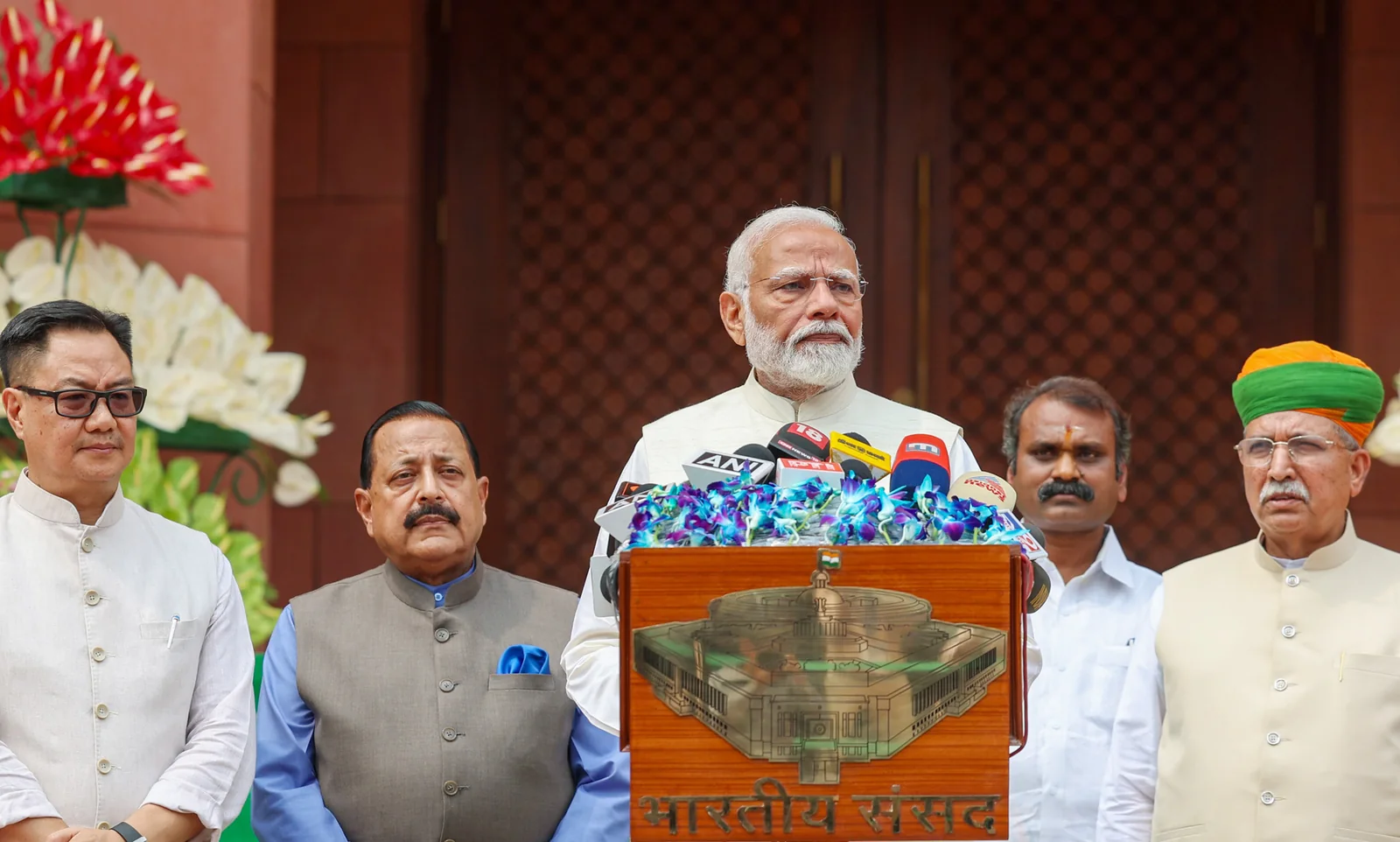
During the 2002 Gujarat violence, Vajpayee publicly reminded Chief Minister Narendra Modi of raj dharma, the obligation to govern without discrimination. The statement is often cited as evidence of his concern. Yet Modi remained chief minister, and critics question whether Vajpayee used the central government’s political authority adequately to protect citizens and enforce accountability.
A remark about constitutional duty and an effective governmental response are not equivalent. This tension belongs alongside his coalition skills and diplomatic initiatives in any assessment. After the NDA lost the 2004 election, Manmohan Singh succeeded him. Vajpayee died on 16 August 2018, leaving a record that cannot be reduced either to a reassuring personal style or to a single dramatic decision.
Quick answers
Frequently asked questions about Atal Bihari Vajpayee
- How many separate periods did Vajpayee serve as prime minister?
- He led a short government in 1996 and returned in 1998, forming another government after the 1999 election that continued until 2004.
- Why is the 1996 government called thirteen days long?
- He took office on 16 May and resigned on 28 May when he could not secure a majority. Official tenure lists also include the caretaker interval until 1 June.
- Did the 1998 tests prevent war with Pakistan?
- No. The Kargil conflict followed in 1999. Nuclear weapons added escalation risks rather than removing the possibility of conventional fighting.
- What was his raj dharma message?
- During the 2002 Gujarat crisis he reminded Modi of the duty to govern without discrimination. Evaluating the statement also requires examining what governments did to protect citizens.
Keep exploring
Lives connected to this story
- Narendra Modi
Compare the Gujarat chief minister who later led the BJP’s national governments.
- Manmohan Singh
Follow the UPA government that succeeded the NDA in 2004.
- Indira Gandhi
Read the history of the Emergency before the Janata government in which Vajpayee became foreign minister.
Sources and further reading
Explore the evidence
These references support the biography and offer further reading. Official records, first-person accounts and independent reporting provide different perspectives; image records document attribution and licensing.
- 1. Prime Minister’s Office, IndiaAtal Bihari Vajpayee: former prime minister profile
Official profile combines a 1996 tenure heading with a narrative written during a later government. It is not a complete retrospective chronology.
- 2. Parliament Digital LibraryVajpayee’s motion of confidence, 28 May 1996: catalogued parliamentary recording
- 3. Reuters / EuronewsFormer Indian prime minister Vajpayee dies, 16 August 2018
- 4. Congressional Research Service, United StatesIndia’s 2024 National Election, 10 June 2024
- 5. United NationsHistory of nuclear testing: India and Pakistan in May 1998
- 6. UN Security CouncilResolution 1172, adopted 6 June 1998
- 7. Ministry of External Affairs, IndiaIndia–Pakistan relations documentary compilation: Lahore documents of February 1999
The dated Lahore entries and selected declaration material were consulted; the entire multi-decade documentary archive was not read.
- 8. William J. Clinton Presidential LibraryKargil War: archival collection introduction and scope
- 9. Clinton White House archiveJoint statement with Nawaz Sharif on Kashmir, 4 July 1999
- 10. Press Information Bureau, IndiaNational Highways Development Project: contemporary outline
- 11. The Indian ExpressGujarat Assembly recalls Vajpayee’s 2002 raj dharma message, 2018
- 12. The Indian ExpressSupreme Court dismisses Zakia Jafri’s appeal, 24 June 2022
- 13. Union Cabinet / Prime Minister’s Office, IndiaCondolence resolution: Manmohan Singh’s education, offices and death in 2024
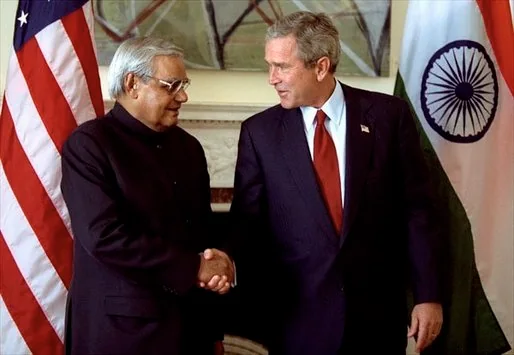
- 14. Paul Morse, White House / Wikimedia CommonsBush and Vajpayee in New York, 24 September 2003
- 15. US Code / Cornell Legal Information Institute17 USC 105: United States Government works
- 16. Creative CommonsPublic Domain Mark 1.0