
The short answer
The defeat of Congress did not automatically select a prime minister or create a unified governing party. Janata had to turn cooperation among opposition organisations into a parliamentary leadership, a cabinet and a workable government. That process explains both the significance of March 1977 and the difficulties that followed.
Chronology
A timeline of the turning points
Opposition cooperation takes shape
Congress (O), Bharatiya Lok Dal, Jana Sangh and socialist leaders organise the Janata challenge.
Voters defeat Congress
The opposition alliance secures a parliamentary majority, with particularly strong northern results.
Leadership and oath
Desai is selected as parliamentary leader and sworn in by acting president B. D. Jatti.
Party consolidation continues
The new parliamentary government and the formal consolidation of its component organisations proceed on related but different timetables.
Cooperation deteriorates
Leadership rivalry and disputes among constituent groups weaken the government.
Desai resigns
Charan Singh subsequently succeeds him; Desai’s official tenure ends on 28 July.
An electoral alliance joined several political traditions
The 1977 challenge united Congress (Organisation), Bharatiya Lok Dal, Jana Sangh and socialist politicians, with additional allies. Opposition to the Emergency supplied a shared cause, but the participants had different social bases, leadership ambitions and views of government.
This was more than an ordinary alliance between parties that expected to retain wholly separate identities. They sought a common formation, while the practical and formal work of merger continued across the election period. “Janata” can consequently refer to a political alliance, a parliamentary grouping or the consolidated party at different points.
Election labels explain apparently different seat totals
Contemporary electoral categories did not always use the eventual Janata name. Independent accounts explain that candidates ran principally under the Bharatiya Lok Dal banner and, in some settings, Congress (O). A tally of the BLD-labelled result can therefore differ from a total describing the broader Janata formation.
The distinction matters more than selecting an unexplained number. A reader comparing tables should ask whether the author counts a registered party label, merged components or allies. All such figures need a defined unit; they are not necessarily contradictory claims about the same set of candidates.
A majority still needed an agreed prime minister
Desai, Charan Singh and Jagjivan Ram were senior figures with substantial political standing. Desai emerged as the parliamentary leader and took the oath on 24 March. The Lok Sabha journal’s installation account and the PMO chronology identify that date.
Citizens had elected parliamentarians, not cast a separate national ballot for Desai. The selection of a leader able to command the new majority connected the election result to the formation of the executive. It also required accommodation among leaders who had not previously operated as one settled party.
The cabinet embodied the coalition’s breadth
Desai’s government included former Congress leaders, agrarian politicians, socialists and former Jana Sangh ministers. Vajpayee handled external affairs and Advani information and broadcasting. Their presence demonstrated the breadth of the new arrangement, rather than a government consisting only of Desai’s immediate followers.
Breadth could supply experience and representation while making coordination harder. The government’s survival depended on maintaining support among those components, not merely on preserving the prime minister’s personal authority. Opposition unity had answered who should be defeated; cabinet government required agreements about what should happen next.
The transfer of power endured even though the government did not
Rivalry involving Charan Singh and disputes about the RSS associations of former Jana Sangh politicians helped break the arrangement. Desai resigned in July 1979. His official tenure continued until Charan Singh took office on 28 July, so the resignation and formal succession should be distinguished.
The government’s failure does not cancel the importance of its formation. Congress’s national predominance had been interrupted through an election and a new parliamentary executive installed. The lesson is specific: a successful transfer of power and a durable governing organisation are related democratic achievements, but they are not the same achievement.
Continue the chronology
Related history guides
Biography context
Explore India through connected lives
Morarji Desai
Read the longer career behind the late arrival at the premiership.
Explore the biographiesInformation and broadcasting ministerL. K. Advani
Follow a former Jana Sangh leader’s participation in the Janata cabinet.
Explore the biographiesExternal affairs ministerAtal Bihari Vajpayee
Read another minister’s route through the coalition experiment.
Explore the biographiesConnected biographies
Leaders who served in the Janata government

1896–1995
Morarji Desai
Independence activist, finance minister and prime ministerMorarji Desai’s long career ran from colonial administration and the independence struggle to Bombay state government, Union finance and the premiership. In 1977 he headed the first Union government formed outside Congress. The Janata victory established that national power could change hands, but its internal rivalries undermined his administration.Read biography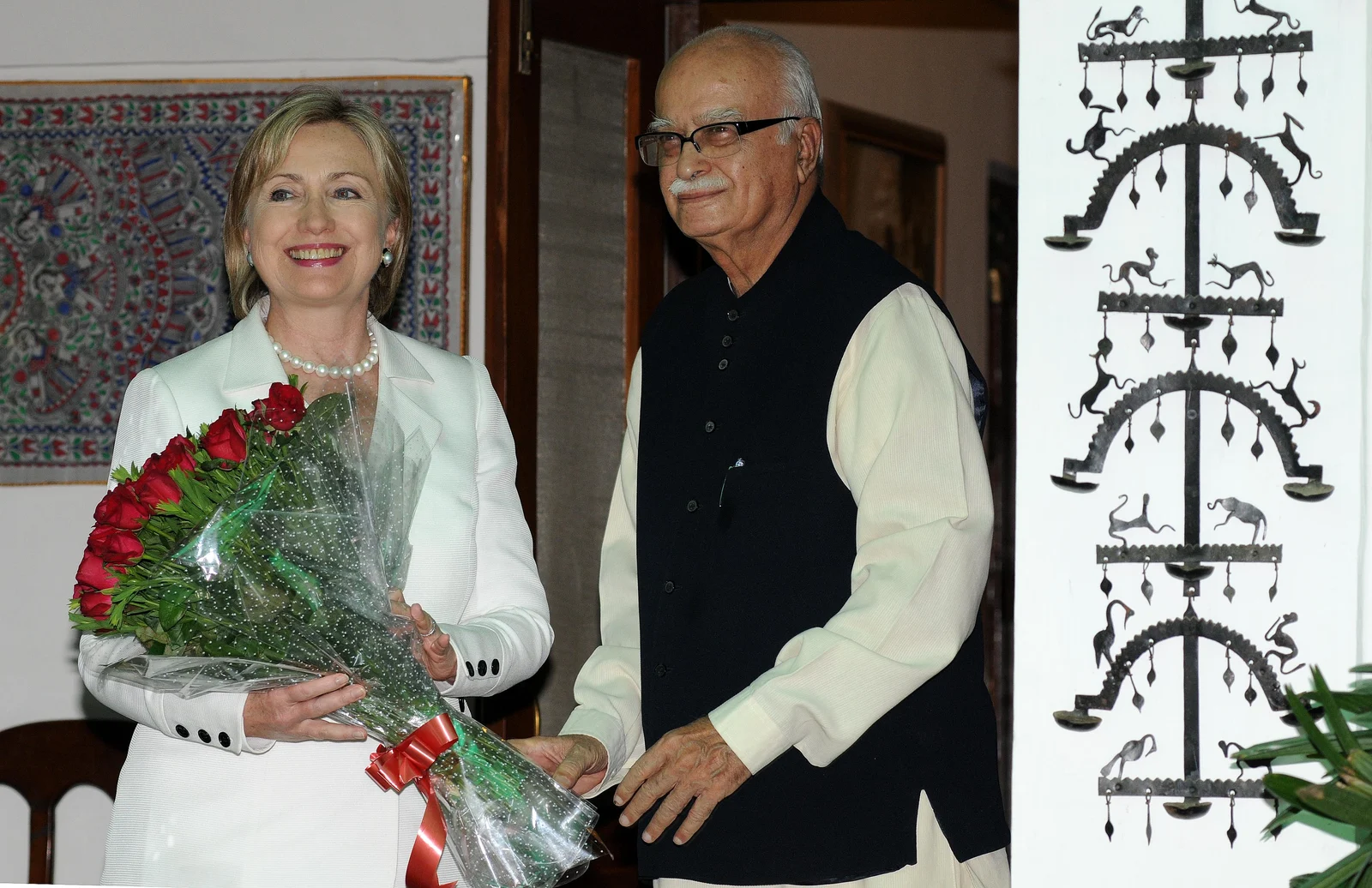
1927–
L. K. Advani
BJP organiser, Union home minister and deputy prime ministerL. K. Advani helped turn the Bharatiya Janata Party into a major national force. His organisational partnership with Atal Bihari Vajpayee, leadership of the Ram temple campaign and later ministerial offices reshaped Indian politics. That influence is inseparable from disputes over communal mobilisation and the destruction of the Babri Masjid.Read biography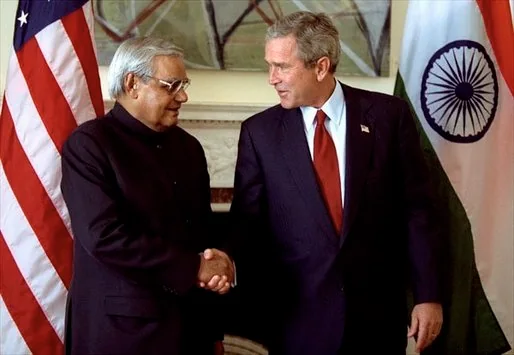
1924–2018
Atal Bihari Vajpayee
BJP leader, foreign minister and prime ministerAtal Bihari Vajpayee helped turn the Hindu nationalist parliamentary opposition into a governing coalition. His career connected Jana Sangh organisation and foreign-ministry service with brief office in 1996 and longer governments from 1998 to 2004.Read biographyQuick answers
Common questions
- Was Desai elected directly as prime minister?
- No. Voters elected Lok Sabha members. Janata selected its parliamentary leader, who was then sworn in as prime minister.
- Why do accounts sometimes say BLD instead of Janata?
- Most of the formation contested using the Bharatiya Lok Dal label, while formal party consolidation and recognition followed a different timetable. The label counted needs to be specified.
- Had Desai always opposed Congress?
- No. He had a long Congress career and had been Indira Gandhi’s deputy prime minister before their 1969 break.
- Did the 1977 government last a full parliamentary term?
- No. Internal conflicts undermined it and Desai resigned in July 1979.
Primary and institutional sources
How this history was checked
The focus is government formation, leadership and coalition organisation. The Emergency is treated as context and has its own guide. Selected indexed passages of the 1977 parliamentary journal and BJP documentary history were consulted; no full-issue or full-book reading is claimed. Different BLD and broader Janata totals are not combined into a synthetic seat count. This article was reviewed on 31 August 2026.
- Mira Patel / The Indian Express1977 general election: party labels, regional results and Janata, 2024
- Harikishan Sharma / The Indian ExpressMorarji Desai: Congress, finance and the 1977 premiership, 2022
- Lok Sabha SecretariatJournal of Parliamentary Information, April–June 1977: installation of the Janata government
- Prime Minister’s Office, IndiaMorarji Desai: former-prime-minister profile and tenure
- Sciences Po, Mass Violence and Resistance Research NetworkMorarji Desai: political career and Janata government, 2012
- Bharatiya Janata Party e-LibraryEvolution of BJP: selected passages on Janata and the new party
- Bharatiya Janata Party, GujaratL. K. Advani: historical parliamentary and organisational profile
- The Indian ExpressVia Vajpayee: party history from Jana Sangh to BJP, 2018
- Prime Minister’s Office, IndiaCopyright policy: accurate reproduction with prominent source acknowledgment