
The short answer
How did different mutations in the same gene strengthen the explanation of an inherited LPS-response defect?
Compare the records
Genetic association, convergence and scope
Each record strengthens a defined claim while leaving other questions open.
| Evidence | Supported reading | Additional question |
|---|---|---|
| 1998 mutations | Different Tlr4 defects connect to LPS hyporesponsiveness. | The detailed recognition complex. |
| 1999 mapping | An independent genetic investigation supports the locus. | All possible microbial responses. |
| 2000 deletion bounds | The deleted interval is more precisely defined. | The causes of other strain abnormalities. |
Begin with the response that required explanation
The 1998 study concerned mouse strains with an impaired response to LPS. Its abstract reports that these animals could resist endotoxin effects yet remain susceptible to Gram-negative infection. That combination makes the biological question more precise: diminished inflammatory responsiveness is not the same thing as universally stronger immunity. The investigation sought the genetic basis of a defined response difference. It did not test a human therapy or establish that one altered receptor would improve resistance to every organism, in every tissue or experimental setting.
Sources for this section: [4]
Two defects converged on one candidate
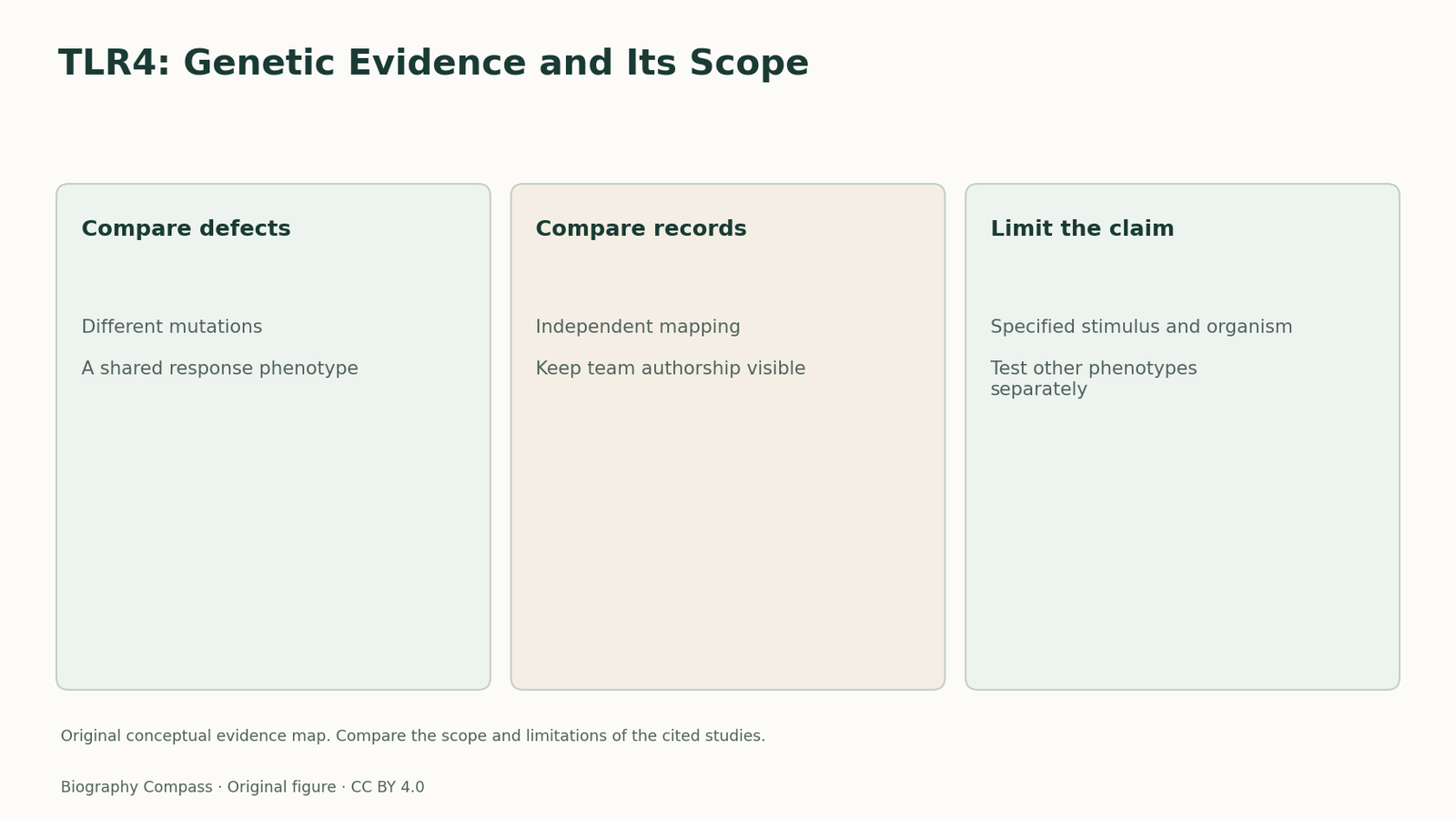
Poltorak and colleagues identified a missense change in Tlr4 in one strain and a null mutation in the other. These were different molecular defects associated with the response phenotype. Convergence made Tlr4 a much stronger explanation than a candidate selected solely because its predicted structure looked plausible. The full author list also matters: the paper records a collaborative programme of mapping and molecular analysis. A later autobiographical account can explain the researchers’ reasoning, but it does not replace the publication as the record of its authorship.
An independent record strengthened the genetic argument
Qureshi and colleagues’ 1999 paper also identified distinct Tlr4 mutations in the two strains after genetic and physical mapping. Its abstract described this as strong support for altered Tlr4 function causing endotoxin tolerance. Comparing that record with the 1998 paper makes the evidential advance clearer without merging the research teams. The studies connected inherited response differences with a particular gene. A complete account of molecular recognition still requires distinguishing the signalling component, its partners and evidence about physical interaction with the microbial molecule.
A later deletion analysis preserved an important limit
The 2000 abstract defined the boundaries of the deletion spanning Tlr4 and discussed other immune abnormalities in the strain. It explicitly left alternatives for those additional phenotypes: changes elsewhere in the genome or broader consequences of the Tlr4 deletion. This is an important restraint on retrospective storytelling. Finding a causal explanation for one carefully defined phenotype does not automatically explain every characteristic of an animal carrying that mutation. Each extension of the claim requires its own evidence and an appropriate comparison.
Sources for this section: [6]
Original evidence exercise and reference answer
Sort three editorial claims into supported, too broad or requiring another test. A: two different genetic defects implicate the same gene in a defined LPS-response phenotype. B: the studies prove that TLR4 detects every pathogen. C: an observed cellular response identifies exactly which partner directly contacts LPS. A matches the genetic argument. B expands beyond the organism and stimulus studied. C requires evidence addressing physical interaction, rather than response measurements alone. A useful answer also states why independent mapping matters and why additional abnormalities cannot simply be assigned to the same mutation. These questions distinguish the scope of the genetic evidence.
Continue the chronology
Related history guides
How Did the 1976 Antibody Study Show DNA Rearrangement?
Compare Hozumi and Tonegawa’s embryo and plasmacytoma DNA evidence, distinguish later V(D)J explanations and solve a labelled antibody-segment counting exercise.
Read the timeline1961–2020Non-A, Non-B Hepatitis: Exclusion and Cause
Compare Alter’s 1975 clinical evidence through test sensitivity, residual cases and causal identification, with an original exercise showing what exclusion can establish.
Read the timelineBiography context
Explore United States through connected lives
Connected biographies
Researchers and different immune questions
1957–
Bruce A. Beutler
Immunologist and geneticistBruce Beutler used mouse genetics to investigate innate immunity, linking impaired LPS responses to Tlr4 mutations and sharing the 2011 Nobel Prize in Medicine.Read biographyQuick answers
Common questions
- Does endotoxin tolerance mean protection from infection?
- The 1998 abstract distinguishes resistance to endotoxin effects from susceptibility to Gram-negative infection.
- Does a response phenotype alone prove direct molecular binding?
- No. The physical interaction and the downstream response are distinct evidential questions.
Primary and institutional sources
How this history was checked
Original indexed abstracts, a participant account and institutional biography are distinguished below. The exercises apply those records without reproducing experimental methods. This article was reviewed on 8 November 2026.
- Nobel Prize OutreachBruce A. Beutler — Facts
- Bruce Beutler / Nobel FoundationBruce A. Beutler — Biographical
- UT Southwestern Medical CenterBruce Beutler — Faculty biography
- Alexander Poltorak and colleagues / Science, 1998Defective LPS signaling in C3H/HeJ and C57BL/10ScCr mice: mutations in Tlr4 gene
- Salman T. Qureshi and colleagues / Journal of Experimental Medicine, 1999Endotoxin-tolerant mice have mutations in Toll-like receptor 4
- Poltorak and colleagues / Journal of Endotoxin Research, 2000Limits of a deletion spanning Tlr4 in C57BL/10ScCr mice