
The short answer
How did transfusion studies establish an unexplained hepatitis category without yet identifying its molecular cause?
Read the evidence
Different records within the same investigation
The following comparison distinguishes the specific questions answered by the inspected records.
| Record or test | What it establishes | What remains different |
|---|---|---|
| Screening result | Depends on method and timing. | A negative is not a method-free guarantee. |
| Residual category | Identifies cases not explained by tested causes. | Does not automatically identify one new agent. |
| Molecular or functional evidence | Addresses identity or causal capability. | Is a later question beyond exclusion. |
A reduced risk did not mean the problem had disappeared
Alter’s programme followed hepatitis after blood transfusion while donor selection and hepatitis-B testing improved. The concrete question concerned the cases left unexplained by those known categories. A fall in one type of infection is compatible with a persistent residual problem. The original clinical and serological reports therefore compared outcomes with laboratory evidence rather than assuming that screening for one agent had removed every cause. This guide examines the historical inference, not present-day advice about personal transfusion or infection risk.
Exclusion depended on the tests actually available
The 1975 Lancet report distinguishes screening methods with different sensitivities. More sensitive later testing identified hepatitis-B-related material that earlier screening had missed in some cases. That makes test performance part of the interpretation. A negative result is not an abstract guarantee of biological absence independent of method. Nevertheless, the study also identified hepatitis cases not serologically explained by hepatitis A, B, cytomegalovirus or Epstein–Barr virus. The residual category was not simply every sample that happened to be negative on one old assay.
Sources for this section: [1]
The 1975 hepatitis-A comparison addressed a specific alternative
The separate New England Journal of Medicine study examined transfusion-associated cases without positive hepatitis-B antigen evidence and compared pre-exposure with later samples. Its abstract reported no developed serological evidence of hepatitis A among the investigated patients. That result addressed an important candidate explanation. It did not independently reveal the sequence, shape or exact number of unidentified agents. The historically cautious non-A, non-B name retained that distinction between excluding known causes and identifying an unknown cause.
The category motivated further causal research
Alter’s first-person account explains why the investigators did not immediately use a name implying a fully identified new virus. Transmission studies and later molecular work addressed uncertainties that clinical exclusion left unresolved. His Nobel recognition links those stages with Houghton’s and Rice’s contributions, but the stages should remain separately described. Clinical observation can establish that an important explanatory gap exists. Filling that gap with a molecular identity or a functional causal account requires additional evidence rather than a more confident restatement of the negative tests.
An original exclusion exercise and answer
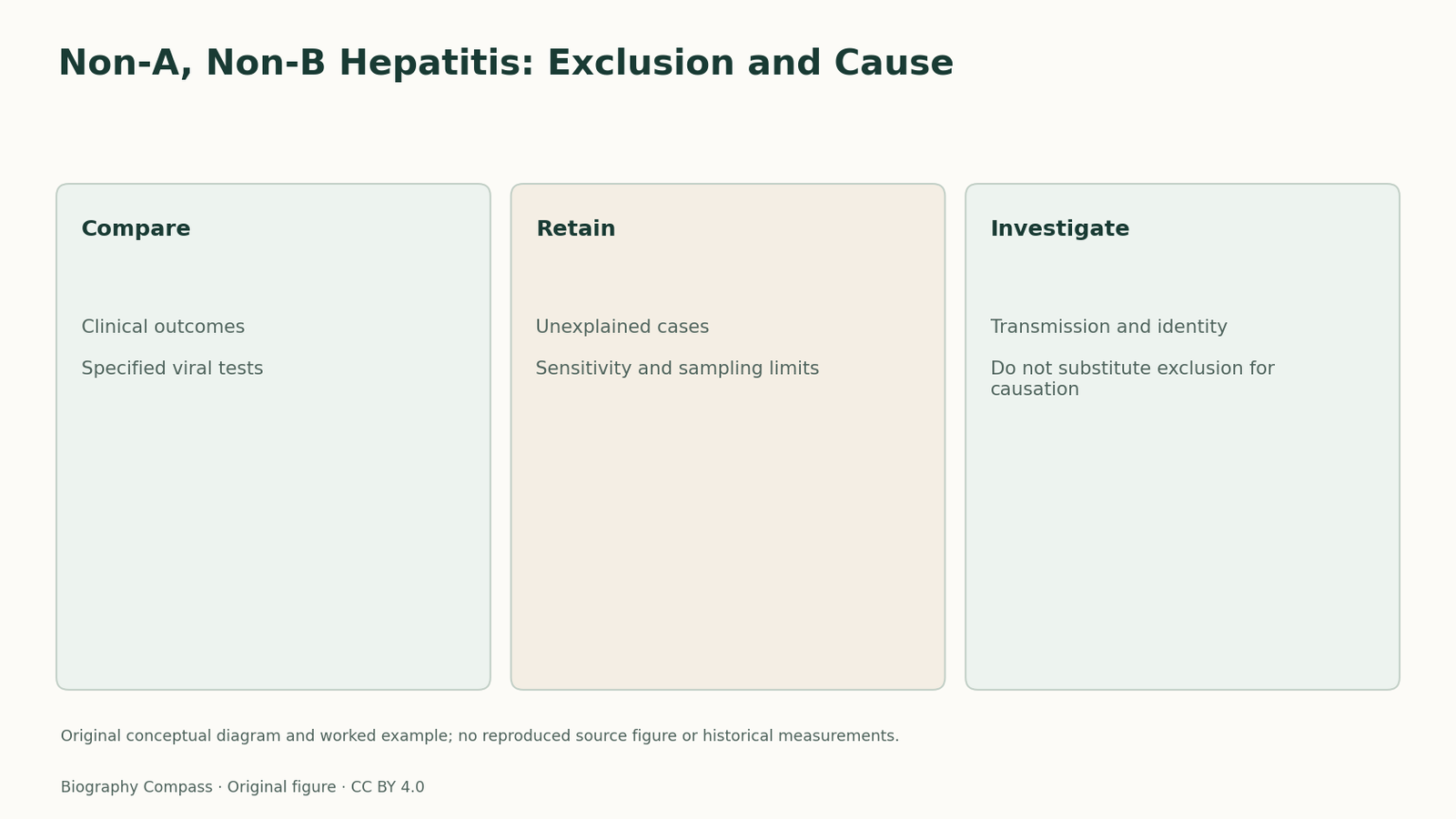
Imagine twenty fictional disease cases tested for known causes A and B. Twelve receive convincing A or B explanations, while eight remain unexplained after appropriate comparisons. What does the residual group establish? It supports an unresolved category under the stated tests; it does not prove that all eight share one newly named cause. These invented counts are not Alter’s patient data. A useful answer asks whether test sensitivity, sampling time and alternative causes were considered, then states what further evidence would identify the remaining explanation. The reasoning also works in reverse: discovering one missed A case would revise that case’s classification without automatically eliminating every other unresolved case. Exclusion is an informative stage of investigation, with a scope that should be reported precisely.
Continue the chronology
Related history guides
Hepatitis C 1989: From a Clone to Identification
Examine the 1989 hepatitis C identification paper through antibody recognition, RNA evidence and host exclusion, distinguishing molecular identification from infectivity.
Read the timeline1981–2020Hepatitis C 1997: Testing Infectious RNA
Examine Rice and colleagues’ 1997 functional evidence through sequence association, biological outcomes and negative-result limits, with an original causality exercise.
Read the timelineBiography context
Explore United States through connected lives
Connected biographies
Researchers and related approaches
1935–
Harvey J. Alter
Physician and transfusion-hepatitis researcherHarvey Alter investigated hepatitis after transfusion, helping establish the non-A, non-B disease problem that preceded hepatitis C molecular identification.Read biography1925–2011
Baruch S. Blumberg
Physician, geneticist and hepatitis-B researcherBlumberg's group examined antibodies in the serum of people who had received multiple transfusions.Read biographyQuick answers
Common questions
- Does exclusion prove one unknown cause?
- No. Several possibilities can remain.
- Can better tests change case classification?
- Yes. Test sensitivity and sampling affect what a negative result establishes.
Primary and institutional sources
How this history was checked
The references below distinguish the original study from later explanations. The worked exercise and comparison are newly written for this article. This article was reviewed on 8 November 2026.
- Alter, Holland, Morrow, Purcell and Feinstone, Lancet, 1975Clinical and serological analysis of transfusion-associated hepatitis
- Feinstone, Kapikian, Purcell, Alter and Holland, New England Journal of Medicine, 1975Transfusion-Associated Hepatitis Not Due to Viral Hepatitis Type A or B
- Nobel Prize OutreachHarvey J. Alter — Nobel lecture
- Nobel Prize OutreachHarvey J. Alter — Facts
- Nobel Prize OutreachHarvey J. Alter — Biographical