
The short answer
A recorder can collect data slowly and send it later at a different rate. The stored amount, the duration represented and the available contact time must still balance.
Selected record and original reasoning
Recording time is not contact time
Keep the stated conditions attached to each calculation.
| Check | Observation or input | What follows |
|---|---|---|
| Stored amount | 1,536,000 invented bits | Capacity is an explicit fixture input. |
| Replay | 2,560 bits/s before overhead | Do not substitute the radio carrier frequency. |
| Continuing inflow | Subtract recording from useful replay | Only the separately stipulated mode permits this. |
Chronology
A timeline of the turning points
Launch
Aryabhata entered orbit.
Programme leadership
Rao chaired ISRO.
Engineering record
Dated institutional account used in this study.
Three different properties in the record
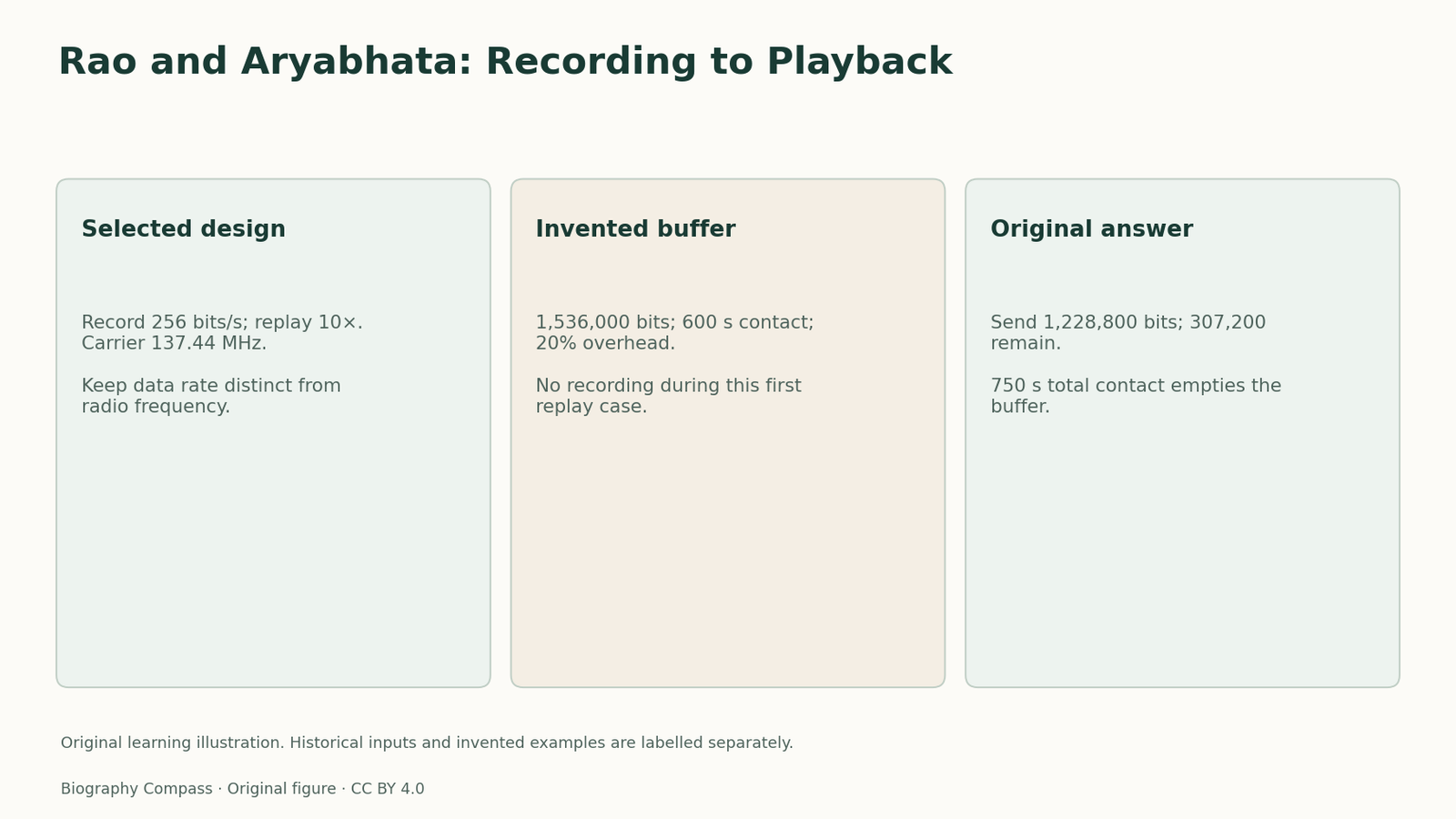
The Aryabhata history specifies tape recording at 256 bits/s, playback at ten times that rate, and telemetry at 137.44 MHz. It also distinguishes early payload power difficulties from the spacecraft’s long tracking history.
Bits per second measures data rate. Megahertz measures cycles per second; the carrier frequency alone does not provide a data rate without additional information about the communication system. Nor does a tracking interval establish how much useful scientific data were stored.
Sources for this section: [1]
Original buffer fixture
Invent a buffer containing 1,536,000 bits, recorded at the stated recording rate. Define playback as ten times that rate. Assume no recording during playback, no data compression and no headers. How much recording time does the buffer represent, and what ideal contact time empties it?
Now reserve 20% of each contact for overhead, leaving 80% for payload bits. A contact lasts 600 seconds. Calculate useful capacity, remaining bits and total contact time required. Finally, as a separate invented mode, allow continued recording during playback. Does the emptying time change? The actual spacecraft’s simultaneous-operation capability is not established by this fixture.
Sources for this section: [1]
Reference answer: conserve the bits
The buffer represents 1,536,000/256=6,000 seconds, or 100 minutes, of recording. Playback is 2,560 bits/s, so the ideal emptying time is 600 seconds, or 10 minutes. A hundred minutes of data do not require a hundred minutes of playback under this stipulated design.
With overhead, the useful rate is 0.80×2,560=2,048 bits/s. The 600-second contact sends 1,228,800 bits and leaves 307,200. Emptying the original buffer requires 750 seconds of total contact. If recording continues at 256 bits/s, the net drain is 2,048−256=1,792 bits/s and emptying instead takes about 857.14 seconds.
Each result follows from its declared mode. Adding a continuing inflow changes the conservation equation; it is not a minor rounding adjustment. The numbers do not establish actual memory capacity, flight schedules or a communication link’s error performance.
Sources for this section: [1]
Return to the engineering history
The record describes ground reception at several sites and a young engineering team developing multiple test models.
That institutional and hardware context is part of the answer. A statement about one rate is a specification, not a complete history of a successful contact. A useful note separates the stored quantity, the receiving opportunity, the operational mode and the evidence for which experiment was functioning.
Sources for this section: [1]
Continue the chronology
Related history guides
Biography context
Explore Earth orbit through connected lives
Connected biographies
The research career behind the record
Quick answers
Common questions
- Does the carrier frequency alone determine how fast the buffer can be sent?
- No. The fixture uses an explicitly supplied data rate; frequency and bit rate have different units.
- Was the buffer capacity recovered from the spacecraft record?
- No. Capacity, contact duration, overhead and simultaneous operation are original stipulated inputs.
Primary and institutional sources
How this history was checked
Selected records and their reading limits are identified below. The numerical fixtures and reference answers are original. This article was reviewed on 31 October 2026.