
The short answer
After Bataan surrendered, more than 70,000 already weakened Filipino and American troops were forced from two starting points toward a prison system unprepared to sustain them. Deprivation, deliberate violence, crowded boxcars and lethal camp conditions turned military surrender into a continuing catastrophe.
Chronology
A timeline of the turning points
Bataan surrenders
Major General Edward King surrendered exhausted Filipino and American forces on the peninsula. Japanese troops began assembling prisoners for transfer.
The march starts from Mariveles
Prisoners began moving north from the southern end of Bataan with little food, water or medical care.
A second route starts from Bagac
Columns from western Bataan moved through Pilar and Balanga before the routes converged farther north.
Columns pass through Bataan and Pampanga
Groups marched through Balanga, Orani, Hermosa, Lubao, Guagua and Bacolor toward the railhead at San Fernando.
The transfer continues by boxcar
At San Fernando, survivors were packed into railway cars for the journey north to Capas. Prisoners died from heat and suffocation.
The last march reaches Camp O’Donnell
After leaving the train at Capas, prisoners walked another six kilometres to the unfinished camp.
Mass death continues in captivity
Overcrowding, inadequate water, disease and a lack of medicine killed many more prisoners at Camp O’Donnell.
Araw ng Kagitingan commemorates Bataan
The Philippines remembers the defenders, prisoners and civilians who aided them on the Day of Valor.
What was the Bataan Death March?
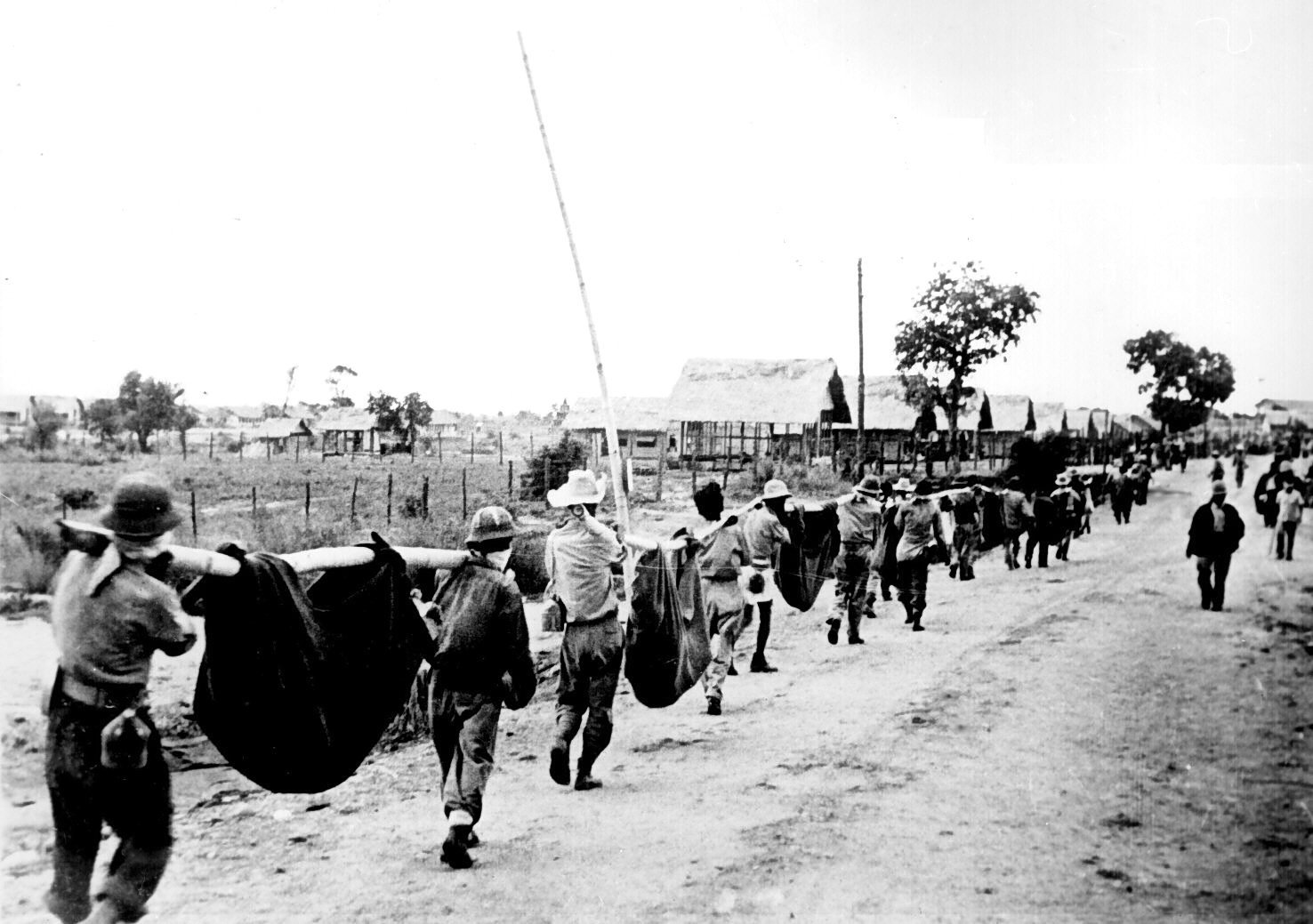
The Bataan Death March was the forced transfer of more than 70,000 surviving Filipino and American troops after the surrender of Bataan in April 1942. The prisoners began from Mariveles and Bagac and were moved north under Japanese guard.
“March” describes only part of the route. Prisoners walked to San Fernando in Pampanga, were packed into boxcars to Capas in Tarlac and then walked the final six kilometres to Camp O’Donnell.
What route did the prisoners follow?
The National Historical Commission marker records two starting points: Mariveles on 10 April and Bagac on 11 April. Columns passed through communities including Limay, Orion, Pilar, Balanga, Abucay, Samal, Orani, Hermosa, Lubao, Guagua and Bacolor before reaching San Fernando.
At San Fernando, the prisoners were forced into crowded railway cars. They disembarked at Capas and walked to Camp O’Donnell. Individual groups moved at different speeds, so there was no single journey time shared by every prisoner.
Why did so many prisoners die?
Many prisoners entered captivity with malaria, dysentery, wounds and severe malnutrition from the Battle of Bataan. Japanese planning underestimated both their number and condition, but inadequate preparation does not explain away deliberate violence.
Prisoners were denied adequate food, water, rest and medical care. Guards beat, shot or bayoneted some who fell behind, while civilians risked punishment to pass food and water to the columns. Suffocation in crowded boxcars added another lethal stage.
How many people died on the march?
No single exact death toll is supported by all records. The U.S. Army’s official medical history estimated about 650 American deaths and between 5,000 and 10,000 Filipino deaths during the march. Other commemorative accounts use different totals or combine the march with later camp deaths.
Biography Compass preserves the official range rather than selecting a dramatic single number. Filipino prisoners were the large majority of those forced along the route and of those who died.
Camp O’Donnell was a separate phase of mass death
Camp O’Donnell was an unfinished Philippine Army training site pressed into use as a prison camp. Its water, sanitation, shelter and medical capacity were wholly inadequate for tens of thousands of already weakened prisoners.
The National Historical Commission marker at Capas records more than 40,000 Filipino and 9,000 American prisoners and approximately 30,000 deaths from disease and mistreatment between April and June 1942. That camp figure should not be added casually to every march estimate, because sources define time periods and prisoner populations differently.
How is the Death March remembered?
Markers trace the route through towns where prisoners marched and civilians offered aid. The Capas National Shrine commemorates those who died in the camp, while Mount Samat places the ordeal inside the larger defence of Bataan.
The memory is both Filipino and American, but not numerically equal: Filipino troops formed most of the prisoner population. Survivors such as Jose Calugas and Vicente Lim also connect captivity to later guerrilla resistance.
Continue the chronology
Related history guides
The Battle of Bataan
Understand the campaign, blockade, disease and surrender that preceded the march.
Read the timeline29 Dec 1941–6 May 1942The Battle of Corregidor
Continue to the last fortified defence in Manila Bay and its surrender.
Read the timeline1942–1945The Japanese Occupation of the Philippines
Place prisoner suffering inside occupation, resistance and eventual liberation.
Read the timelineEleven sourced livesBataan, Corregidor and Philippine Resistance
Meet soldiers, officials, couriers and organisers whose lives crossed the campaign.
Read the timelineConnected biographies
Two documented survivors who carried resistance beyond surrender
1888—1944
Vicente Lim
Brigadier general and guerrilla organiserThe first Filipino graduate of West Point, a 41st Division commander in Bataan and a guerrilla organiser executed by Japanese forces in Manila.Read biography1907—1998
Jose Calugas
Philippine Scout, Medal of Honor recipient and guerrilla agentA Philippine Scout who crossed exposed ground to restore a silenced gun at Bataan, survived the Death March and captivity, and later aided a guerrilla intelligence network.Read biographyQuick answers
Common questions
- When did the Bataan Death March begin?
- The forced transfer followed Bataan’s surrender on 9 April 1942. The National Historical Commission records departures from Mariveles on 10 April and Bagac on 11 April.
- How long was the Bataan Death March route?
- The main overland march to San Fernando was roughly 100 to 105 kilometres, often described as 65 miles. Prisoners then travelled by rail to Capas and walked another six kilometres to Camp O’Donnell.
- How many prisoners were on the Bataan Death March?
- Official accounts commonly describe more than 70,000 surviving Filipino and American troops. Estimates vary because capture and transfer unfolded across different locations and days.
- How many died during the Bataan Death March?
- The U.S. Army’s official medical history estimated about 650 American deaths and 5,000 to 10,000 Filipino deaths on the march. Counts differ, especially when later deaths in prison camps are included.
- Where did the Bataan Death March end?
- The prisoners marched to San Fernando, travelled by boxcar to Capas and then walked the final six kilometres to Camp O’Donnell.
- Was the Bataan Death March a war crime?
- Yes. Prisoners were subjected to deliberate killings, beatings, denial of basic necessities and inhumane transport. The U.S. Army identifies the forced march as a war crime.
Primary and institutional sources
How this history was checked
Dates, legal milestones and historical claims are checked against the official and institutional records below. This article was reviewed on 9 September 2026.
- National Historical Commission of the PhilippinesBataan Death March route historical marker
- National Historical Commission of the PhilippinesCapas Concentration Camp National Shrine
- United States ArmyHistory of the Bataan Death March
- U.S. Army Center of Military HistoryThe Medical Department: Medical Service in the War Against Japan
- U.S. Army Center of Military HistoryThe Fall of the Philippines
- Wikimedia CommonsCamp O’Donnell burial detail photograph and licence