
The short answer
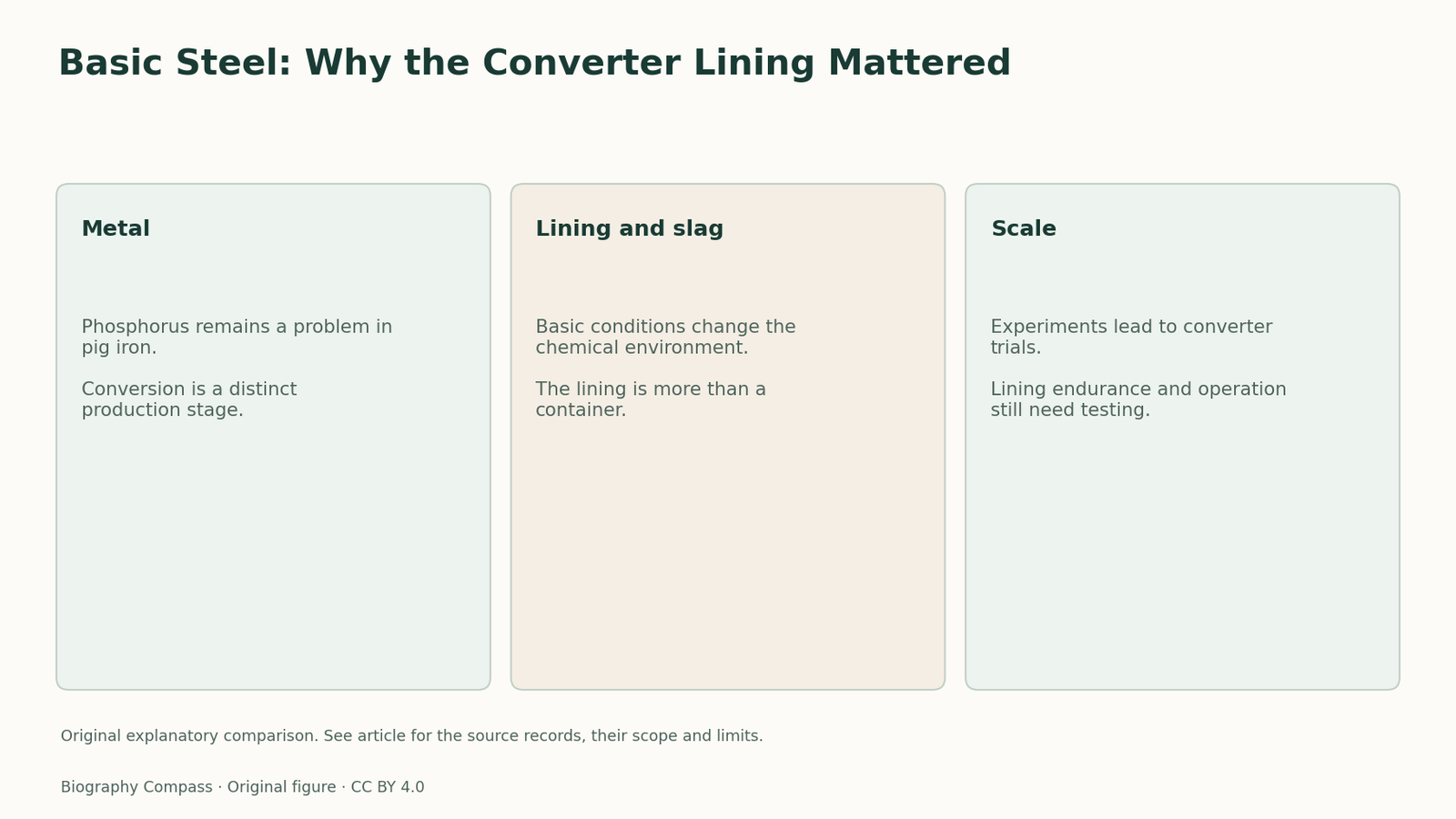
A converter’s lining was part of its chemical environment. Changing the lining and slag conditions helped solve a problem that blowing air alone had left unresolved.
Compare the evidence
Basic Steel: Why the Converter Lining Mattered
Keep the observations and the conclusions they support together.
| Record | What it supports | What it does not establish |
|---|---|---|
| Welsh biographical account | Thomas pursued dephosphorisation while employed as a clerk. | Biography alone does not supply a complete operating recipe. |
| Blaenavon industrial records | Basic lining experiments progressed toward converter trials. | A small successful test does not establish every works-scale condition. |
Name the material and the problem
The problem concerned phosphorus remaining in metal during conversion of pig iron to steel. It should not be described as simply picking unwanted pieces out of an ore. Thomas and Gilchrist investigated conditions inside a converter. The Blaenavon nomination explains that their developing lining would absorb the unwanted phosphorus. Read that account with the location of the process in mind: the metal had already passed through earlier stages of iron production.
Why a lining could change the result
The standard acidic converter arrangement did not supply the conditions needed for the desired removal. A basic lining and the associated slag chemistry changed what could happen during conversion. The lining was therefore more than a passive container whose only job was to resist heat. Thomas’s biography also records the later usefulness of the resulting basic slag as fertiliser. This is a relationship among metal, lining and slag, not a claim that an identical result follows from adding arbitrary limestone to any molten metal.
Separate a chemical result from a works method
Blaenavon’s account distinguishes the cousins’ initial experiments from the company’s provision of a small converter for larger trials. A useful teaching diagram has three stages: identify phosphorus in the metal, establish suitable chemical conditions, and test an industrial operation. The first successful result does not establish the endurance of every lining or the economics of every works. Keeping those questions separate explains both the process’s significance and why laboratory work needed collaboration with a manufacturing site before it could change large-scale steel production.
Continue the chronology
Related history guides
Blaenavon: From Chemical Tests to a Converter
Trace the Blaenavon experiments from Gilchrist’s analytical work to company-backed converter trials, separating useful evidence from claims of instant scale-up.
Read the timeline1840–1884Mushet’s1884 Letter: A Ferro-Manganese Claim
Examine Robert Mushet’s1884 letter citing his father’s1840 book, distinguishing a reported experiment, a republication date and a claim to priority.
Read the timelineBiography context
Explore United Kingdom through connected lives
Connected biographies
People behind the records
1850–1885
Sidney Gilchrist Thomas
Metallurgical inventor and police-court clerkSidney Gilchrist Thomas combined paid clerical work with chemical study and experiments that helped make phosphorus-rich iron usable in large-scale steelmaking.Read biography1851–1935
Percy Gilchrist
Works chemist and metallurgistPercy Gilchrist supplied works-based chemistry and experimentation to the steelmaking process that bears his and his cousin Sidney Gilchrist Thomas’s names.Read biography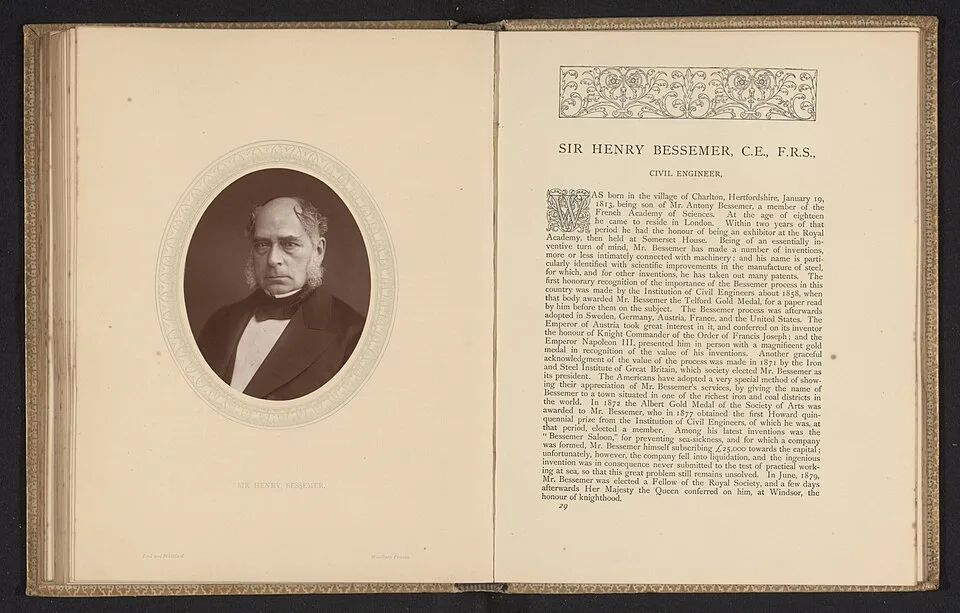
1813–1898
Henry Bessemer
Inventor, steel manufacturer and patent entrepreneurHenry Bessemer developed an air-blown method for converting molten pig iron and helped make bulk steel commercially practical. His 1856 announcement preceded serious failures, further experiments and a Sheffield business; his success also involved disputes over patents and other metallurgists’ contributions.Read biographyQuick answers
Common questions
- Why did the basic steel process require a different lining?
- The basic lining and associated slag conditions provided a chemical environment for removing phosphorus during conversion. Proving removal in an experiment was still different from establishing repeatable operation at a works.
Primary and institutional sources
How this history was checked
The sources distinguish institutional biographies, participant accounts and records of individual objects. The related biography gives context for their use. This article was reviewed on 7 November 2026.