
The short answer
The Blaenavon account records a transition from privately financed experiments to tests supported by an ironworks. Each stage supplied different evidence.
Compare the evidence
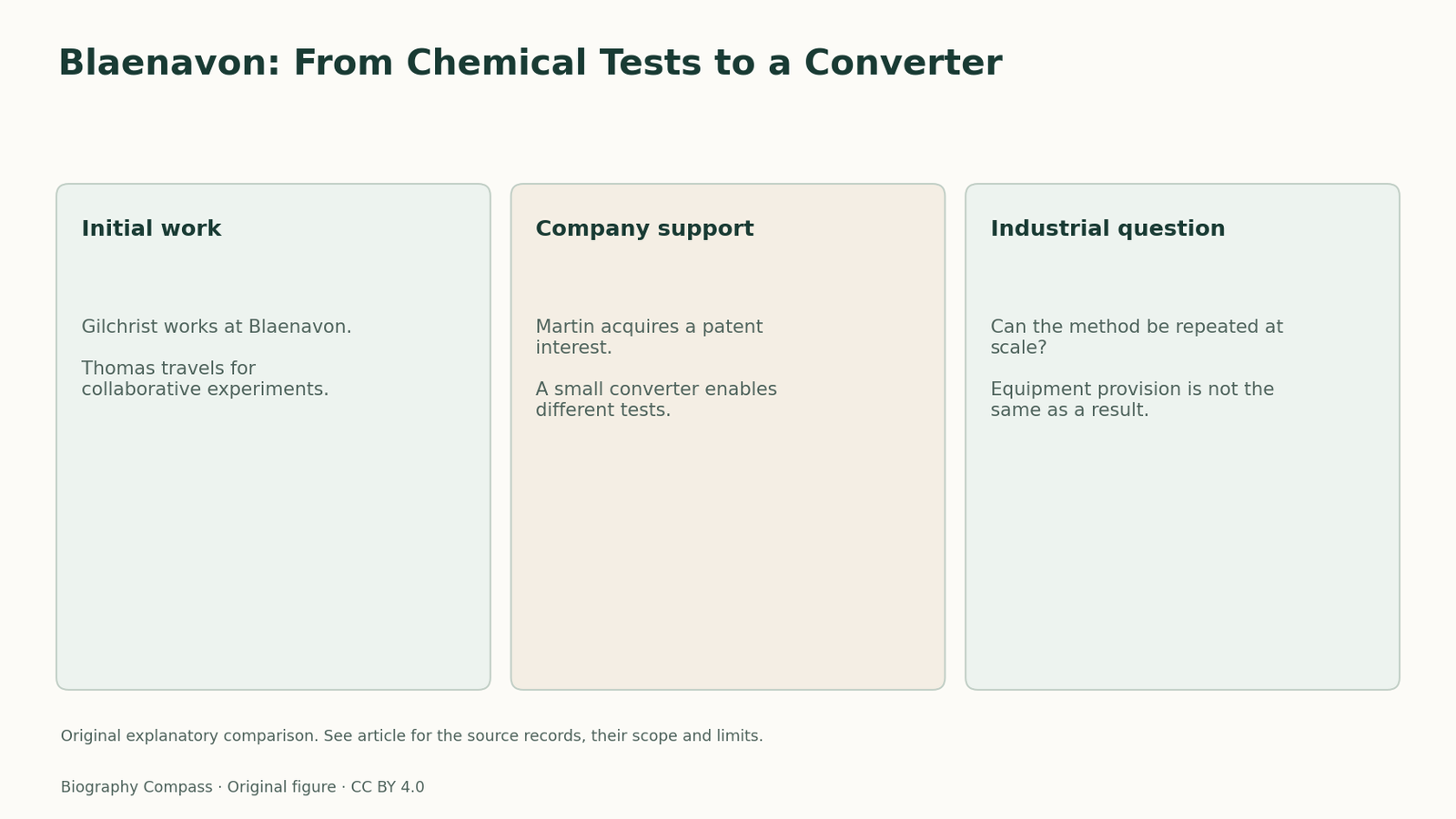
Blaenavon: From Chemical Tests to a Converter
Keep the observations and the conclusions they support together.
| Record | What it supports | What it does not establish |
|---|---|---|
| Gilchrist’s works appointment | Provides a setting for analytical chemistry and experiments. | A job title does not demonstrate every experimental result. |
| Martin’s company support | Supplies equipment and connects the work with a commercial interest. | Financing and patent participation do not themselves prove a process works. |
An appointment made a difference
Blaenavon’s institutional account places Gilchrist’s appointment as analytical chemist in 1876. Thomas travelled from London to collaborate with him in 1877. That arrangement joined a researcher’s proposal with a works setting where materials and apparatus were accessible. An experiment depended on more than possession of a theory: someone had to prepare materials, observe results and decide what to test next. Gilchrist’s industrial position helps explain how the collaboration could proceed.
Support changed the possible scale
The account says general manager Edward Pritchard Martin became aware of the work, purchased a share in the patent and provided a small Bessemer converter. These actions belong to different categories. Patent participation concerned a commercial interest; supplying equipment changed what could be tested. Neither action should be substituted for the experimental result itself. The transition was from limited investigations toward converter trials, not directly from a private idea to universal industrial adoption.
Sources for this section: [2]
Ask what the next test would need to show
Use three columns headed material result, repeatability and works operation. Place a successful small experiment in the first column and the provision of a converter beside the question it made possible to investigate. The answer should still ask whether suitable linings could be made and used reliably at the larger scale. This is an original planning exercise, not a reconstruction of an uninspected laboratory notebook. It explains why Thomas’s contribution, Gilchrist’s chemical work and the company’s practical support are complementary parts of the history rather than competing substitutes for one another.
Continue the chronology
Related history guides
Basic Steel: Why the Converter Lining Mattered
Understand why the Thomas–Gilchrist basic process changed the converter lining, and distinguish removing phosphorus from proving a works could run the method.
Read the timeline1840–1884Mushet’s1884 Letter: A Ferro-Manganese Claim
Examine Robert Mushet’s1884 letter citing his father’s1840 book, distinguishing a reported experiment, a republication date and a claim to priority.
Read the timelineBiography context
Explore United Kingdom through connected lives
Connected biographies
People behind the records
1851–1935
Percy Gilchrist
Works chemist and metallurgistPercy Gilchrist supplied works-based chemistry and experimentation to the steelmaking process that bears his and his cousin Sidney Gilchrist Thomas’s names.Read biography1850–1885
Sidney Gilchrist Thomas
Metallurgical inventor and police-court clerkSidney Gilchrist Thomas combined paid clerical work with chemical study and experiments that helped make phosphorus-rich iron usable in large-scale steelmaking.Read biography1811–1891
Robert Forester Mushet
Metallurgist and steelmakerRobert Mushet worked at Darkhill on the composition of iron and steel, linking an important steelmaking addition with later self-hardening tool steel.Read biographyQuick answers
Common questions
- How did laboratory chemistry become a steelworks trial at Blaenavon?
- Gilchrist’s works-based experiments with Thomas preceded company-backed converter trials. Martin’s patent interest and equipment support made larger tests possible, but commercial participation was not itself evidence of a successful chemical result.
Primary and institutional sources
How this history was checked
The sources distinguish institutional biographies, participant accounts and records of individual objects. The related biography gives context for their use. This article was reviewed on 7 November 2026.