
The short answer
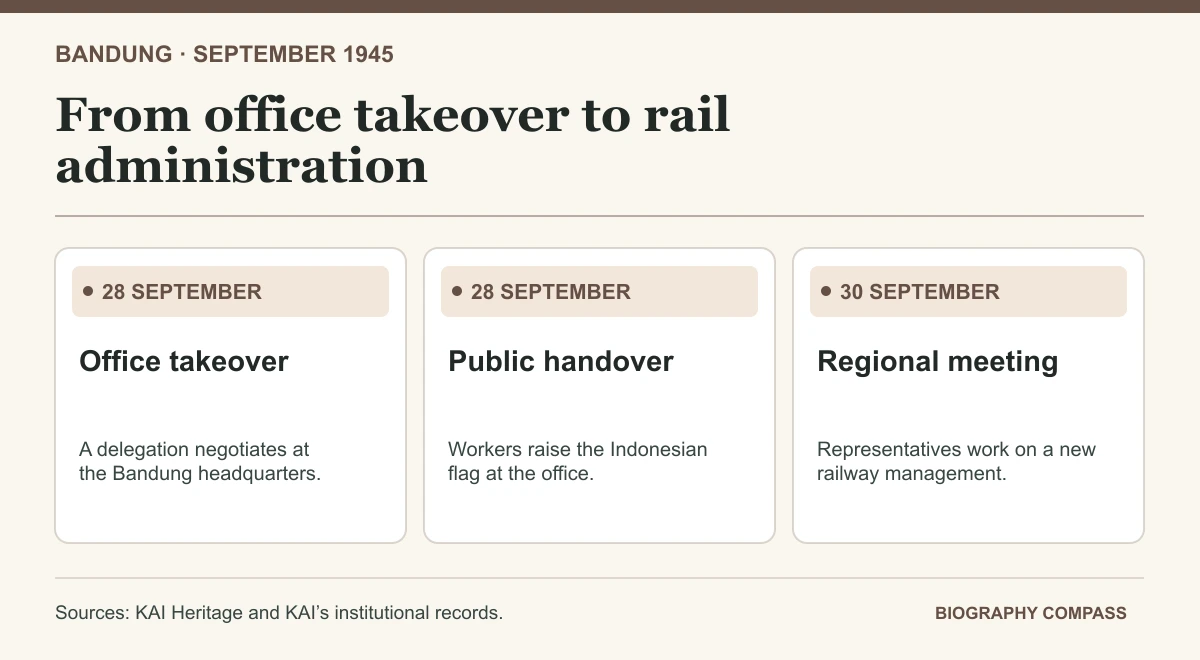
On 28 September 1945, Indonesian railway workers took over the Bandung headquarters from Japanese authorities. Two days later, representatives from regional railway offices met there to organise management. Modern KAI traces its founding anniversary to the takeover, while its heritage account also records the work required to form a railway administration.
Compare the records
What happened on each date
The Bandung records distinguish wider independence, control of an office and organisation of a service.
| Event | Date | What it helps explain |
|---|---|---|
| Independence proclamation | 17 August 1945 | Why control of public assets became an urgent question |
| Takeover in Bandung | 28 September 1945 | Why the railway marks its anniversary on that date |
| Management meeting | 30 September 1945 | How a headquarters involved several regional administrations |
Chronology
A timeline of the turning points
Jakarta takeover
KAI’s history records that Indonesian staff took over railway operations in Jakarta.
Bandung office changes hands
Workers and representatives gather while a delegation negotiates in the headquarters.
Railway leaders meet
Delegates from several regional offices meet to form a new management.
Operations face disruption
The Bandung office must organise train services amid fighting and later relocation.
Why Bandung mattered to railway workers
The former Staatsspoorwegen head office in Bandung served as a railway administrative centre during the Japanese occupation. KAI’s account says Indonesian railway employees were already working inside the organisation. After the proclamation of independence and the takeover in Jakarta, thousands of workers gathered in Bandung on 28 September. Their representatives negotiated in the agency head’s office while workers and young people waited outside. The flag raising that followed publicly marked the change in control.
A headquarters had to coordinate with regions
The handover put staff in control of the building, where they could convene representatives from Jakarta, Semarang and Surabaya. KAI’s heritage history dates that discussion to 30 September and associates the formation of DKARI, the Department of Railways of the Republic of Indonesia, with meetings after the takeover. Its annual report uses 28 September as the institutional founding date. The records are useful together because one gives the anniversary and the other describes how management took shape.
The service mattered even as the office moved
KAI’s account describes trains continuing to run intermittently as conflict reached Bandung. Staff later coordinated operations and maintenance from Cisurupan. This part of the record shows why the history hinges on more than the occupation of a building. A national railway administration also needed workers and equipment in different regions to keep trains moving.
Continue the chronology
Related history guides
How Java’s First Railway Opened from Semarang to Tanggung
Explore the earlier operating history of the rail lines the new administration inherited.
Read the timeline1945–1949Indonesian Independence, 1945–1949
Place the takeover and its aftermath within the wider Indonesian revolution.
Read the timelineConnected biographies
People connected to this history
Quick answers
Common questions
- Why is 28 September a railway anniversary in Indonesia?
- On that date in 1945, Indonesian railway workers took over the Bandung headquarters from Japanese authorities.
- What did DKARI stand for?
- Djawatan Kereta Api Republik Indonesia, the Department of Railways of the Republic of Indonesia.
Primary and institutional sources
How this history was checked
Dates, legal milestones and historical claims are checked against the official and institutional records below. This article was reviewed on 19 November 2026.