
The short answer
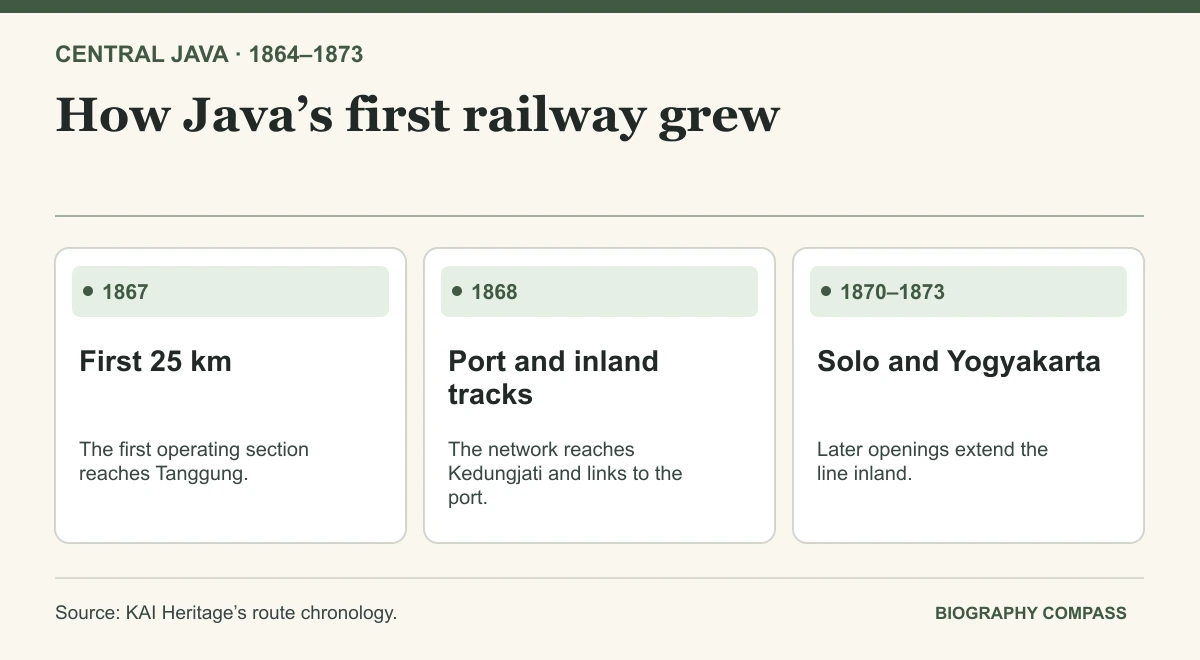
On 10 August 1867, a 25-kilometre railway opened between Semarang and Tanggung. The Dutch East Indies’ first railway grew in stages after that opening. A spur connected it to Semarang’s port in 1868 and the inland route eventually reached Solo and Yogyakarta.
Compare the records
How the first route grew
KAI’s heritage history records inland progress and the port connection as separate works.
| Section | Date | Length in KAI’s chronology |
|---|---|---|
| Semarang–Tanggung | 10 August 1867 | 25 km |
| Tanggung–Kedungjati | 19 July 1868 | 9 km |
| Semarang–port | 20 July 1868 | 2 km |
| Kedungjati–Solo | 10 February 1870 | 74 km |
Chronology
A timeline of the turning points
Construction begins in Semarang
The railway company begins building the inland line.
First section opens
Trains can operate between Semarang and Tanggung.
Network grows in two directions
The next inland section reaches Kedungjati and a separate spur connects Semarang with the port.
Line reaches Solo and Yogyakarta
The extensions create a longer corridor between the coast and inland cities.
The first 25 kilometres
Construction began at Semarang in 1864 under the private Nederlandsch-Indische Spoorweg Maatschappij, known as NISM. The first operating section reached Tanggung in August 1867. Although the project was intended to reach further inland, it opened in sections. The first date refers to the part open to traffic, while the later dates document how the wider route was assembled.
Why the two-kilometre spur mattered
KAI dates the connection to Semarang’s port to 20 July 1868, the day after the Tanggung–Kedungjati extension opened on the inland side. The spur was much shorter than the inland extensions, but it made a different part of the journey possible. A train could connect goods arriving from central Java with a place to transfer them to ships. The heritage account records 9,039 tonnes of sugar carried from Solo to the port in 1870, alongside coffee and indigo.
Sources for this section: [1]
The railway also carried passengers
The operator’s historical account lists stations and smaller stopping places along the Semarang–Solo route. It also records ticket sales across three classes in 1870. Most of the tickets it lists were in third class. Freight figures explain why the port link mattered economically, while ticket records show another use of the same track. Reading both sets of material gives a broader picture of what the railway did after the first section opened.
Continue the chronology
Related history guides
How Railway Workers Took Over Bandung’s Rail Office in 1945
Follow the very different question of who controlled the rail offices at independence.
Read the timeline1884–1885How the Taiping–Port Weld Railway Opened in 1885
Compare an early railway built to link a Perak mining district with the coast.
Read the timelineConnected biographies
People connected to this history
Quick answers
Common questions
- When did the first railway open in Java?
- The Semarang–Tanggung section opened on 10 August 1867.
- Did the first section reach Solo?
- The first section ended at Tanggung. KAI dates the extension to Solo to 10 February 1870.
Primary and institutional sources
How this history was checked
Dates, legal milestones and historical claims are checked against the official and institutional records below. This article was reviewed on 19 November 2026.