
The short answer
Why did RNA-dependent DNA synthesis change virus classification?
Evidence comparison
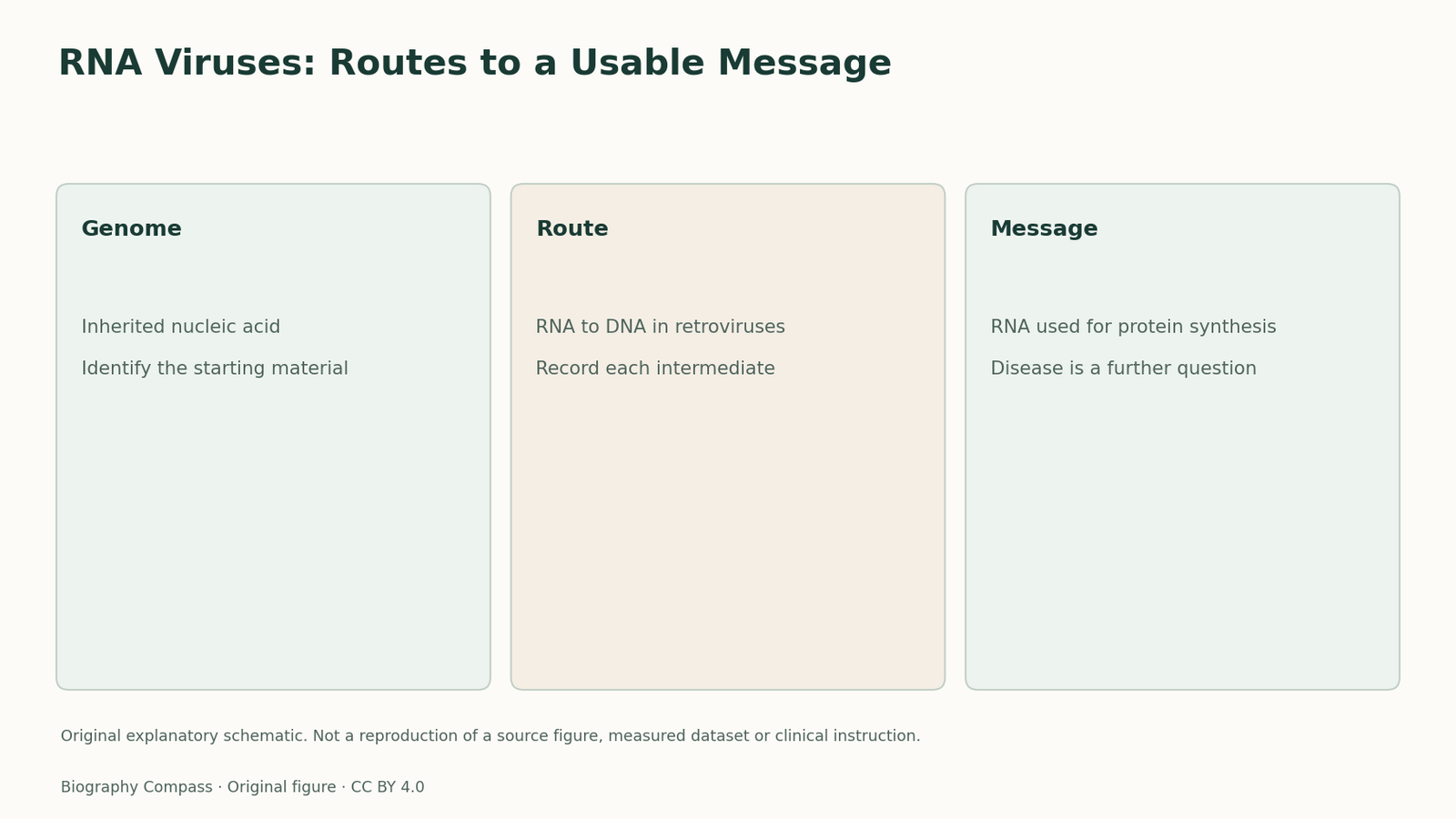
RNA Viruses: Routes to a Usable Message
Compare the observations with the narrower conclusions they support.
| Record or observation | What it supports | What remains separate |
|---|---|---|
| RNA-directed DNA synthesis | Changes nucleic-acid form from RNA to DNA | Does not establish protein-to-DNA information transfer |
| Messenger-RNA production | Makes information usable for protein synthesis | Does not predict disease severity from genome class |
Every genome still needs a message
Baltimore's Nobel lecture begins with the shared requirements of very different viral genetic systems: inherited nucleic acid and a messenger RNA capable of directing protein synthesis. The genome is the information carried between infections. The usable message is the form read to make proteins. These can be closely related in one virus and connected through several transformations in another. Classification by the route to a message therefore explains something a simple list of genome materials would miss.
Follow the reverse-transcription route
Retroviral RNA can be copied into DNA by reverse transcriptase. Baltimore's lecture distinguishes an early period involving DNA formation and establishment of a provirus from a later period of viral gene expression and new particle production. The discovery of polymerase activity supported a chemical step in that pathway. It did not by itself identify every intermediate, every integration mechanism or the full relationship between infection and disease.
Sources for this section: [3]
Compare arrows rather than names
For an original classroom map, draw genome RNA to DNA to messenger RNA for a retroviral route. Beside it, draw a hypothetical RNA genome copied through RNA intermediates. Mark the chemical identity at every arrow's beginning and end. Ask which arrow distinguishes the first route. The answer is RNA-directed DNA synthesis. Do not add protein-to-nucleic-acid transfer: that is not what reverse transcription demonstrates, and a diagram with such an arrow would make a substantially different claim.
Sources for this section: [3]
Do not classify symptoms from the diagram
Baltimore explicitly noted that disease symptoms do not simply follow the biochemical class of a virus. A replication diagram can explain an information pathway while leaving tissue effects and disease severity unresolved. Read it as a model of molecular operations, not a diagnosis or a prediction that all viruses grouped together behave identically in patients.
Sources for this section: [3]
Continue the chronology
Related history guides
Biography context
Explore United States through connected lives
Connected biographies
Researchers and related questions
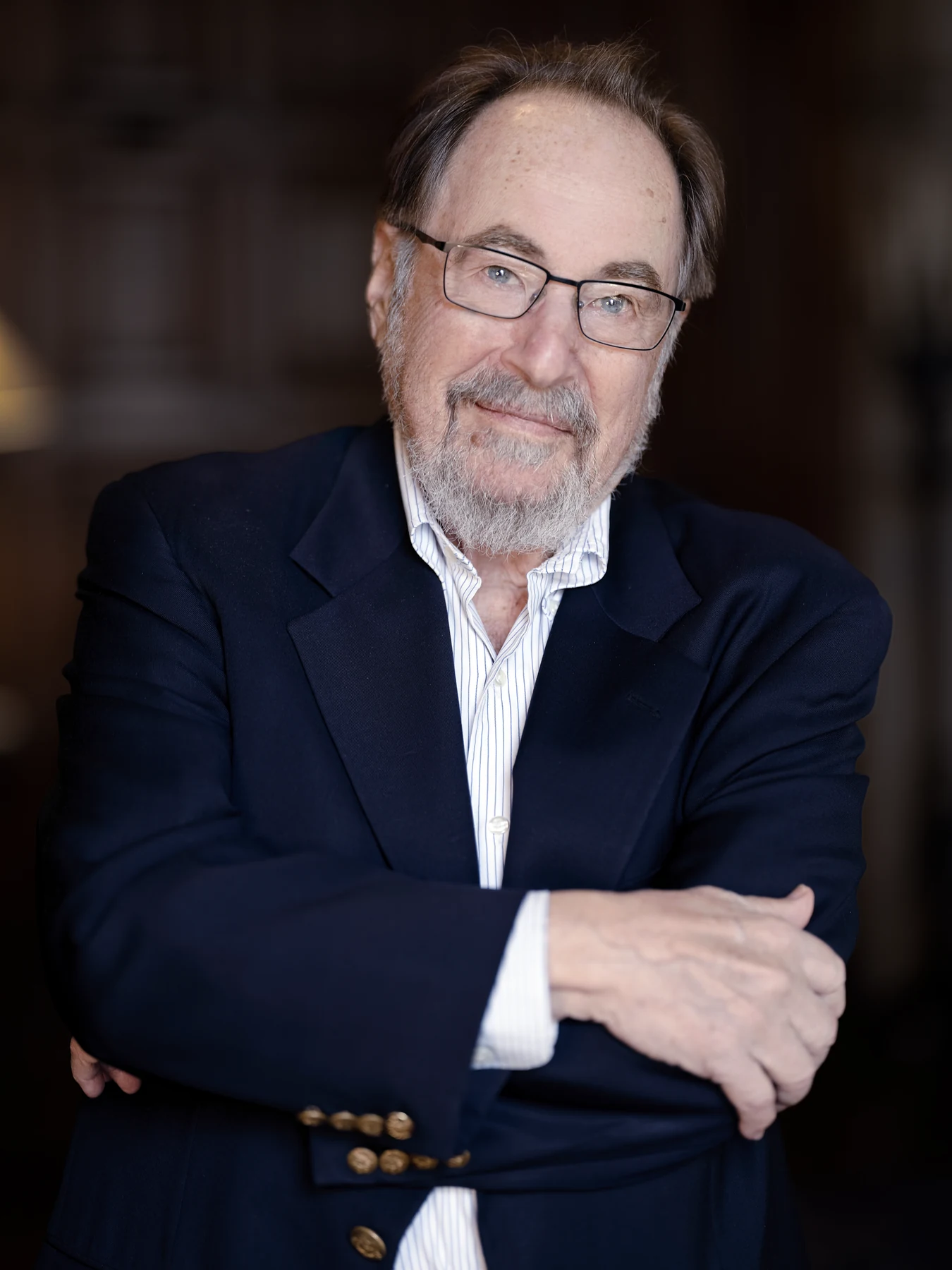
1938–2025
David Baltimore
Molecular biologist and virologistBaltimore independently discovered RNA-directed DNA polymerase activity in 1970, at the same time that Howard Temin and Satoshi Mizutani identified the activity in their own work.Read biography1934–1994
Howard Temin
Virologist and provirus researcherAt Wisconsin, where he moved in 1960, Temin developed the DNA provirus hypothesis.Read biography1927–2010
Marshall Nirenberg
Biochemist and genetic-code researcherWorking with Heinrich Matthaei, Nirenberg developed a cell-free system in which added RNA could guide amino-acid incorporation.Read biographyQuick answers
Common questions
- Why did RNA-dependent DNA synthesis change virus classification?
- Changes nucleic-acid form from RNA to DNA. Does not establish protein-to-DNA information transfer.
- Are the classroom examples historical measurements?
- No. Invented examples are labelled as classroom models; the source-based discussion identifies the historical evidence separately.
Primary and institutional sources
How this history was checked
Official biographical and award records are read alongside the researcher’s technical account. Source scope and hypothetical examples remain distinct. This article was reviewed on 7 November 2026.