
The short answer
How did Baker v. Carr differ from Reynolds v. Sims, and why do population and seat counts need to be examined together?
Source comparison
Follow the question, not just the era label
Identify the question a record answers before using it to support a wider claim.
| Record or concept | What it establishes | What needs other evidence |
|---|---|---|
| Baker | A challenge may proceed. | The final apportionment remedy. |
| Reynolds | A population standard. | An exact universal numerical tolerance. |
| Worked calculation | Population divided by seats. | Turnout or individual voting power. |
Chronology
A timeline of the turning points
Baker
Brennan delivers the opinion on 26 March.
Reynolds
Warren delivers the opinion on 15 June.
Could the challenge be heard?
In Baker v. Carr, the 1962 majority opinion by William Brennan held that the Tennessee challenge presented a justiciable equal-protection claim. The Court reversed the dismissal and remanded the case. It expressly declined at that stage to prescribe the most appropriate remedy.
That procedural position matters. A decision allowing a claim to be considered is not already a final answer to every question about the arrangement challenged. Identify what the lower court did and what the appellate court was asked to review.
Sources for this section: [1]
What population principle applied?
In Reynolds v. Sims, the 1964 opinion by Earl Warren addressed Alabama’s legislative apportionment. It required a population basis in both chambers of a state legislature, while recognising that mathematical exactness was not a workable requirement.
The two decisions should therefore be read in sequence without collapsing their questions. One concerns judicial consideration of a constitutional claim; the other states a substantive standard in a different case. Neither is authored simply by an impersonal label such as the Warren Court.
An original population-per-seat calculation
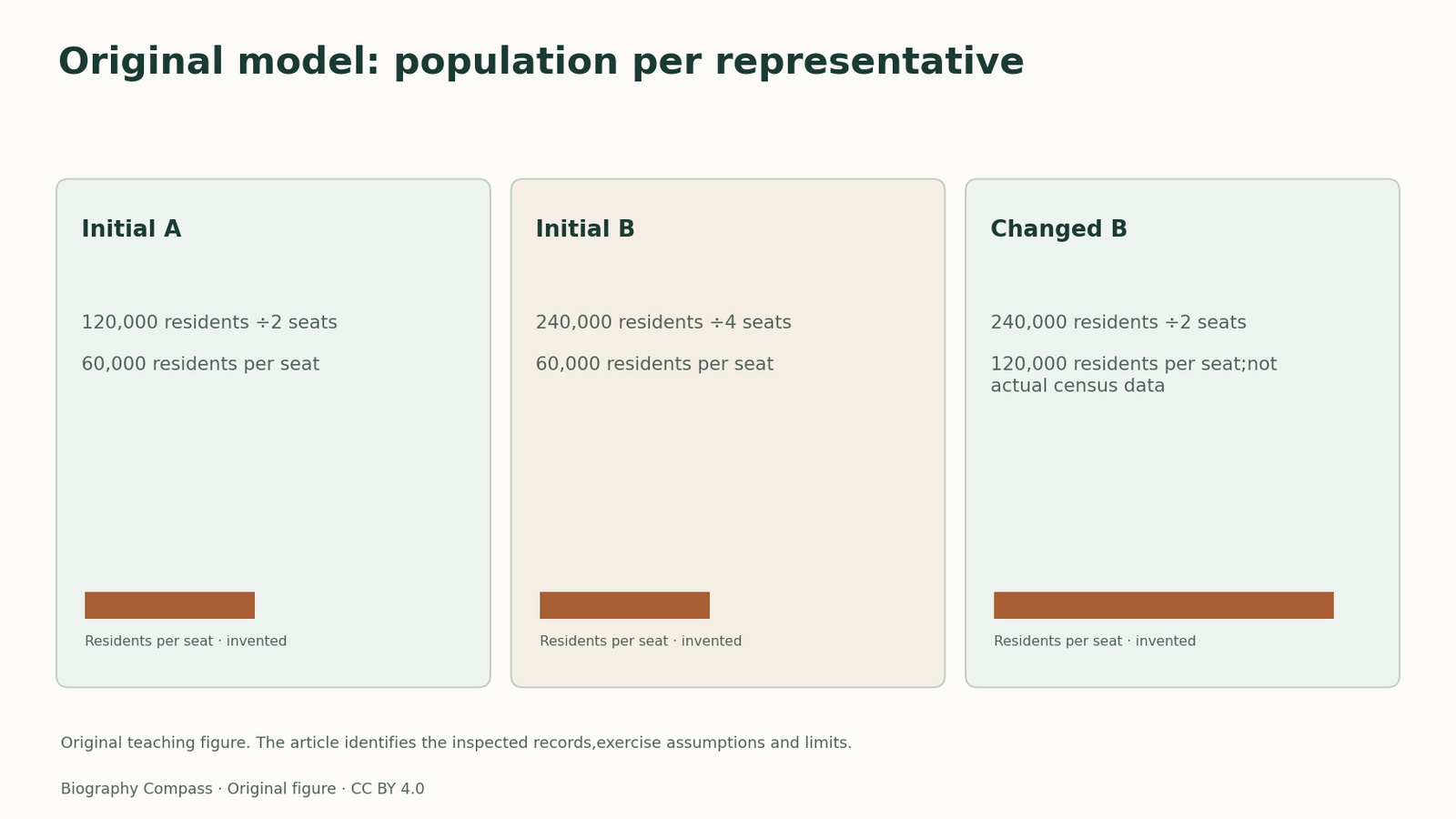
Invent two areas. Area A has 120,000 residents and two representatives; Area B has 240,000 residents and four. Calculate population per representative. Then suppose B still has 240,000 residents but only two seats. Assume the supplied totals exhaust the relevant population and count comparable seats; do not infer voting-age population or turnout.
Reference answer: initially, both areas have 60,000 residents per representative. Unequal seat totals alone do not show unequal population-per-seat ratios. In the changed arrangement, A remains at 60,000 and B rises to 120,000. The ratio is 2:1. That arithmetic identifies a representational difference within the invented model; it does not measure every person’s voting power or apply a legal tolerance to a real district plan.
Sources for this section: [2]
What an adequate historical comparison records
A useful worksheet should keep jurisdiction, holding, remedy, opinion author and measured population separate. It should also say when a number is supplied for teaching rather than taken from a census. Without those distinctions, a caption can mistakenly credit one justice with a colleague’s opinion or turn an illustrative ratio into a rule announced by the Court.
The selected majority passages support this historical comparison. The full dissenting and concurring arguments, later cases and present districting law are outside its scope. A study of current requirements needs its own legal sources rather than an extrapolation from this exercise.
Continue the chronology
Related history guides
Biography context
Explore United States through connected lives
Connected biographies
People behind the institutional history

1891–1974
Earl Warren
California governor and Chief Justice of the United StatesEarl Warren’s public career extended from California prosecution and state government to the leadership of the Supreme Court.Read biographyQuick answers
Common questions
- Are the exercise figures Alabama or Tennessee census data?
- No. All populations and seat allocations in the worked example are invented and explicitly supplied for calculation.
Primary and institutional sources
How this history was checked
The access notes distinguish selected transcriptions, official registers and later accounts. This is a historical study, not an assertion about present legal powers. This article was reviewed on 31 October 2026.