
The short answer
Brown is both the name of a landmark ruling and a shorthand for a wider school-desegregation struggle. Following the cases, participants and implementation decisions separately explains what changed in 1954—and why a unanimous judgment did not instantly transform every school.
Four state cases and a federal-district companion
The cases behind the shorthand
The state disputes were considered together in Brown; Bolling produced a separate opinion on the same day.
| Case | Jurisdiction | Decision route |
|---|---|---|
| Brown v. Board of Education | Kansas | Fourteenth Amendment; consolidated Brown opinion |
| Briggs v. Elliott | South Carolina | Fourteenth Amendment; consolidated Brown opinion |
| Davis v. County School Board | Virginia | Fourteenth Amendment; consolidated Brown opinion |
| Gebhart v. Belton | Delaware | Fourteenth Amendment; consolidated Brown opinion |
| Bolling v. Sharpe | District of Columbia | Fifth Amendment; separate opinion |
Chronology
A timeline of the turning points
Arguments and reargument
The Court considered school-segregation disputes from four states alongside the District of Columbia case.
Brown
The unanimous opinion rejected state-imposed racial segregation in public schools under the Fourteenth Amendment.
Bolling
A separate opinion addressed the District of Columbia through the Fifth Amendment.
Arguments on relief
Counsel returned to discuss how the constitutional rulings should be implemented.
Brown II
The Court assigned responsibilities for local plans and judicial supervision, with different treatment of the Delaware judgment.
Why does a Kansas case stand for several communities?
Oliver Brown’s name appears first in the familiar title, but the litigation reached beyond one family and one city. Cases from Kansas, South Carolina, Virginia and Delaware presented a common constitutional question despite different local facts. The Delaware litigation itself combined claims associated with the Belton and Bulah families. Counting every local lawsuit as a separate Supreme Court opinion therefore produces confusion.
The National Archives distinguishes that four-state consolidation from the District of Columbia dispute heard alongside it. The wider history is often described through five communities or five cases. That useful shorthand should not obscure the separate constitutional grounds of the Court’s two opinions on 17 May 1954.
Sources for this section: [2]
Who made the litigation possible?
Parents, students and local supporters challenged the schools available to them before their disputes became a national symbol. The National Park Service’s account traces grassroots efforts to obtain admission or challenge unequal conditions. Different communities supplied the plaintiffs, experiences and local evidence from which a broader legal challenge could be built.
Thurgood Marshall’s leadership belonged to an extensive legal effort rather than a solitary courtroom performance. Robert Carter, Spottswood Robinson, Louis Redding, James Nabrit and George Hayes were among the lawyers involved across the cases and later proceedings. The printed counsel list in Brown II makes that breadth visible. Distinguishing a lead strategist from a whole team gives a fuller account of how litigation develops.
What did the 1954 Brown opinion decide?
Chief Justice Earl Warren delivered the unanimous ruling on 17 May 1954. The Court held that state-imposed racial segregation in public schools denied equal protection under the Fourteenth Amendment. Equality could not be established simply by comparing buildings, teachers’ salaries or other measurable facilities while leaving the racial separation intact.
The Court considered education’s place in American life and the effects of segregation itself. Its conclusion rejected the separate-but-equal doctrine in public education. That is a more precise account than saying the opinion instantly resolved every form of discrimination. The Court also reserved the question of appropriate relief for further argument, separating the constitutional holding from the machinery of implementation.
Sources for this section: [1]
Why did Washington, D.C., need the Bolling opinion?
Bolling v. Sharpe concerned children denied admission to a District of Columbia public school because of race. The Fourteenth Amendment’s equal-protection clause addresses states; the District presented a question about federal authority. The Court therefore issued a separate opinion on the same day as Brown rather than simply treating Washington as another state.
Bolling used the Fifth Amendment’s due-process guarantee. The Court explained that unjustifiable discrimination could violate due process even though the amendment does not contain the same express equal-protection clause. It held the District’s public-school segregation unconstitutional. Brown and Bolling reached related results through distinct constitutional routes, a distinction that remains important when reading the historical documents.
Sources for this section: [4]
What did Brown II add in 1955?
The Court returned to relief after arguments in April 1955 and announced Brown II on 31 May. School authorities had responsibility for developing local solutions; the courts that originally heard the cases would evaluate good-faith compliance and retain supervisory responsibilities. The decision contemplated practical problems involving school buildings, personnel, transportation and attendance areas.
Its instruction for compliance with all deliberate speed did not create one nationwide opening-day deadline. Yet the opinion also required a prompt, reasonable start and placed the burden on defendants to justify additional time. The Delaware judgment ordering admission received distinct treatment: it was affirmed and remanded, rather than simply reversed like the other judgments. These details show why reading the remedy matters alongside the famous first ruling.
Sources for this section: [5]
How should the result and its aftermath be studied?
The National Archives organizes relevant records into litigation before Brown, the landmark decision itself, and the post-decision implementation period. That structure offers a practical reading route. Begin with the constitutional question, identify what a particular community sought, then follow the orders and official decisions that shaped what happened afterward. A case name alone cannot supply that local chronology.
This approach keeps the achievement and the continuing struggle in view together. The ruling supplied a decisive constitutional principle, while subsequent court proceedings, administration and activism determined how it operated in practice. Marshall’s biography explains one lawyer’s wider career; the associated case files recover the actions of families, colleagues and institutions. This is historical explanation, not advice about current school policy or litigation.
Continue the chronology
Related history guides
Biography context
Explore United States through connected lives
Connected biographies
Follow the lawyer’s wider public life
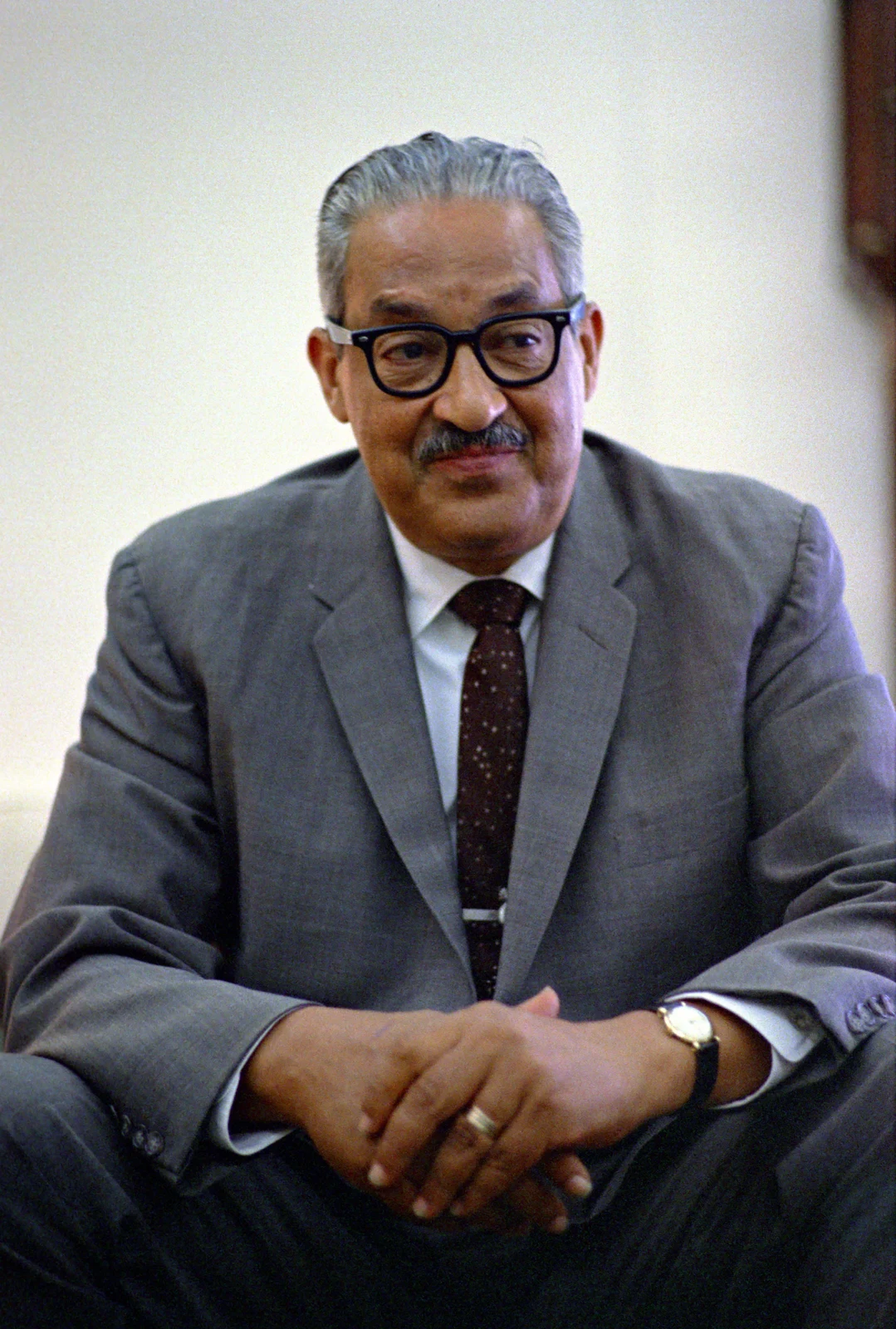
1908–1993
Thurgood Marshall
Civil rights lawyer, solicitor general and Supreme Court justiceA civil rights advocate who helped build a sustained legal campaign against segregation before serving as solicitor general and the first Black Supreme Court justice.Read biographyQuick answers
Common questions
- Was Brown v. Board of Education only about Kansas?
- No. The consolidated Brown opinion addressed cases from Kansas, South Carolina, Virginia and Delaware. The District of Columbia companion, Bolling v. Sharpe, received its own opinion.
- What is the difference between Brown I and Brown II?
- The 1954 ruling established the constitutional principle against state-imposed public-school segregation. Brown II, announced on 31 May 1955, addressed relief, local planning and judicial supervision.
- Did Thurgood Marshall work on the cases alone?
- No. He was a leading lawyer in an extensive effort involving other attorneys, local families, students and community organizations. The printed court records identify many participants.
- Did the 1954 decision set one immediate national deadline?
- No. Implementation was considered separately. Brown II required good-faith compliance and a prompt start while allowing courts to examine justified requests for additional time.
Primary and institutional sources
How this history was checked
Original opinions and archival guides distinguish constitutional holdings, counsel and implementation. Broad five-case summaries are not substituted for the separate Brown and Bolling opinions; no present-day legal advice is offered. This article was reviewed on 21 October 2026.
- U.S. Supreme Court; transcript held by the National ArchivesBrown v. Board of Education, 347 U.S. 483 (1954)
- National ArchivesFederal Records Pertaining to Brown: preface and introduction
- National Park ServiceBrown v. Board: Five Communities That Changed America
- U.S. Supreme Court; Library of Congress U.S. ReportsBolling v. Sharpe, 347 U.S. 497 (1954)
- U.S. Supreme Court; Library of Congress U.S. ReportsBrown v. Board of Education, 349 U.S. 294 (1955)