
The short answer
ASEAN put electronic Form D into live exchange among five members in January 2018. By December 2019, all ten members at the time had joined live exchange of that document. Form D is evidence of origin under the ASEAN Trade in Goods Agreement. The regional window carries the document between national systems so the importing side can assess the claim.
From origin proof to import assessment
What moves between the windows?
The document concerns a claim about where goods qualify as originating under ATIGA.
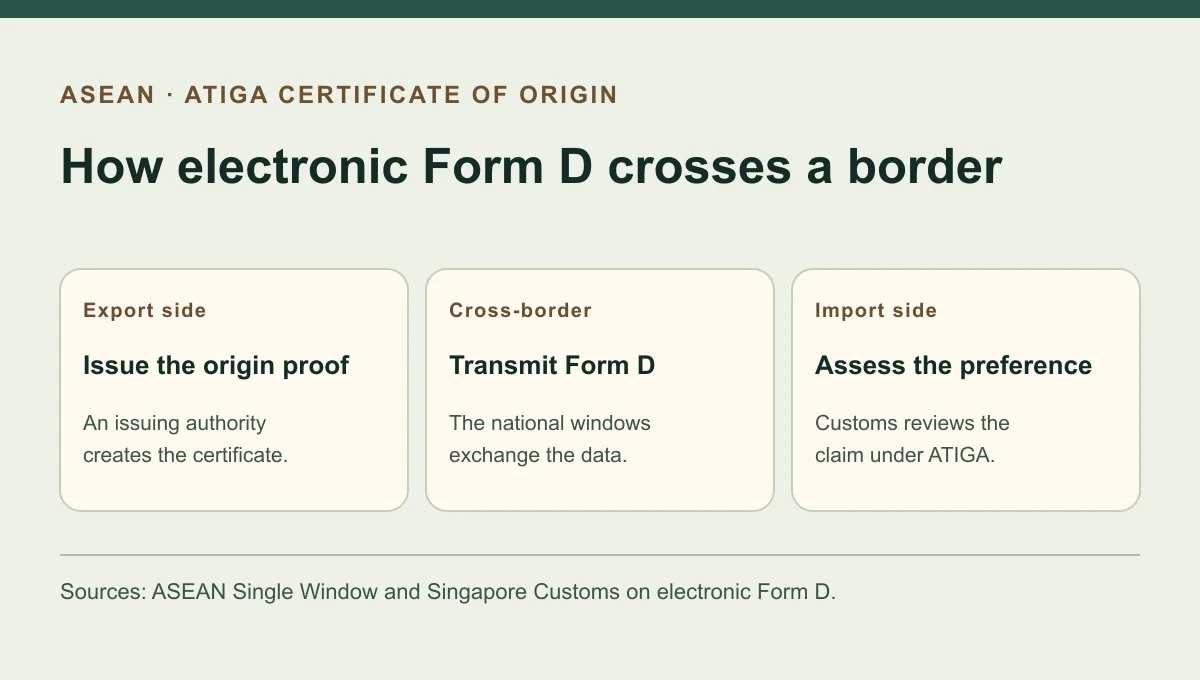
| Stage | What happens | What the stage addresses |
|---|---|---|
| Issuing side | An issuing authority creates the electronic certificate | Records origin evidence for the eligible goods. |
| Regional exchange | Participating national single windows transfer the certificate data | Makes the exporter-side document available to the importing side. |
| Importing side | Customs can assess the tariff claim with the evidence | Applies the relevant origin and preferential tariff rules. |
Chronology
A timeline of the turning points
The ASEAN Single Window agreement is signed
Member states set out a framework for national and regional exchange.
Electronic Form D enters live exchange among five members
Indonesia, Malaysia, Singapore, Thailand and Viet Nam are the initial participants.
Live exchange extends to all ten members at the time
A wider set of members can exchange electronic origin documents.
Why Form D was selected as an early exchange
The Single Window connects participating national systems. It gives them a way to exchange specified electronic trade records across borders. Electronic Form D was the first document exchanged live through it. Origin proof is a useful example because the document is prepared on one side and needed by an authority on the other.
A trader seeking a tariff preference still has to meet the applicable conditions. Transporting the proof changes how it reaches customs and leaves the claim to be evaluated there.
What the two rollout dates count
The ASEAN record dates the first live exchanges to January 2018 among five members. It dates all ten then-members’ participation to December 2019. An account that uses 2018 is dating the initial operational exchange, while 2019 describes its regional coverage at the time.
Why a national window and the regional system are both needed
A trader or an issuing authority uses national procedures. Those systems exchange records through the regional connection. This is why Singapore Customs can describe Form D transmission through an ASEAN window while its own application processes still exist. Other documents, including export-declaration data, entered regional exchange on their own schedules.
Continue the chronology
Related history guides
How Singapore’s TradeNet Changed Customs Permits
Compare Singapore’s one-entry-point permit system at the national level.
Read the timeline2020How ASEAN Let Certified Exporters Declare Origin
See how a certified exporter can use an origin declaration as an alternative proof.
Read the timeline2020–2022How ASEAN Began Sharing Export Declarations Before Arrival
Read about a later document exchanged for customs risk management.
Read the timeline1992–1993How ASEAN Started Its Free Trade Area in 1992
Read the earlier origin and tariff context of the ASEAN Free Trade Area.
Read the timelineConnected biographies
People connected to this history
Quick answers
Common questions
- When did all ten ASEAN members at the time begin exchanging electronic Form D?
- The ASEAN Single Window records December 2019 for participation by all ten.
- Does electronic transmission itself establish tariff eligibility?
- It makes origin evidence available. Authorities still assess the claim under the applicable trade rules.
Primary and institutional sources
How this history was checked
Dates, legal milestones and historical claims are checked against the official and institutional records below. This article was reviewed on 19 November 2026.
- ASEAN Single WindowOfficial chronology and explanation of the regional exchange
- ASEAN SecretariatAll 10 members exchange ATIGA e-Form D through the ASEAN Single Window
- Singapore CustomsElectronic exchange of Form D via the ASEAN Single Window
- ASEANAgreement to Establish and Implement the ASEAN Single Window