
The short answer
Singapore launched TradeNet in 1989 as a national electronic window for trade documentation. A trader could submit permit information through one system instead of moving the same details through separate paper channels. The responsible authorities could assess the application and return the result through the electronic process.
How a permit moves
One entry point and distinct decisions
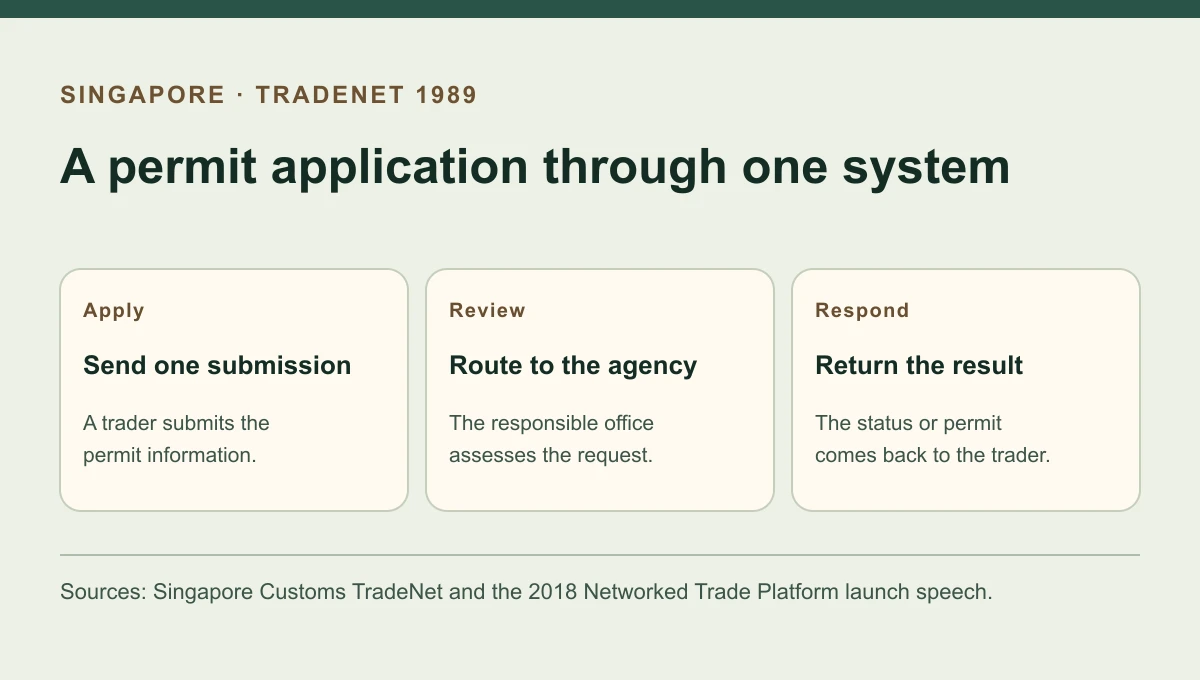
An illustrative permit flow shows what traders and authorities each contribute.
| Step | Actor and information | Purpose |
|---|---|---|
| Submission | A trader or declaring agent enters shipment and permit information | Uses a common channel for interacting with the relevant authorities. |
| Processing | The application can be routed to the relevant authority | Leaves the appropriate agency responsible for its part. |
| Response | The system returns a permit or a response to the submission | Gives the trader an electronic record of the outcome. |
Chronology
A timeline of the turning points
Traders use earlier paper processes
Separate documents and submissions can carry overlapping data.
Singapore launches the national window
TradeNet brings permit submissions into an electronic system.
Singapore develops further trade platforms
TradeXchange and the Networked Trade Platform address other exchanges and services.
What a national trade window changes
Before an electronic single window, a shipment could require several paper forms carrying the same data. TradeNet brought permit applications into one channel. That made it possible to carry common information in one electronic submission and route it to the bodies responsible for the application.
The change concerns how an application moves among traders and government. A common interface can reduce repeated handling while the relevant authorities retain their roles.
What the permit covers in a shipment
Singapore Customs describes TradeNet as the channel for permit applications for imports, exports and transhipment. For example, a trader applying for an import permit may have to provide details about the goods and the destination. The electronic channel can return the agency’s response. Other records, such as a carrier’s bill of lading, serve a different purpose.
The distinction matters because a later business data platform can assist with trade documentation while the national permit function remains identifiable.
Why the 1989 launch is a separate milestone
Singapore Customs records the TradeNet launch in 1989. The 2018 launch speech for the Networked Trade Platform places TradeNet before TradeXchange and the newer services. Read as a sequence, the milestones distinguish the electronic government permit workflow from subsequent exchanges across the wider supply chain.
Continue the chronology
Related history guides
Why Singapore Launched the Networked Trade Platform
Follow the later platform for sharing trade records and reaching service providers.
Read the timeline2005–2019How ASEAN Put Electronic Form D into Live Exchange
Read how ASEAN connected national windows to exchange evidence of origin.
Read the timeline1990s–2000How Pasir Panjang Expanded Singapore’s Container Port
See how terminal operations changed alongside trade documentation.
Read the timelineConnected biographies
People connected to this history
Quick answers
Common questions
- When did Singapore launch TradeNet?
- Singapore Customs dates the launch to 1989.
- Does a single window mean the same agency decides every question?
- The window provides a common submission channel. The relevant authority can still assess the part for which it is responsible.
Primary and institutional sources
How this history was checked
Dates, legal milestones and historical claims are checked against the official and institutional records below. This article was reviewed on 19 November 2026.