
The short answer
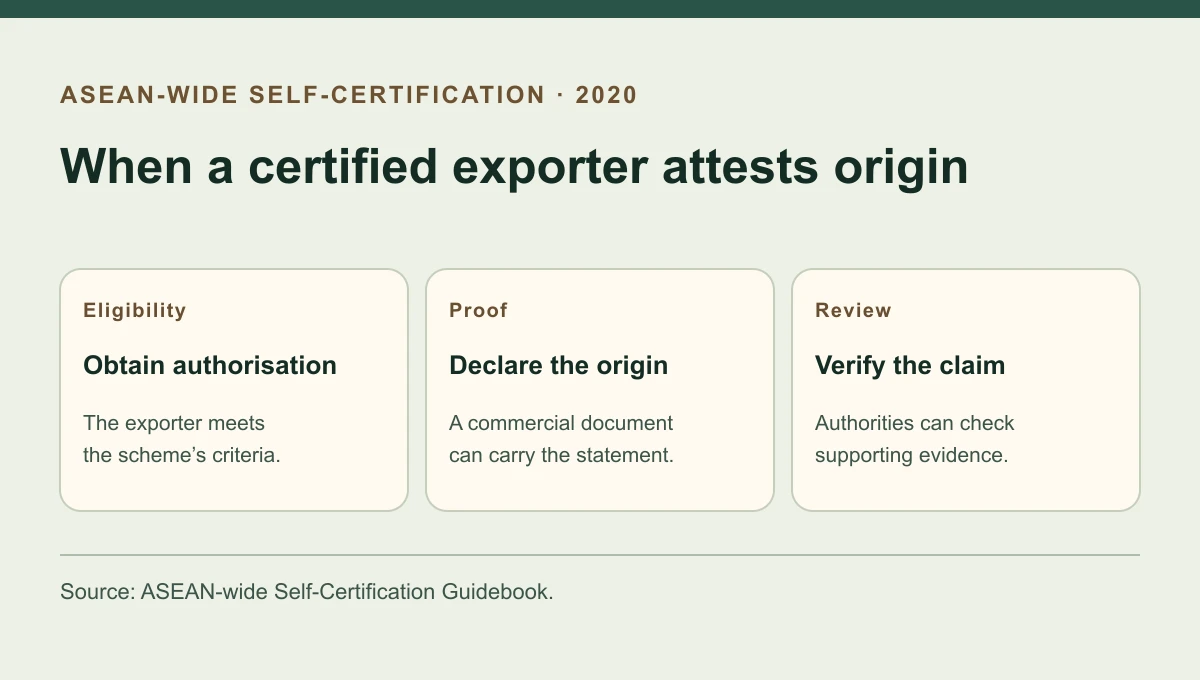
ASEAN-wide self-certification entered into force on 20 September 2020. It gave approved Certified Exporters a route to make an origin declaration for eligible goods on a commercial document. The scheme changes who prepares the proof of origin. The underlying origin requirements and the ability of customs to verify a claim remain important.
Who prepares the evidence
Two routes to a proof of origin
The scheme gives qualified exporters an alternative way to provide the proof.
| Route | Who prepares the proof | What remains to check |
|---|---|---|
| Form D | The competent issuing authority issues the certificate | Whether the goods and claim satisfy the origin requirements. |
| Origin declaration under AWSC | An authorised Certified Exporter makes the declaration | The exporter’s approval, the stated goods and their originating status. |
| Importing customs review | The importing authority examines the claim | The origin proof can be checked under the applicable procedures. |
Chronology
A timeline of the turning points
ASEAN operates pilot projects
Earlier efforts test allowing exporters to certify origin.
ASEAN-wide Self-Certification enters into force
The region establishes a broader framework for certified exporters.
Authorities can verify the declaration
The origin claim remains subject to the applicable conditions.
Why authorisation comes before a declaration
Self-certification under the scheme is available to exporters granted the relevant authorisation. The ASEAN guidebook describes conditions for that status and records the information an authorised exporter needs to provide. A company obtaining permission to use the scheme is a different event from declaring the origin of a particular shipment.
This matters where a business trades both qualifying and non-qualifying products. Approval to use the scheme does not itself answer the origin question for every line of goods it sells.
How a declaration differs from Form D
Under the authorisation, an exporter can make an origin declaration on a qualifying commercial document, such as an invoice. Form D is an issued certificate. Both can concern a tariff preference under ATIGA. The difference in how the proof is generated affects what the importer and assessing authority need to check.
Why records and verification still matter
The declaring exporter needs to support the claim that the covered goods meet the applicable origin rules. The guide explains verification arrangements. A commercial document can carry the declaration while underlying production or sourcing evidence explains why the goods qualify. Read together, the evidence and the declaration answer separate questions.
Continue the chronology
Related history guides
How ASEAN Put Electronic Form D into Live Exchange
Compare how a Form D certificate is exchanged electronically between national windows.
Read the timeline1992–1993How ASEAN Started Its Free Trade Area in 1992
Read why rules of origin have been part of ASEAN tariff preferences.
Read the timelineConnected biographies
People connected to this history
Quick answers
Common questions
- When did the ASEAN-wide scheme enter into force?
- The ASEAN guidebook gives 20 September 2020.
- Who can make an origin declaration under the scheme?
- The scheme provides for a duly authorised Certified Exporter to make the declaration under its conditions.
Primary and institutional sources
How this history was checked
Dates, legal milestones and historical claims are checked against the official and institutional records below. This article was reviewed on 19 November 2026.