
The short answer
What changed when Dublin acquired a standing voice on Northern Ireland? Follow the treaty’s machinery and the arguments in both parliaments, while keeping consultation, governmental decisions and police operations distinct.
Original evidence comparison
A voice, a decision and an operation
The agreement connects these activities without making their powers identical.
| Country | Holder or forum | Power described in the text | Limit |
|---|---|---|---|
| Irish views and proposals | Irish government through the Conference. | Put forward views on relevant matters within its remit. | No general transfer of Northern Ireland administration. |
| Government decisions | Each government in its own jurisdiction. | Decisions and administration remain its responsibility. | Conference participation does not create joint sovereignty. |
| Security cooperation | Conference and the two police chiefs in their specified roles. | Discuss policy; arrange information and threat-assessment cooperation. | Conference has no operational responsibility. |
| Constitutional change | Northern Ireland majority; both governments support resulting legislation. | Majority wishes supply the consent condition. | No automatic unity date or unilateral bypass. |
Chronology
A timeline of the turning points
Agreement signed
Garret FitzGerald and Margaret Thatcher sign at Hillsborough.
Westminster statement
Thatcher explains the agreement and faces unionist objections.
Dáil debate
FitzGerald seeks approval and defends the consent principle and Irish role.
Entry into force
Article 13 requires exchanged notifications of acceptance; signature alone is not that condition.
Review provision
Article 11 requires a review after three years, or earlier at either government’s request.
The agreement joined a consent rule to a diplomatic channel
Signed by the Irish and British governments on 15 November 1985, the Anglo-Irish Agreement addressed a central political difficulty: how the Irish government could influence Northern Ireland affairs while the United Kingdom remained responsible for governing there. Garret FitzGerald and Margaret Thatcher negotiated a continuing intergovernmental structure. Its significance lies in the relationship it created, rather than in an immediate solution to every constitutional or security dispute.
Article 1 combined recognition of the existing majority’s wish to remain in the United Kingdom with a rule that constitutional change depended on the wishes of a majority in Northern Ireland. It also committed both governments to support legislation for a united Ireland if such a majority clearly wished it. The article therefore recognised both a present position and a possible future change. It did not prescribe a date for unity or give either government a power to bypass the consent condition.
Sources for this section: [1]
A conference gave Irish proposals a regular institutional home
Article 2 established an Intergovernmental Conference within the existing Anglo-Irish Intergovernmental Council framework. Its remit included political, security, legal and cross-border matters. The Irish government could put forward views and proposals on relevant Northern Ireland matters within the Conference’s activity that were not the responsibility of a devolved administration. Both sides were to make determined efforts to resolve differences. Article 3 provided for frequent meetings at ministerial and official levels and a continuing secretariat.
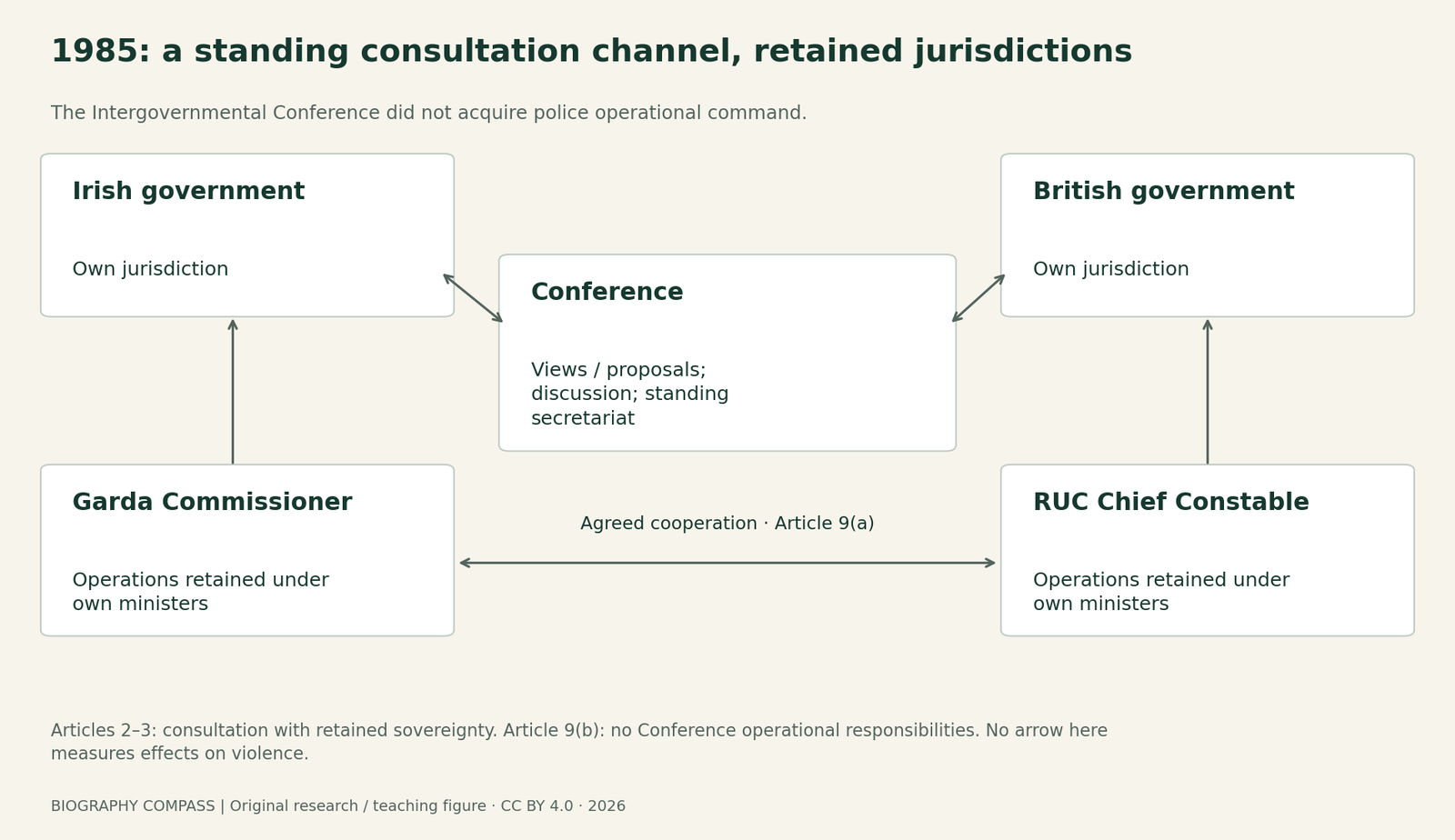
This was more substantial than an occasional exchange of letters: officials and ministers acquired a standing channel through which concerns could be raised, considered and followed up. It was nevertheless a consultative mechanism. Article 2 explicitly preserved each government’s sovereignty and responsibility for decisions and administration in its own jurisdiction. A diagram of the machinery should show a route for proposals and discussions, rather than an arrow transferring the government of Northern Ireland to Dublin.
Sources for this section: [1]
The remit was broad, but it did not confer operational command
Articles 5 and 7 allowed discussion of subjects including rights, identities, discrimination, policing relationships and prisons. Article 8 envisaged consideration of criminal-justice issues, including possible mixed courts; mentioning that possibility did not itself create such courts. Article 9 provided for cooperation between the two police forces through arrangements made by their chiefs, such as information exchange and threat assessment. Its second paragraph then excluded operational responsibilities from the Conference. Operations remained the responsibility of the police chiefs, with their respective ministerial accountability. A conference discussion of policy or public confidence must therefore be distinguished from an instruction to conduct an arrest, patrol or investigation.
Sources for this section: [1]
Devolution and other institutions remained conditional
The governments supported devolution with widespread acceptance in both Northern Ireland traditions, requiring cooperation among constitutional representatives. The scope for Irish views under Article 2 was tied to matters not devolved. That provision anticipated a possible transfer of responsibilities within Northern Ireland; the signing ceremony did not itself create the envisaged devolved administration. Article 12 similarly left any parliamentary body to decisions by the two parliaments. Article 10 supported economic and social cooperation and international assistance, but contained no measured guarantee of growth or reconciliation. The text supplied procedures and commitments whose later operation requires separate evidence.
Sources for this section: [1]
Both parliaments reveal why the same machinery divided opinion
In the Dáil on 19 November, FitzGerald linked the aspiration to Irish unity with acceptance of the Northern Ireland majority’s decision. He defended an Irish voice as a way to address nationalist alienation. Opposition within the chamber challenged the agreement and its constitutional implications. This was a debate about the value and meaning of a diplomatic arrangement, rather than a record of unanimous nationalist approval.
At Westminster the previous day, unionist MPs pressed a different objection: formal Irish participation itself was threatening. James Molyneaux sought suspension while judicial review was considered, and Ian Paisley attacked the agreement as betrayal. Thatcher replied that there was no transfer of sovereignty and that each government retained its own decisions. Those exchanges are primary evidence of opposition and governmental explanation. A unionist claim of betrayal is a participant’s judgment; it does not override the agreement’s express allocation of jurisdiction. The legal distinction also does not erase the political significance opponents attached to consultation.
Signature, entry into force and review need separate labels
Article 13 made entry into force depend on exchange of notifications of acceptance. This guide dates the signature and parliamentary debates precisely, while leaving the notification date unasserted because its primary treaty-series record was not accessible in this research pass. Article 11 required review after three years, or earlier if either government requested it. That is a rule for review, not proof that a particular meeting happened on the third anniversary. The distinction matters when evaluating implementation: the signed text establishes obligations and procedures, while meeting records, decisions and evidence of effects would be needed to assess delivery.
Sources for this section: [1]
Exercise: classify three proposed arrows
Imagine an institutional diagram with Dublin, the Conference, the British government and the police chiefs. Decide which arrows the text supports: Irish ministers submitting proposals on policing confidence to the Conference; the Conference directing a particular police raid; and police chiefs arranging information exchange while retaining responsibility for operations. For each choice, name the article that supplies the limit or authority. Then explain whether the diagram alone demonstrates that the mechanism reduced violence.
Reference answer: the first arrow is supported by Articles 2 and 7, subject to the agreement’s remit and jurisdictional limits. The second is excluded by Article 9(b). The third is supported by Article 9’s cooperation arrangements and retained operational responsibility. None of these institutional arrows measures violence or proves an effect on it. Evaluating outcomes requires dated implementation and security evidence beyond the agreement. The later Good Friday Agreement created different structures and should be studied as a subsequent settlement, rather than silently read back into the 1985 text.
Continue the chronology
Related history guides
The Good Friday Agreement
Continue to the later settlement and its different institutional structures.
Read the timeline1921–1922Reading the Anglo-Irish Treaty Debate
Compare the signed terms, alternative proposal, approval vote and implementation steps.
Read the timeline1937How Ireland Approved Its Constitution
Follow drafting, parliamentary approval, the ballot count and commencement.
Read the timelineBiography context
Explore Ireland through connected lives
Connected biographies
People in the records
1926–2011
Garret FitzGerald
Economist, foreign minister and TaoiseachGarret FitzGerald brought airline planning, economics and journalism into politics. As foreign minister and twice Taoiseach, he worked on European cooperation, domestic reform and a formal Irish role in discussions about Northern Ireland.Read biographyQuick answers
Common questions
- Did the agreement create joint sovereignty?
- No. Article 2 preserved each government’s decisions and administration in its own jurisdiction, while giving the Irish government a standing consultative role.
- Could the Conference order police operations?
- No. Article 9(b) excluded operational responsibilities and left operations with police chiefs under their respective ministerial accountability.
- Was the 1985 agreement the Good Friday Agreement?
- No. It created intergovernmental consultation in 1985. The 1998 settlement had different institutions, commitments and approval processes.
Primary and institutional sources
How this history was checked
Original texts and dated parliamentary arguments are distinguished from later historical interpretation. The comparison and exercises are original reading aids. Source-access limits accompany the research packet. This article was reviewed on 27 October 2026.
- Governments of Ireland and the United Kingdom; CAIN, Ulster UniversityAnglo-Irish Agreement, signed at Hillsborough, 15 November 1985: complete text
- Houses of the OireachtasAnglo-Irish Agreement 1985: motion and debate, 19 November 1985
- United Kingdom Parliament, HansardAnglo-Irish Agreement: statement and questions, 18 November 1985
- CAIN, Ulster UniversityGarret FitzGerald: biography — Brendan Lynn