
The short answer
Borrowing a tool and surrendering judgment are different actions. The selected article makes that distinction useful for designing a study: what is being borrowed, what assumptions travel with it and what would justify adapting it?
Record comparison
Read the evidence by function
Separate the object established by a record from an inference requiring other evidence.
| Record | What it establishes | What it does not establish |
|---|---|---|
| Borrowed procedure | A possible starting point. | Prestige does not establish fit. |
| Documented adaptation | A reasoned change can be checked. | It does not guarantee a correct conclusion. |
Chronology
A timeline of the turning points
The selected article
Read its distinction rather than attributing an unread book’s full argument.
Identify the actual article
The native 1974 article is titled The captive mind and creative development. Its opening revisits an earlier 1972 contribution; the two texts should not be merged into a single publication.
The later book The Myth of the Lazy Native concerns colonial stereotypes, according to the inspected publisher description.
That description supplies context only. This study’s close reading uses the selected article pages rather than claiming access to the book’s complete argument.
The argument permits constructive imitation
Alatas argues that borrowing can save effort and be useful when it is consciously assessed and adapted. His criticism targets uncritical dependence, including failure to question a framework’s fundamental assumptions.
A NUS memorial places the argument within his wider concern with knowledge, colonialism and social responsibility.
The distinction directs attention to the work a method does. An imported technique is not disqualified by its origin, and a locally produced technique does not escape scrutiny merely because it is local.
Exercise: inspect two invented study designs
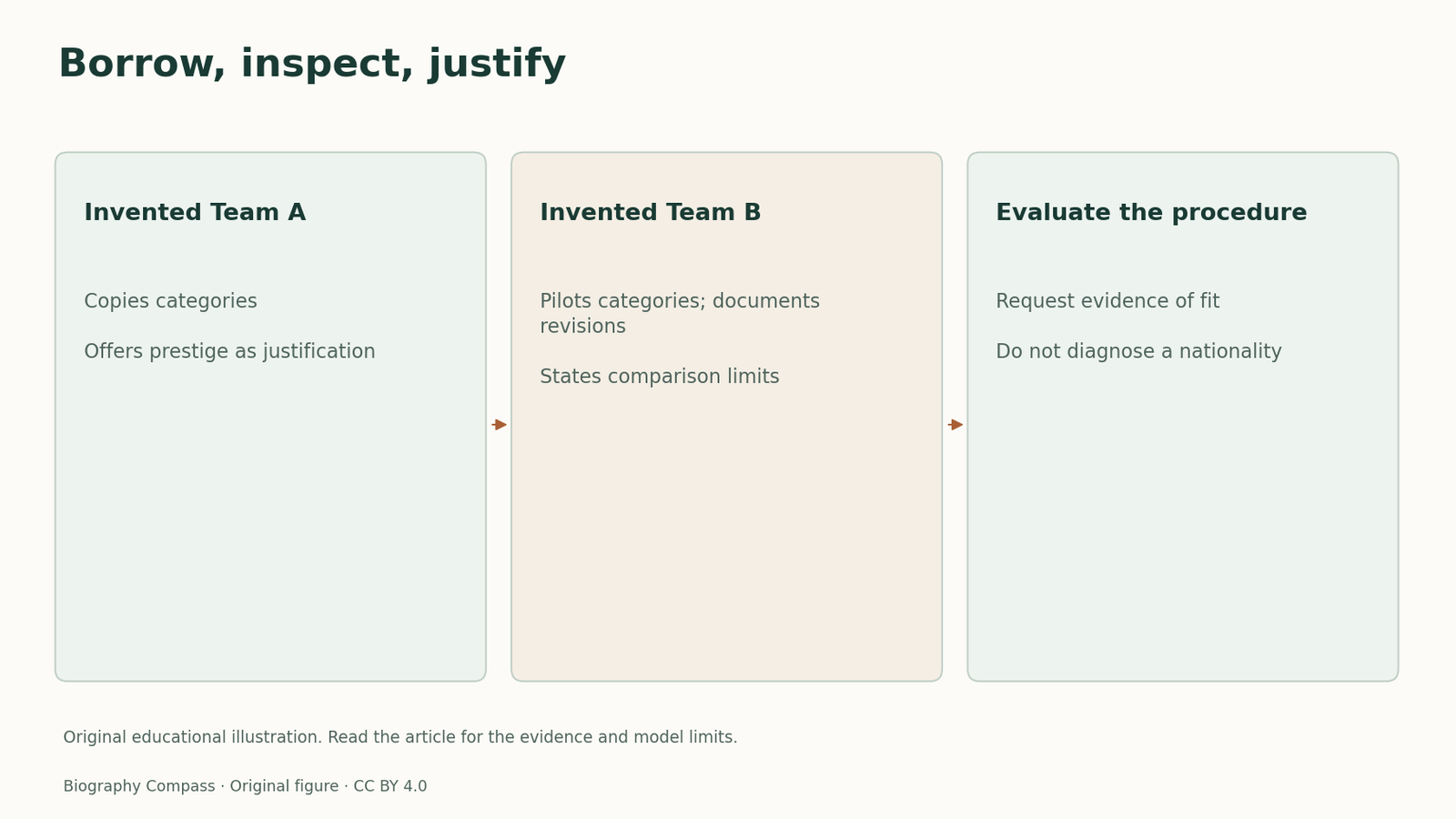
Team A copies a questionnaire because it was used by a prestigious institution. It does not test whether respondents understand the categories. Team B starts from the same questionnaire, conducts interviews, revises categories that misdescribe local work and documents which comparisons remain valid. Which design better supports independent inquiry, and what evidence would you request?
Reference answer: B documents a reasoned adaptation. A’s appeal to prestige supplies no evidence that its categories fit. Ask both teams for the research question, definitions, pilot results, changes and remaining limitations. B’s procedure is more defensible under the stated facts, but its conclusions could still be wrong; adaptation is not a guarantee of validity.
This is an original design comparison, not an empirical diagnosis of particular researchers. Do not score a person’s nationality, language or place of training as a measure of intellectual independence.
Sources for this section: [1]
An invitation to test, not a label to attach
A productive use of the argument makes criticism inspectable: identify the assumption, show the mismatch and explain the proposed revision. Simply calling a colleague dependent would avoid that work. The exercise therefore evaluates an observable procedure and leaves open whether the eventual findings withstand evidence.
Sources for this section: [1]
Continue the chronology
Related history guides
Biography context
Explore Malaysia and Singapore through connected lives
Connected biographies
People connected with this study
Quick answers
Common questions
- Is the exercise a test of a researcher’s identity?
- No. It evaluates the stated design and its evidence, not nationality or intellectual worth.
Primary and institutional sources
How this history was checked
Read the named selected records together; the notes distinguish direct texts, later accounts and limits of access. This article was reviewed on 31 October 2026.