
The short answer
A familiar label can conceal a different population. This study compares definitions before asking readers to classify anyone. Its purpose is to make a research category reproducible, not to infer a passport or political allegiance from a name.
Record comparison
Read the evidence by function
Separate the object established by a record from an inference requiring other evidence.
| Record | What it establishes | What it does not establish |
|---|---|---|
| First inspected passage | A narrower citizenship-based category. | Not a universal dictionary rule. |
| Second inspected passage | An umbrella containing two groups. | Not evidence about any particular person. |
Chronology
A timeline of the turning points
First definition
Read the author’s operational category.
Second definition
Compare who enters the broader category.
Two authors, two stated usages
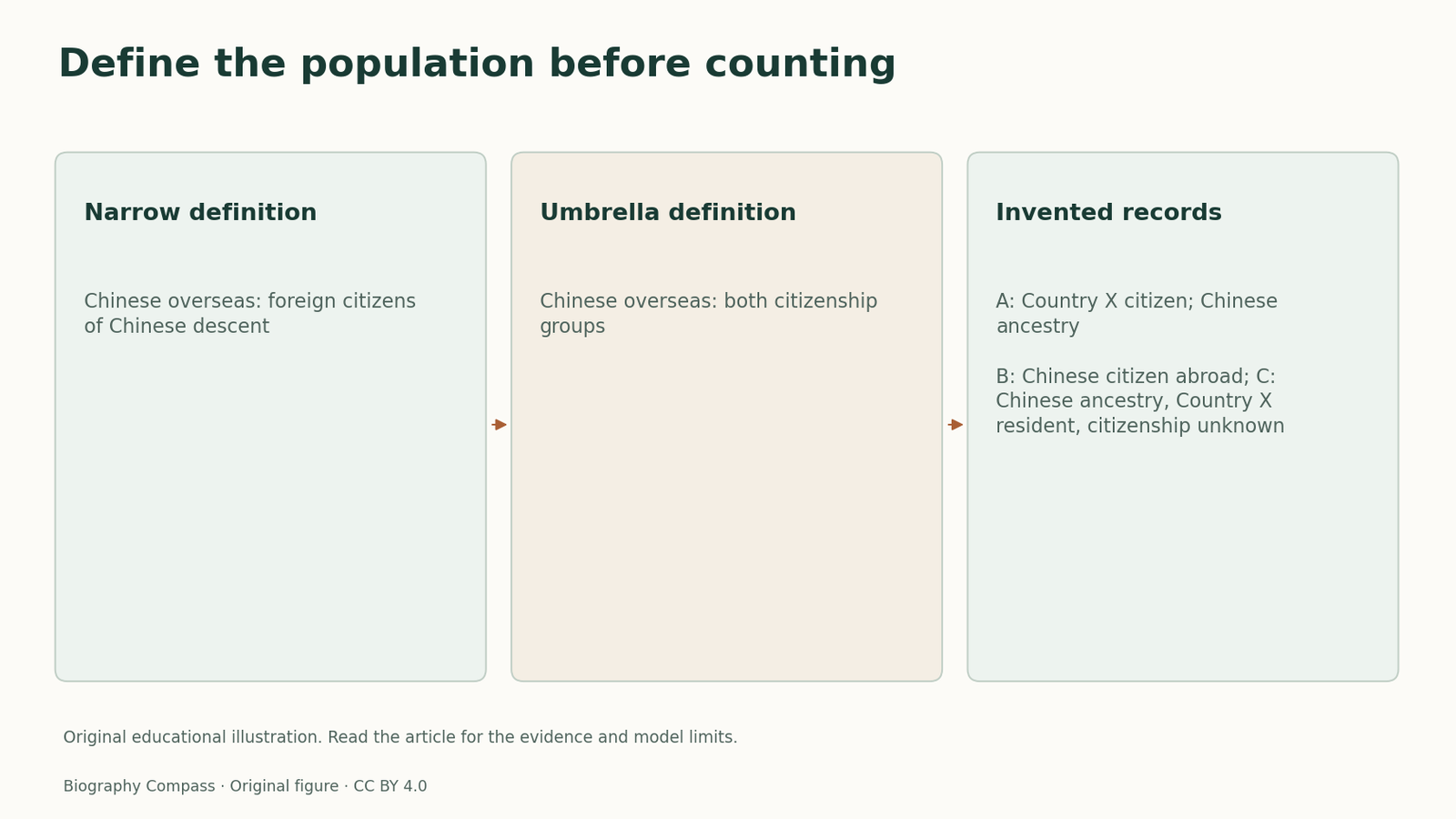
Wu Xiao An’s 2019 introduction attributes a distinction to Wang Gungwu: overseas Chinese are Chinese citizens abroad, while Chinese overseas are foreign citizens of Chinese descent.
Leo Suryadinata’s 2024 paper also invokes Wang, but uses Chinese overseas as an umbrella covering Chinese nationals abroad and foreign citizens of Chinese descent.
The disagreement is visible at the level of definitions. It cannot be repaired by assuming the identical English words always select an identical set of people.
Keep the operational definition attached to the data
Before combining two counts, record who could enter each count. An apparent increase may reflect a broader definition rather than a new migration. A careful comparison would need the source’s population, reference date, geographical coverage and treatment of missing citizenship. Where those details are absent, mark the comparison unresolved.
Neither a shared surname nor a reported cultural connection supplies the missing legal fact. A researcher may record self-described ancestry and citizenship as separate variables, with an explicit unknown category. That design preserves uncertainty instead of converting it into a confident classification.
Exercise: classify three invented records
A is a citizen of Country X, lives there and reports Chinese ancestry. B is a Chinese citizen living in Country X. C reports Chinese ancestry and residence in Country X, but citizenship is unrecorded. Apply each paper’s stated meaning of Chinese overseas. Do not add assumptions about dual nationality or a state’s citizenship rules.
Reference answer: under Wu’s narrower usage, A qualifies and B does not; C cannot be settled. Under Leo’s umbrella usage, A and B qualify, and C can be included on the recorded ancestry and residence while citizenship remains unknown. Inclusion in that broader population does not establish C’s passport.
The exercise demonstrates a conditional classification, not the actual status of any individual. If a project deliberately adopts a broader ancestry-only category, it must say so rather than silently presenting it as the same variable.
What remains to be researched
These are two scholars’ formulations, each referring to Wang. Establishing exactly how Wang used the terms across different publications would require the relevant texts and their contexts. The present comparison does not claim to have resolved that wider intellectual history. Its defensible result is narrower: these two inspected passages require different coding instructions.
Continue the chronology
Related history guides
Biography context
Explore Southeast Asia through connected lives
Connected biographies
People connected with this study

Quick answers
Common questions
- Can the label settle an unknown passport?
- No. Preserve an unknown citizenship field and identify the definition actually used.
Primary and institutional sources
How this history was checked
Read the named selected records together; the notes distinguish direct texts, later accounts and limits of access. This article was reviewed on 31 October 2026.