
The short answer
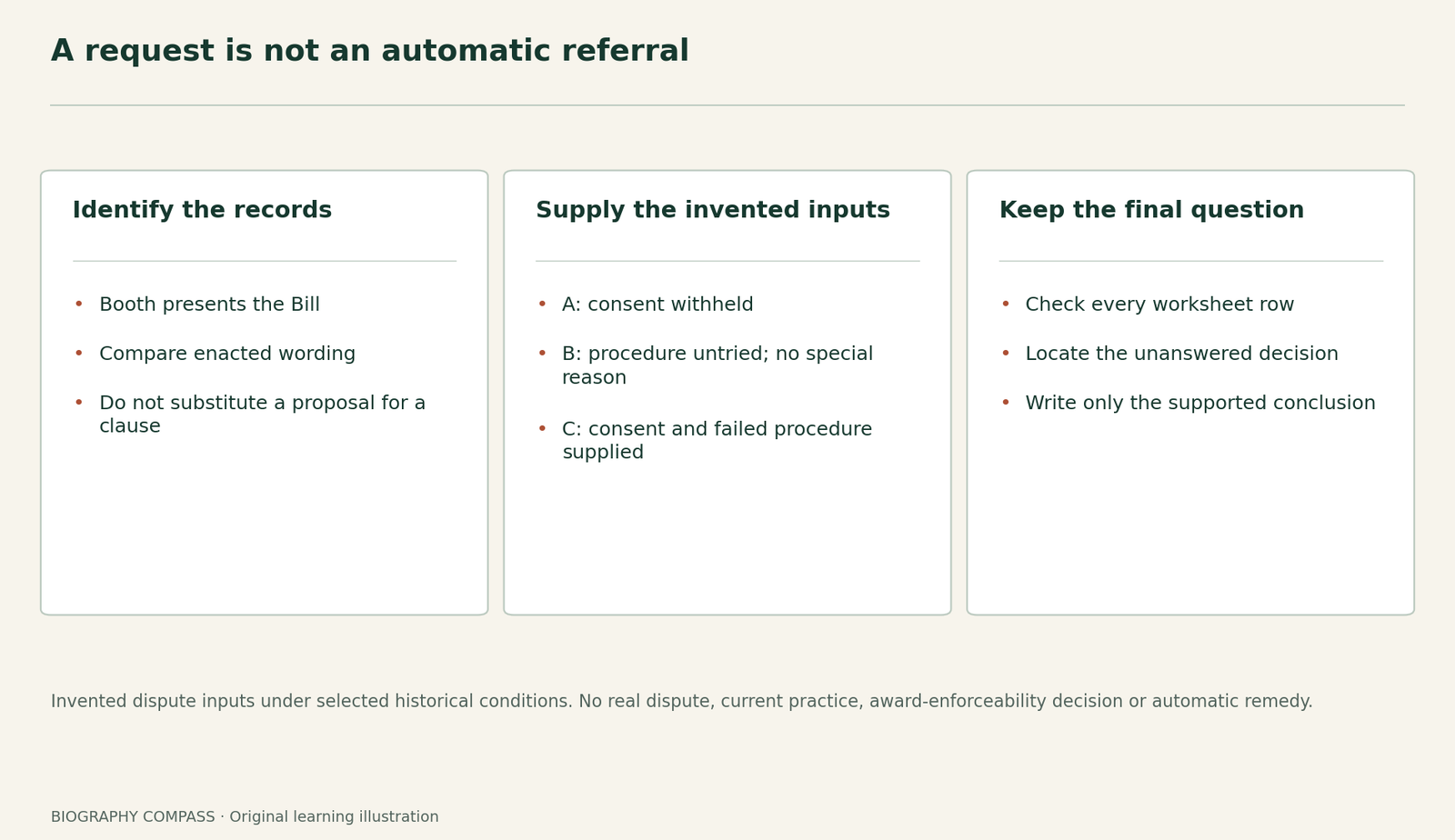
A request can start a process without giving one party control over the outcome. Read the proposed institution beside the enacted conditions, then distinguish assistance, referral and an automatic entitlement.
Compare the records
Do not use one test as a substitute for another
Keep the kind of claim and the evidence for it separate.
| Record or test | What it supports | What it does not settle |
|---|---|---|
| Proposal | The government’s intended design | The final words of an Act |
| Assistance | Settlement help may be offered | An arbitration referral |
| Referral conditions | Conditional referral | An automatic entitlement after the tests |
Chronology
A timeline of the turning points
Bill opening
Separate the proposal and its presenting speaker.
Printed assent date
Enactment is distinct from commencement and outcomes.
The proposal had more than one participant
Albert Booth moved the Employment Protection Bill’s second reading in April 1975, explaining Foot’s absence. His opening described a programme concerned with collective bargaining, individual rights and a statutory basis for the independent service.
That record identifies who presented the proposal and what the government said it intended. It cannot replace the enacted text. Crediting a Secretary of State’s political work should not erase the minister who spoke, the parliamentary process or the earlier institutional setting from which a statutory scheme developed.
Sources for this section: [1]
The enacted conditions do different work
Section 2 permits settlement assistance on request or otherwise for existing or apprehended trade disputes. Section 3 requires request, all-party consent and consideration of the likelihood of settlement by conciliation. Appropriate agreed procedures must have been used and failed unless the Service sees a special reason for arbitration instead. Referral remains discretionary.
Put every required test on a separate worksheet row. A favourable answer in one row cannot supply a missing answer in another. Then add a final row for the decision that remains. That makes a gap visible before it disappears inside a confident conclusion.
Sources for this section: [2]
Exercise: three invented dispute notes
Assume a trade dispute, a request and consideration of conciliation’s likelihood in each invented note. A: consent is withheld despite a failed procedure. B: all consent, but an appropriate agreed procedure is untried and no special reason identified. C: all consent and the agreed procedure was used without settlement.
Answer: A fails consent; B fails procedure/special-reason requirements; C meets supplied conditions without compelling referral. The exercise treats those facts as invented inputs. It does not assess whether a real dispute falls within the statutory definition, predict what a tribunal would do or decide the legal effect of an award.
Sources for this section: [2]
Record a conditional result accurately
A useful decision note has a row for each condition and a separate row for the type of power left after the tests. This avoids two opposite errors: claiming an automatic entitlement after the conditions are met, or assuming that a discretionary power has no conditions at all. Write “the supplied conditions are satisfied” when that is the conclusion, then identify the remaining decision.
This comparison uses the original print and the selected Bill opening. It does not reconstruct commencement, subsequent amendments or current ACAS practice. Those questions require additional records. The purpose is to understand a historical institutional design, not to give advice on a present employment dispute.
Continue the chronology
Related history guides
Biography context
Explore United Kingdom through connected lives
Connected biographies
People connected with these records
1913–2010
Michael Foot
MP, cabinet minister and Labour leaderMichael Foot moved between journalism, authorship, parliamentary opposition and government before leading the Labour Party.Read biographyQuick answers
Common questions
- What does the printed assent date leave unresolved?
- It does not establish when the selected provisions began operating; that needs further dated evidence.
- Do the notes decide the legal force of an award?
- No. That is a different question and is not supplied by the exercise.
Primary and institutional sources
How this history was checked
Compare the identified historical text with the selected contemporary record. The reading scopes distinguish original wording, indexed access and later interpretation. This article was reviewed on 29 October 2026.