
The short answer
An argument about who should be admitted and a clause identifying who falls within a control scheme answer different questions. Read both before turning a broad citizenship label into a legal conclusion.
Compare the records
Argument, category and outcome
Keep the kind of claim and the evidence for it separate.
| Record or test | What it supports | What it does not settle |
|---|---|---|
| Debate | A stated reason for a political position | The final rule for a particular document |
| Section 1 | Defined passport categories | Every later admission question |
| Invented profile | A conclusion from supplied inputs | Facts omitted from a real case |
Chronology
A timeline of the turning points
Bill debate
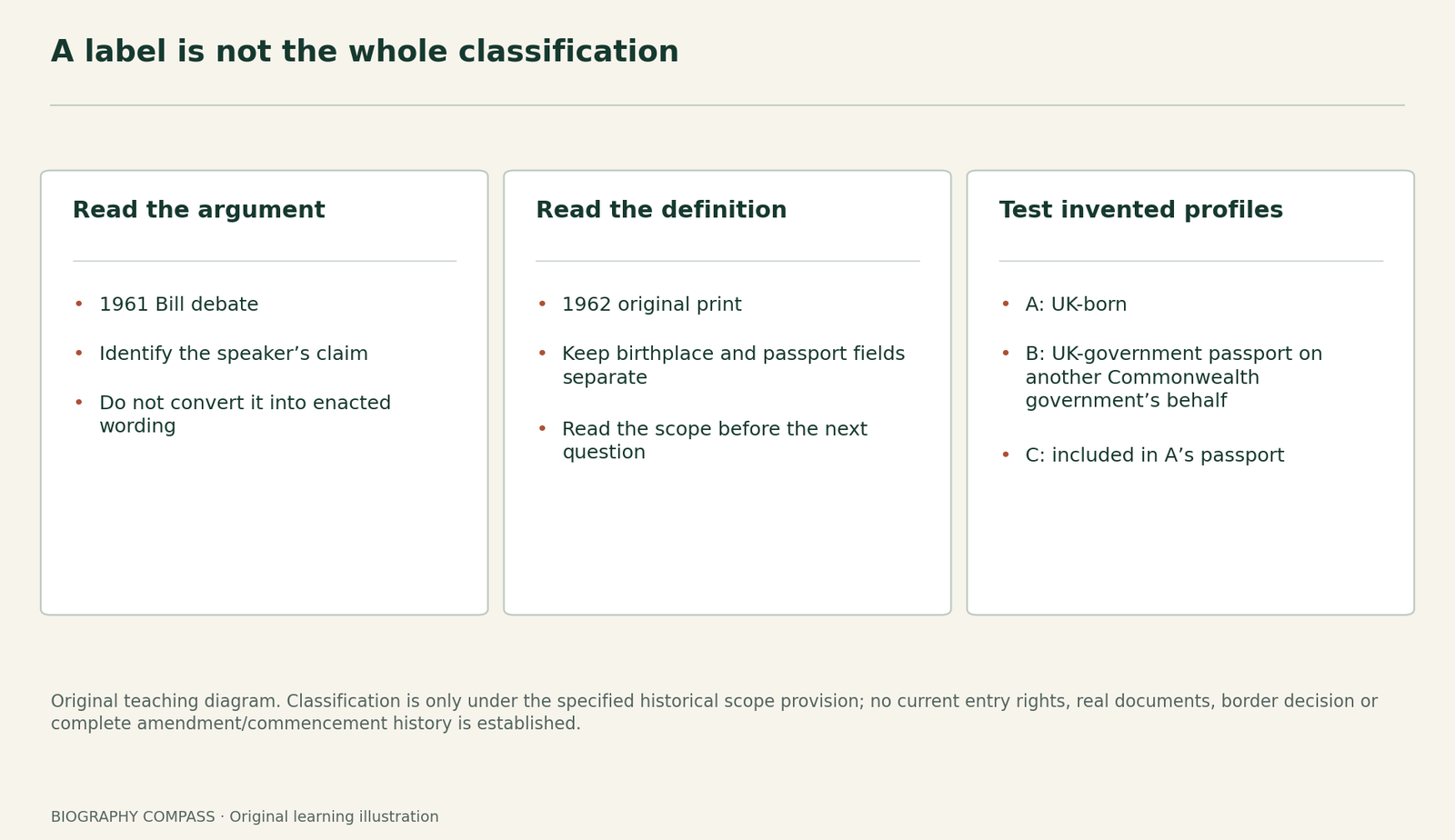
Identify the speaker’s argument.
Assent printed in the Act
Identify the text without assuming commencement.
An opposition argument is not a classification rule
In November 1961 Gaitskell challenged the case for the Commonwealth Immigrants Bill. He linked migration to employers’ demand for labour and distinguished the decision on that Bill from an abstract promise about every imaginable future circumstance.
The distinction keeps a political position from becoming an unlimited proposition its speaker did not make. A speech can explain why a policy is opposed without supplying the final categories used by the enacted measure. It also has a different evidential function from a statistical series: figures advanced in debate are arguments to test, not measurements independently verified by this article.
Sources for this section: [1]
Read the scope and the definition together
Part I covers Commonwealth citizens except those UK-born, those holding defined UK passports with citizenship of the UK and Colonies or issued in the UK or Republic of Ireland, and those included in a current passport of someone in either preceding category. The definition excludes UK-government passports issued on another Commonwealth government’s behalf.
The definition therefore matters as much as the familiar-looking label. A document’s place of issue and the authority on whose behalf it was issued are different fields. Record both. An archive caption that merely calls something a British passport may not contain enough information to perform the statutory classification.
Sources for this section: [2]
Exercise: three invented profiles
For this exercise all three people are Commonwealth citizens, and every passport mentioned is current. A was born in the UK. B was born outside the UK, is not included in another person’s passport, and holds a passport issued by the UK government on behalf of another Commonwealth government. C is included in A’s passport. No real traveller or historical case is being described.
Reference answer: A meets the UK-birth exception. B’s stated document does not meet the defined UK-passport category, and the supplied facts establish neither other exception. C meets the inclusion exception. The classifications concern the scope of Part I. They do not, by themselves, determine the outcome of an examination at a border or supply an answer under later legislation.
Sources for this section: [2]
Keep the next question separate
Section 2 separately addresses admission.
This matters when writing a conclusion. “Within the scope of this Part” and “must be refused admission” are not equivalent statements. A good worksheet has separate columns for the provision being applied, the supplied facts and the conclusion actually reached. Leave a further question open when its necessary facts or clauses have not been examined.
The comparison also has a date limit. It uses the original print and a preceding Bill debate; it does not reconstruct every amendment, commencement instrument or administrative decision. Those are separate records. The exercise is historical reading, not a method for deciding anyone’s present immigration status.
Continue the chronology
Related history guides
Biography context
Explore United Kingdom through connected lives
Connected biographies
People connected with these records
1906–1963
Hugh Gaitskell
Economist, chancellor and Labour leaderHugh Gaitskell moved from economics teaching and wartime administration into Parliament, the Treasury and leadership of the Labour Party.Read biographyQuick answers
Common questions
- Does applying a scope provision decide every later step?
- No. Identify the separate question before importing another provision or an unstated fact.
- Are A, B and C historical travellers?
- No. They are invented profiles designed to test the supplied conditions.
Primary and institutional sources
How this history was checked
Compare the identified historical text with the selected contemporary record. The reading scopes distinguish original wording, indexed access and later interpretation. This article was reviewed on 29 October 2026.