
The short answer
The payer’s identity does not tell you what a payment represents. Start with the agreement, the condition that earns the payment and the goods or service involved.
Compare meanings
Identify the transaction before calculating
The source comparison informs the categories; all numerical examples here are invented.
| Amount | Question to ask | Treatment in the stated model |
|---|---|---|
| Purchase-price rebate | Has the purchase condition been earned? | Allocate 100 between cost of goods sold and inventory. |
| Completed display service | Is this a separate performed service? | Show 40 in the stipulated other-income category. |
| Customer sale | What did customers purchase? | 60 items × 12 = 720. |
| Net profit | Have all other expenses been supplied? | Not determined by this worksheet. |
Chronology
A timeline of the turning points
Commercial narrative
Prospectus describes supplier relationships.
Reporting period
Year end of the selected policies.
Change sales volume
Keep purchase terms fixed; recalculate allocation.
Read the two records
The prospectus discusses procurement savings from supplier rebates.
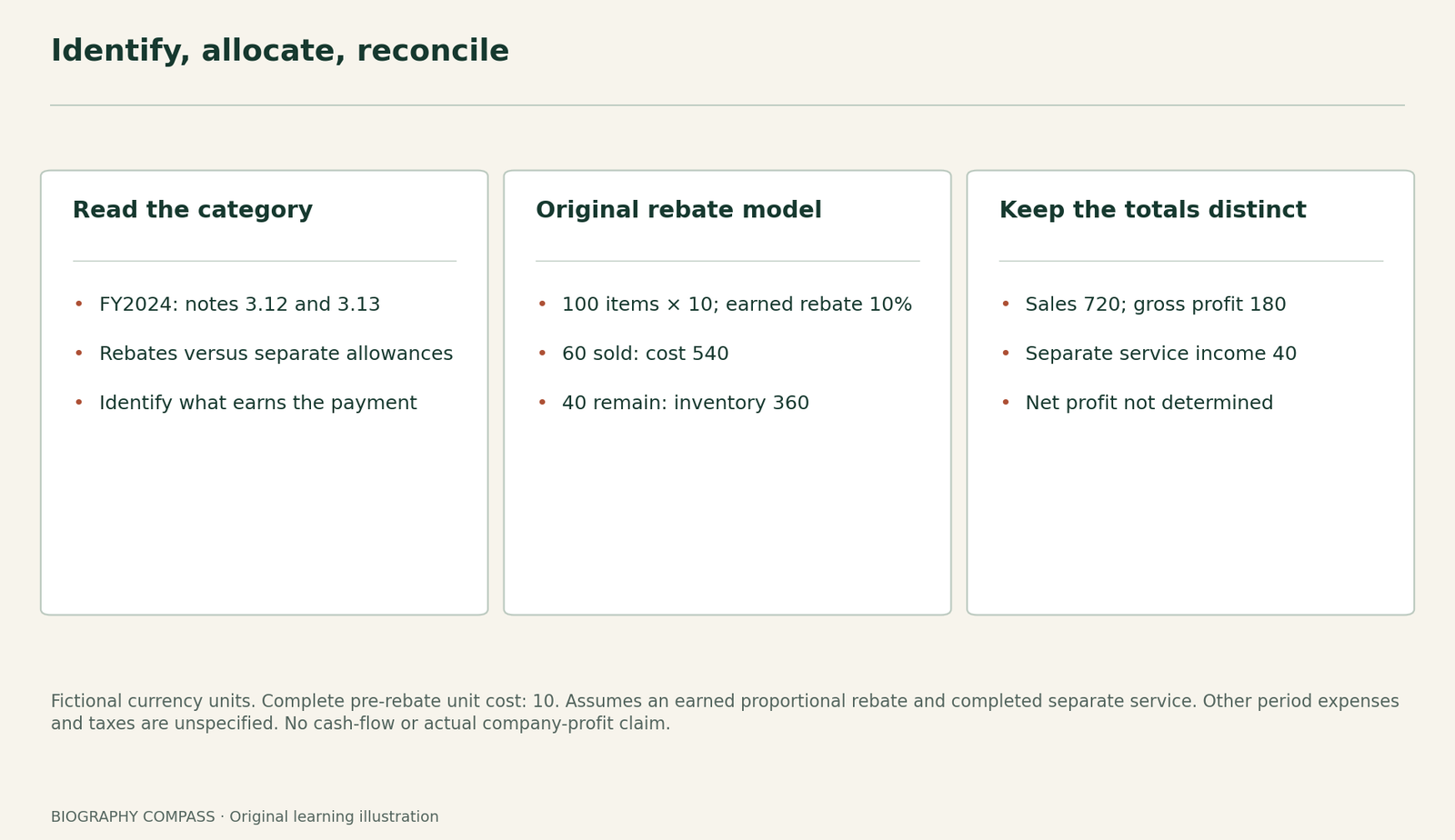
In the FY2024 report, note 3.12 deducts earned purchase rebates from sold goods’ cost or unsold inventories. Note 3.13 treats separately earned display, distribution-centre and marketing allowances as other operating income.
A business description explains the commercial relationship. An accounting policy explains recognition and classification. Reading them together helps distinguish a cheaper purchase from a separately performed service.
Exercise: stipulate the transactions
Use fictional currency units. A retailer buys 100 identical items at 10 each and fully earns a 10% purchase-price rebate attributable to those items. It sells 60 at 12 each; 40 remain. Separately, it earns 40 for a completed display service. In this model that service receipt is other operating income.
Calculate customer sales, net purchase cost, cost of goods sold, closing inventory and gross profit. Keep the service receipt separate. Treat 10 per item as the complete pre-rebate inventory cost, with no returns or other inventory adjustments. Assume equal unit costs, proportional allocation and fulfilled conditions. Other period expenses and taxes are unspecified; do not assume they are zero. These are fictional transactions.
Sources for this section: [1]
Reference answer: follow the goods
The purchase cost is 100 × 10 = 1,000. The rebate is 100, leaving 900, or 9 per item. Cost of goods sold is 60 × 9 = 540; closing inventory is 40 × 9 = 360. The two allocations add back to 900, a useful reconciliation check.
Customer sales are 60 × 12 = 720. Gross profit is 720 − 540 = 180. The separate service adds 40 in its stipulated income category; it does not turn customer sales into 760 or gross profit into 220. Net profit remains undetermined because other expenses have not been supplied.
Sources for this section: [1]
Change one assumption
Now suppose only 25 items are sold at the same price, with the same earned rebate. Recalculate without changing the purchase cost. The answer is sales of 300, cost of goods sold of 225, inventory of 675 and gross profit of 75. The independent completed-service receipt remains 40.
Selling fewer items changes how the purchase cost is divided between the period’s expense and the stock remaining. It does not make the entire rebate a new customer sale. If the rebate has not yet been earned, this worksheet’s recognition assumption no longer applies; obtain the actual agreement and policy before calculating.
Sources for this section: [1]
What the worksheet establishes
The exercise makes a classification choice and an allocation rule explicit, then checks that the amounts reconcile. It cannot determine whether a real supplier contract has been fulfilled, whether stock is impaired, or whether a separate service has actually been delivered.
When reading another set of accounts, locate the policy before comparing totals. Ask whether the reported amount concerns customers, purchases, inventories or another activity. A ratio made from mismatched categories can be arithmetically correct while answering the wrong question.
Continue the chronology
Related history guides
What a pewter percentage can establish
Compare another exercise in matching a conclusion to the scope of its evidence.
Read the timeline2018 and 2020 records · evidence exerciseRead a finding and a later release of directions
Compare another exercise in matching a conclusion to the scope of its evidence.
Read the timelineBiography context
Explore Malaysia through connected lives
Connected biographies
Careers behind the records
Business career
Lee Thiam Wah
Retail entrepreneurLee Thiam Wah built a grocery chain through successive organisational stages.Read biographyQuick answers
Common questions
- Does a supplier payment automatically count as a customer sale?
- No. First identify what was bought, earned or supplied; the worksheet deliberately separates those transactions.
- Is the result actual company profit?
- No. These are fictional transactions with important real-world costs omitted.
Primary and institutional sources
How this history was checked
Selected records are linked below. Reading scope is limited to the passages discussed; fictional tasks are labelled and do not certify a company, product or present regulatory position. This article was reviewed on 29 October 2026.
- 99 Speed Mart Retail Holdings BerhadAnnual Report 2024: milestones, Lee Thiam Wah profile and accounting policies
- 99 Speed Mart Retail Holdings BerhadProspectus 2024: directors, supplier relationships and business overview
- Competition and Consumer Commission of SingaporeGrab-Uber Merger: directions and penalties
- Competition and Consumer Commission of SingaporeCCCS Releases Directions On Grab Following P2P Regulatory Framework