
The short answer
A percentage becomes useful only when its object, basis and method are clear. A family of materials, a maker’s description and an individual object are different things to investigate.
Match the evidence
A description is not an assay
Different questions require different observations.
| Record or task | Can support | Cannot supply alone |
|---|---|---|
| Manufacturer range | A statement about the maker’s material. | A measured result for an unidentified object. |
| Historical alloy account | Evidence that pewter compositions varied. | A link between a specific object and a maker. |
| Mass-fraction worksheet | 93.8% under the declared assumptions. | An assay, provenance or safety certificate. |
Chronology
A timeline of the turning points
Alloy family
Composition varies across historical grades.
A stated range
Royal Selangor describes its own pewter.
Declare the basis
Use stipulated mass fractions and measured-in-the-model masses.
A manufacturer describes its material
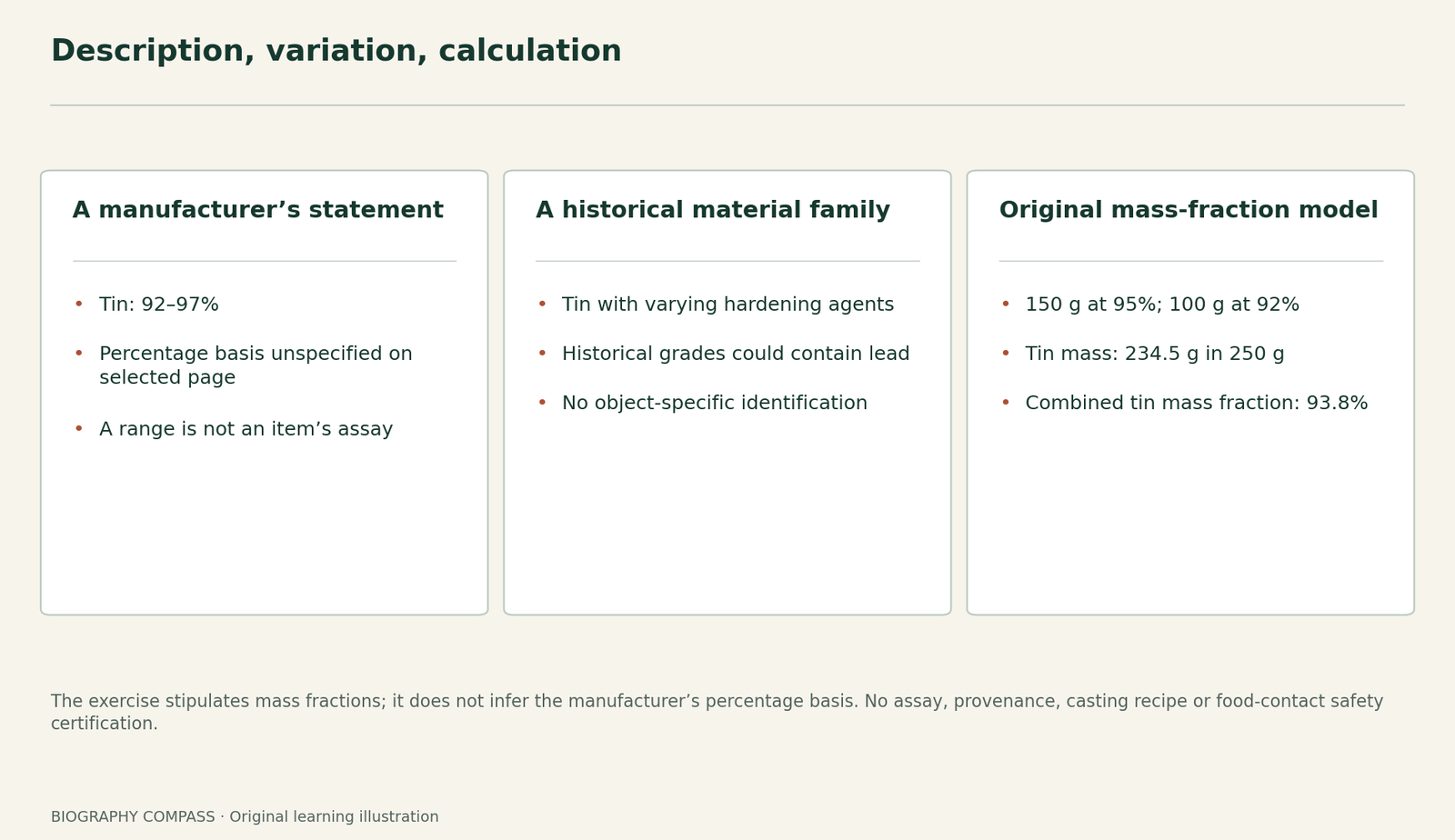
Royal Selangor’s page states a 92–97% tin range, with copper and antimony added. The selected page does not specify a percentage basis or an item-specific assay method.
Treat this as a manufacturer’s description of its material. The missing information matters when a reader tries to turn a range into the measured composition of one object. A stated range is not itself a measurement of the object in your hand.
Sources for this section: [1]
A historical family contains different alloys
The Pewter Society describes pewter as primarily tin with varying hardening agents. Its historical account includes lead-bearing lay metal and later tin-antimony-copper alloys without lead.
These records operate at different levels: a brand describes its products, while a historical reference surveys a material family. Their coexistence gives no reason to assign a modern manufacturer’s range to an unidentified older object. It also supplies no chain of custody for that object.
Exercise: declare a mass basis
For a fictional arithmetic problem, stipulate that sample A weighs 150 g and contains 95% tin by mass. Sample B weighs 100 g and contains 92% tin by mass. Calculate the tin mass in each and their combined tin mass fraction. Assume no loss and that only the stated sample masses enter the total.
The explicit mass basis belongs to this invented task. It is not inferred from the manufacturer’s unspecific percentage statement. This is a calculation, not a casting procedure, product recipe, identification test or recommendation to use any object with food.
Reference answer: use the masses
Sample A contains 150 × 0.95 = 142.5 g of tin. Sample B contains 100 × 0.92 = 92 g. Together they contain 234.5 g of tin in 250 g of material, so the combined mass fraction is 234.5 ÷ 250 = 0.938, or 93.8%.
The unweighted mean, (95 + 92) ÷ 2 = 93.5%, gives each sample equal influence even though their masses differ. That would answer a different question. If the two samples instead had equal masses, the simple mean and the mass-weighted result would coincide.
What would an object-specific claim require?
Separate the arithmetic from the investigation. For an actual object, ask who identified it, what evidence links it to a maker and period, what was measured, where the measurement was taken and which method produced the result. A calculation cannot supply those missing observations.
Nor can the selected pages certify a particular item’s safety or authenticate an old piece. The useful conclusion is narrower: preserve the difference between a descriptive range, historical variation and a declared teaching assumption.
Continue the chronology
Related history guides
Why supplier payments get different classifications
Compare another exercise in matching a conclusion to the scope of its evidence.
Read the timeline2018 and 2020 records · evidence exerciseRead a finding and a later release of directions
Compare another exercise in matching a conclusion to the scope of its evidence.
Read the timelineBiography context
Explore Worldwide through connected lives
Connected biographies
Careers behind the records
Business career
Yong Poh Kon
Engineering and manufacturing leaderYong Poh Kon brought engineering training to pewter manufacturing and later served in Malaysian industry and public institutions.Read biographyQuick answers
Common questions
- Can the toy result authenticate an object?
- No. Correct arithmetic cannot establish the origin or measured composition of an actual item.
- Why not average the two percentages directly?
- The sample masses differ. Weighting by mass answers the combined-mass question.
Primary and institutional sources
How this history was checked
Selected records are linked below. Reading scope is limited to the passages discussed; fictional tasks are labelled and do not certify a company, product or present regulatory position. This article was reviewed on 29 October 2026.
- Royal Selangor International Sdn BhdAbout Pewter
- The Pewter SocietyThe Metal
- University of Adelaide, Adelaidean, April 2005Graduate’s fate sealed in pewter
- 99 Speed Mart Retail Holdings BerhadAnnual Report 2024: milestones, Lee Thiam Wah profile and accounting policies
- Competition and Consumer Commission of SingaporeGrab-Uber Merger: directions and penalties
- Competition and Consumer Commission of SingaporeCCCS Releases Directions On Grab Following P2P Regulatory Framework
- KSI Strategic Institute for Asia PacificTan Sri Yong Poh Kon: short biography