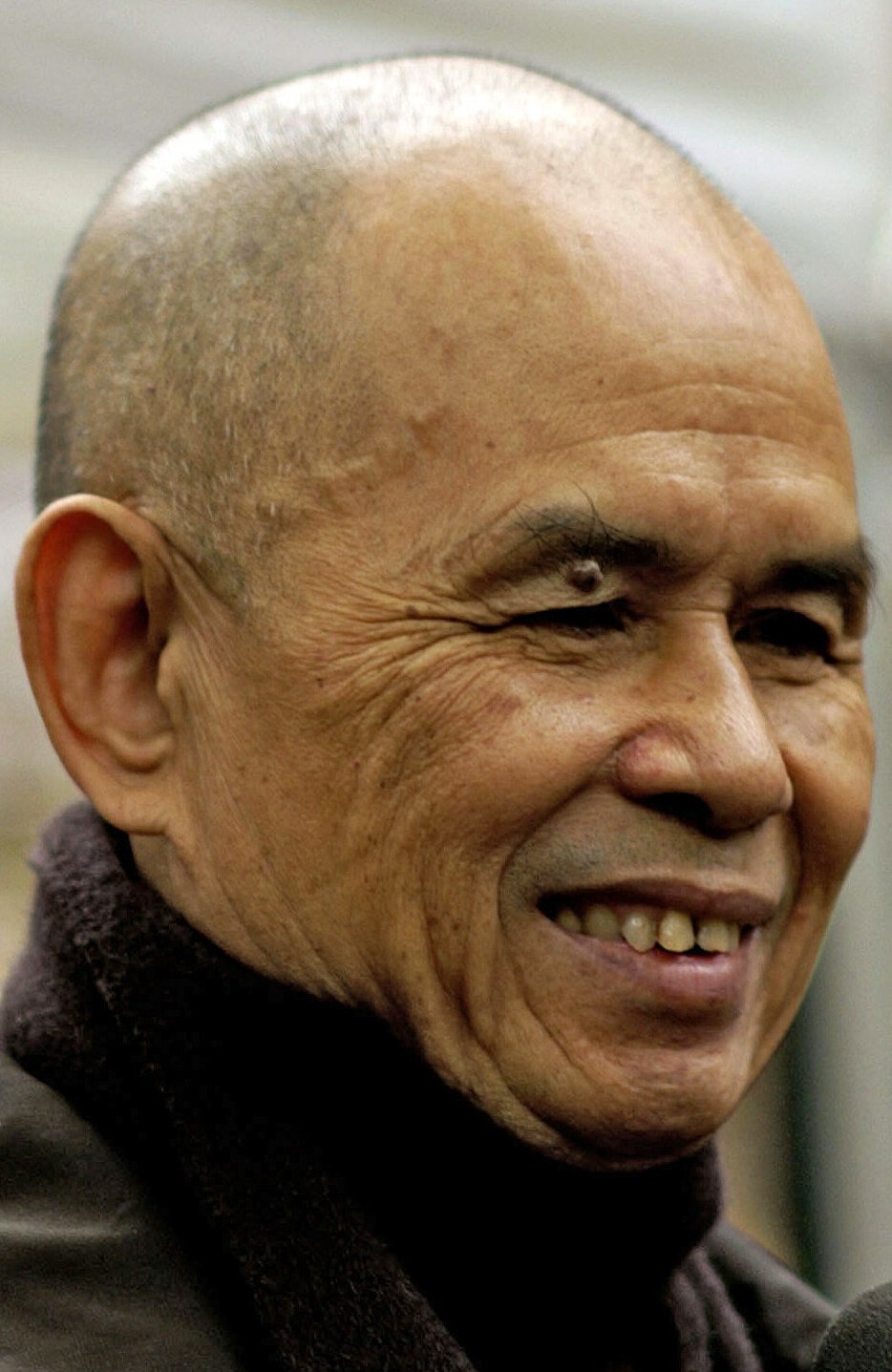
In this biography
Quick facts
- Born
- 11 October 1926
- Died
- 22 January 2022
- Birthplace
- Huế, Vietnam
- Country
- Vietnam
- Nationality
- Vietnamese
- Known for
- Engaged Buddhism, mindfulness teaching and Plum Village
- Entered monastic life
- As a novice at Từ Hiếu Temple, 1942
- Movement
- Engaged Buddhism
- Community founded
- Plum Village, France
- Published work
- More than 100 books and other titles
Why this life matters
Thích Nhất Hạnh connected Buddhist practice with peace activism, community life and everyday ethics across languages and generations.
Timeline
Key moments
Born in Huế
Born Nguyễn Xuân Bảo on 11 October.
Entered monastic life
Began training at Từ Hiếu Temple.
Founded a social-service school
Helped establish the School of Youth for Social Service for rural education, relief and reconstruction.
Travelled for peace advocacy
Called for an end to the war and was unable to return for decades.
Nominated for the Nobel Peace Prize
Martin Luther King Jr. nominated him for his nonviolent advocacy; no prize was awarded that year.
Established Plum Village
Created a monastic and lay community in southwest France.
Returned to Vietnam
Visited after nearly four decades of exile.
Suffered a severe stroke
A brain haemorrhage left him unable to speak or walk and began a long period of rehabilitation.
Returned to Từ Hiếu Temple
Settled at his root temple in Huế for the final years of his life.
Died at Từ Hiếu
Died at his root temple in Huế.
Monastic training and the search for a renewed Buddhism
Thích Nhất Hạnh was born Nguyễn Xuân Bảo in Huế in 1926 and entered Từ Hiếu Temple as a novice at sixteen. His formation belonged to Vietnamese Thiền, the local Zen tradition, but he came of age amid the Japanese occupation, the end of French colonial rule and the First Indochina War. Those upheavals made the relation between contemplative practice and public suffering an urgent question.
He received full monastic ordination, studied Buddhist texts and also engaged modern philosophy, literature and science. As a writer and editor he argued for renewing Buddhist education and institutions rather than isolating monasteries from social change. Study in the United States in the early 1960s widened his international and interfaith contacts before he returned to Vietnam.
Engaged Buddhism during the Vietnam War
In the 1960s he helped create institutions that joined Buddhist learning to practical service, including Vạn Hạnh University and the School of Youth for Social Service. Young workers rebuilt villages, organised schools and offered medical and disaster relief without formally aligning with either side of the war. Colleagues were threatened and killed in a deeply polarised environment.
Nhất Hạnh used “engaged Buddhism” to describe a practice that responded to war, poverty and injustice while remaining grounded in meditation and ethical discipline. The Order of Interbeing, formed in 1966, expressed that approach through mindfulness trainings for monastic and lay practitioners. Engagement did not mean turning Buddhism into a party programme; it meant refusing to separate inner transformation from responsibility for social suffering.
Peace advocacy, Martin Luther King Jr. and exile
He left Vietnam in May 1966 for a speaking tour that called for a ceasefire and a settlement independent of both military blocs. Because his position criticised violence from multiple sides, he was unable to return for thirty-nine years. He travelled widely, met religious and political leaders and later participated in the Buddhist Peace Delegation connected to the Paris peace negotiations.
Martin Luther King Jr. met Nhất Hạnh and nominated him for the 1967 Nobel Peace Prize. No Peace Prize was awarded that year. Their relationship linked opposition to the Vietnam War with a wider nonviolent critique of racism, poverty and militarism, but Nhất Hạnh’s peace work arose from Vietnamese Buddhist networks rather than from Western celebrity endorsement.
Plum Village and the global teaching of mindfulness
After years in Paris, Nhất Hạnh and collaborators including Sister Chân Không established the Sweet Potatoes community in 1975 and Plum Village in southwest France in 1982. Plum Village grew into a residential monastic centre and the base of an international network of monasteries, retreat centres and local sanghas.
Books such as The Miracle of Mindfulness, Being Peace and Peace Is Every Step presented breathing, walking, eating and attentive communication as complete practices rather than abstract ideas. Their direct language reached readers beyond Buddhist institutions. At the same time, his teaching remained rooted in monastic discipline, Mahayana texts and the concept of “interbeing”—the insight that no person or phenomenon exists independently.
He published poetry, commentaries, children’s books and more than one hundred other titles. The breadth of that catalogue helped shape modern popular mindfulness, although reducing him to a wellness author misses his continuing emphasis on ethics, community, nonviolence and collective awakening.
Return to Vietnam, final years and institutional legacy
Vietnam permitted Nhất Hạnh to return in 2005, ending nearly four decades of exile, and he made further visits. Relations with the state and officially recognised Buddhist institutions remained sensitive. In 2014 he suffered a severe stroke that limited speech and movement. His students continued retreats and teachings while he underwent rehabilitation in France, the United States and Thailand.
He returned permanently to Từ Hiếu Temple in 2018 and died there on 22 January 2022. Plum Village communities described the continuation of his work collectively rather than through a single successor. That structure is central to his legacy: an international practice tradition, publishing programme and network of ordained and lay teachers able to outlast its founder.
Nhất Hạnh’s influence lies in connecting several worlds often treated separately—Vietnamese Buddhist reform, wartime humanitarian action, interfaith peace activism and accessible meditation practice. His biography also restores the political and institutional history behind a word, mindfulness, that is frequently detached from the ethical commitments he taught with it.
Quick answers
Frequently asked questions about Thích Nhất Hạnh
- What did Thích Nhất Hạnh mean by engaged Buddhism?
- Buddhist practice joined with responsibility for social suffering, including peace work, education and relief, rather than meditation separated from everyday ethical and public life.
- When was Plum Village founded?
- Thích Nhất Hạnh and collaborators including Sister Chân Không established Plum Village in southwest France in 1982, after the earlier Sweet Potatoes community founded in 1975.
- Did Thích Nhất Hạnh win the Nobel Peace Prize?
- No. Martin Luther King Jr. nominated him for the 1967 Nobel Peace Prize, but no Peace Prize was awarded that year. A nomination is not a prize.
- When and where did Thích Nhất Hạnh die?
- He died on 22 January 2022 at Từ Hiếu Temple in Huế, Vietnam, where he had returned to live in 2018. His community continued his work collectively after his death.
Keep exploring
Lives connected to this story
- Trịnh Công Sơn
Compare a separate Vietnamese artist’s response to war and Buddhist ideas; no direct collaboration is implied.
- Hồ Chí Minh
Understand the separate political leadership and wartime state history behind this religious reformer’s peace advocacy.
Sources and further reading
Explore the evidence
These references support the biography and offer further reading. Official records, first-person accounts and independent reporting provide different perspectives; image records document attribution and licensing.
- 1. Plum VillageBiography of Thich Nhat Hanh
The updated life story supports the 2022 death and collective continuation. No current monastery count, single-successor appointment or therapeutic outcome is inferred.
- 2. Plum VillageThich Nhat Hanh full biography
Used for historical events, not present institutional counts. This older page retains pre-death wording and an inconsistent stroke-age reference; the updated biography supplies the death date. Differing October/November homecoming accounts are not resolved into an unsupported exact month.
- 3. Martin Luther King Jr. Research and Education InstituteFellowship of Reconciliation and the 1967 Nobel nomination
Supports King’s nomination and the relationship to peace activism, not a Nobel award. No Peace Prize was awarded in 1967.
- 4. Union Theological SeminaryThich Nhat Hanh receives the Union Medal
- 5. Parallax PressThich Nhat Hanh publishing timeline
- 6. Union Theological SeminarySister Chan Khong and Buddhist social work during the war
- 7. Wikimedia CommonsPortrait and CC BY-SA 2.0 record
- 8. Plum Village App TeamThe Plum Village Tradition: historical interview and Nguyễn Xuân Bảo name
The 2020 institutional interview supports the Nguyễn Xuân Bảo name and early tradition. Other institutional histories discuss additional family and monastic names; they are not treated as proof that this name is false. The page’s pre-death present tense is not used for current status.