In this biography
Quick facts
- Born
- 2 December 1969
- Birthplace
- Sydney, New South Wales, Australia
- Country
- Australia
- Nationality
- Not independently established
- Known for
- Labor deputy leadership, social-policy ministries and contested environmental reform
- Born
- 2 December 1969, Sydney
- Education
- UTS communications; Macquarie politics and public policy
- Electorate
- Sydney, first elected 1998
- Labor deputy leader
- 2013–2019
- Environment and Water
- 2022–2025
- Social Services minister
- Since 13 May 2025; confirmed October 2026
Why this life matters
Her career connects constituency representation, party leadership and executive decisions affecting people and ecosystems. Its reform ambitions must be read alongside parliamentary bargaining, regional opposition and the limits imposed by wider government decisions.
Timeline
Key moments
Education and public-policy work
Born in Sydney, she studies communications and public policy and works in the NSW Domestic Violence Unit.
Member for Sydney
She enters the House of Representatives.
First ministries
Housing and women’s portfolios precede human services, social inclusion and health.
Labor deputy
She combines deputy leadership with senior shadow portfolios, then declines to contest the leadership after the 2019 defeat.
Environment and water
She joins the Albanese cabinet and negotiates the Restoring Our Rivers legislation.
Social services
She changes portfolios in May 2025; dated departmental material confirms her continuing role in October 2026.
Education and work with women preceded election
Plibersek was born in Sydney on 2 December 1969 and grew up in the Sutherland Shire. Her own account describes a family shaped by migration from Slovenia and a father who worked on the Snowy scheme. She studied communications at the University of Technology Sydney and later politics and public policy at Macquarie.
Before entering Parliament she worked in the NSW Domestic Violence Unit. That experience linked public policy to practical questions about safety and services, rather than treating politics solely as campaigning or parliamentary debate. It became part of the background to a career repeatedly concerned with social provision.
A Sydney seat led to several distinct executive responsibilities
Elected for Sydney in 1998, she spent her early parliamentary years in opposition. Labor’s return to government in 2007 brought the housing and status-of-women portfolios. Human services and social inclusion followed, and she became health minister in December 2011.
These roles concerned different systems: housing provision, service administration and health policy were not interchangeable jobs. Her ministerial record crossed the Rudd and Gillard governments, while her continuing electorate responsibilities connected national policy arguments to the needs of an inner-city constituency.
Deputy leadership did not lead to a contest for the top job
After Labor lost government in 2013, Plibersek became its deputy leader and held senior shadow portfolios, including foreign affairs and later education. She remained a prominent national figure through two further election campaigns.
Following the 2019 defeat she considered seeking the leadership but decided not to run. Her contemporary explanation cited the difficulty of reconciling leadership with family responsibilities. She continued in parliamentary politics instead. That decision should not be rewritten as a leadership ballot she lost, or as proof of what would have happened in a contest that never occurred.
Water reform depended on negotiations beyond the government
As environment and water minister from 2022, Plibersek sought changes to the Murray–Darling Basin framework. The Restoring Our Rivers legislation extended deadlines and reopened recovery options, including voluntary water purchases.
Securing parliamentary support required negotiation with the Greens and crossbench senators. Farmers’ groups, the Coalition and Victoria opposed important elements, especially the socioeconomic consequences of buybacks. Passage in 2023 was a legislative achievement, but delivery of environmental water and the effects on particular communities remained implementation questions.
Environmental decisions also exposed tensions within Labor’s agenda
The environment portfolio placed conservation, development and employment claims in direct conflict. In March 2025 the government moved to protect salmon farming in Macquarie Harbour through legislation while Plibersek was considering a requested review of earlier approvals.
ABC reporting described the planned change as limiting the scope of that ministerial process. Conservation concerns included the endangered Maugean skate, while the government emphasised industry certainty and jobs. This episode belongs alongside water reform: holding the environment portfolio did not mean she independently determined every policy choice made by the government.
Sources for this section: [5]
The social-services appointment returned her to a broad domestic brief
Plibersek became Social Services minister on 13 May 2025 after Labor’s re-election. Her departmental page identifies that office and carries dated October 2026 activity, confirming her role at this biography’s review.
The transition connects her earlier work on housing, social inclusion and women’s policy with a later cabinet responsibility. Her record is still developing. A coherent assessment includes both sustained parliamentary service and the contested choices involved in translating reform commitments into laws, programs and decisions.
Quick answers
Frequently asked questions about Tanya Plibersek
- When did Tanya Plibersek enter Parliament?
- She was first elected for Sydney in 1998.
- Did she contest Labor’s 2019 leadership ballot?
- No. She considered running but announced that she would not nominate.
- Was she still environment minister in October 2026?
- No. She moved from Environment and Water to Social Services in May 2025.
- Did the 2023 rivers law itself deliver all the promised water?
- No. It changed legal tools and deadlines; recovery and environmental outcomes depended on subsequent implementation.
Keep exploring
Lives connected to this story
- Julia Gillard
Read the prime minister under whom Plibersek became health minister.
- Anthony Albanese
Place her later cabinet roles within Labor’s return to federal government.
- Julie Bishop
Compare another woman who combined party deputy leadership with a senior foreign-affairs role.
Sources and further reading
Explore the evidence
These references support the biography and offer further reading. Official records, first-person accounts and independent reporting provide different perspectives; image records document attribution and licensing.
- 1. Parliament of AustraliaTanya Plibersek: service, qualifications and ministerial appointments
- 2. Tanya PlibersekAbout Tanya: upbringing, education and political career
Personal background is attributed to her own account; parliamentary service and qualifications are corroborated by Parliament. Optional nationality is omitted.
- 3. ABC NewsPlibersek declines to contest Labor leadership, 20 May 2019
- 4. Department of Social ServicesTanya Plibersek: ministerial page and October 2026 material
Dated October 2026 material confirms office; funding announcements are not treated as independently demonstrated program results.
- 5. ABC NewsProposed salmon-farming legislation and the environment minister’s review, March 2025
Contemporary account of proposed March 2025 legislation and an active review, not a claim that every later outcome was Plibersek’s personal decision.
- 6. Federal Register of LegislationWater Amendment (Restoring Our Rivers) Act 2023 as made: selected provisions
- 7. ABC NewsRivers legislation, crossbench negotiations and contested buybacks, 30 November 2023
- 8. ABC NewsGovernment and Greens agreement on Basin legislation, 27 November 2023
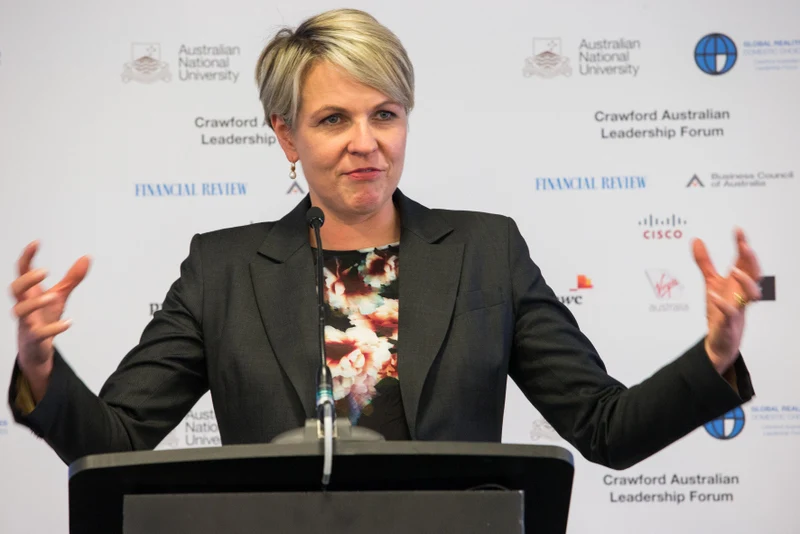
- 9. Crawford Australian Leadership Forum / ANUTanya Plibersek at the 2015 Crawford Forum: Stuart Hay photograph, CC BY 2.0