
In this biography
Quick facts
- Born
- 15 January 1965
- Birthplace
- Pangandaran, West Java
- Country
- Indonesia
- Nationality
- Indonesian
- Known for
- Building a seafood and aviation business before leading a high-profile campaign against illegal fishing
- Cabinet office
- Marine Affairs and Fisheries Minister, 2014–2019
- Airline
- Susi Air
- First business
- Seafood trading and processing
- Policy focus
- Illegal, unreported and unregulated fishing
Why this life matters
Susi’s career crosses small-town enterprise, logistics and public administration, showing how an unconventional business background can reshape a national policy agenda.
Timeline
Key moments
Entered seafood trading
Started buying and selling fish in Pangandaran before expanding into processing and export.
Began Susi Air flights
The airline says its first flights began on 27 December as emergency charter work after the Aceh tsunami.
Expanded scheduled flights
Susi Air added scheduled services across Indonesia after its initial charter and relief operations.
Joined the cabinet
Joko Widodo appointed her minister of marine affairs and fisheries.
Completed her ministerial term
Left office after five years of anti-illegal-fishing enforcement and fisheries reform.
From the fish market to aviation
Susi Pudjiastuti began trading fish in Pangandaran, West Java, in 1983. In a later talk at Universitas Gadjah Mada, she described selling jewellery to raise her first fish-trading capital and struggling to obtain bank loans. Her own marine-conservation organisation dates the growth of that trade into PT ASI Pudjiastuti Marine Product, a fish-processing business, to 1996. Those accounts help explain the business she had built before entering public office; they should not be mistaken for independently audited financial histories.
Transport became another part of her enterprise. Susi Air says the company was founded in 2004 and began operating on 27 December that year, using two aircraft for emergency charter flights after the earthquake and tsunami in Aceh. Its scheduled services expanded in 2006. The distinction matters: the first flights were disaster-response operations, not evidence that a nationwide scheduled airline already existed in 2004. The company subsequently described its role in connecting remote destinations across the Indonesian archipelago.
From entrepreneur to fisheries minister
Indonesia’s Cabinet Secretariat records Pudjiastuti as minister of marine affairs and fisheries from 27 October 2014 to 20 October 2019. The appointment placed a former fish trader and airline founder in charge of the ministry that regulated the sector where she had first worked. Her public profile became closely associated with action against illegal, unreported and unregulated fishing, including the seizure and destruction of vessels found fishing illegally. That enforcement was one element of a larger policy programme, not a synonym for every restriction introduced during her term.
One early measure was Ministerial Regulation 56/2014, dated 3 November 2014, which temporarily stopped certain capture-fishery business permits. The regulation and fisheries research describe it as a moratorium concerning foreign-built or former foreign vessels. It did not amount to a blanket ban on every Indonesian fishing boat. Reading the legal record alongside the ministry’s account of its anti-illegal-fishing strategy keeps the permit policy distinct from vessel enforcement, gear restrictions and transshipment rules, which require their own evidence and dates.
What the evidence says about impact
A 2018 study in Nature Ecology & Evolution examined Indonesia’s response to foreign-vessel illegal fishing and estimated that the policies reduced total fishing effort by at least 25%. That is a research estimate about the studied policy period, not a direct count of recovered fish stocks or proof that every coastal community gained. Its authors modelled the potential for fishery gains if illegal fishing was curtailed; the projections should not be described as outcomes already achieved everywhere.
The moratorium also had distributional questions. Fishery researchers examining former foreign-built vessels and tuna markets investigated effects on particular parts of the domestic industry. This means a biography should not collapse national enforcement, ecological recovery, export performance and individual fishers’ livelihoods into a single success or failure claim. Pudjiastuti’s significance lies partly in making these trade-offs central to Indonesian policy debate. Assessing the full economic and ecological balance still requires more than a ministerial statement, a single model or a headline vessel count.
Marine advocacy after office
Pudjiastuti did not begin speaking about marine conservation only after leaving the cabinet. Pandu Laut Nusantara, the organisation she founded, says it began in Pangandaran in April 2018 and was inaugurated in Jakarta that July, while she was still minister. Its work describes beach clean-ups, mangrove activity and public education as ways for volunteers to participate in protecting the sea. The organisation says she took a direct leadership role in August 2020, after her ministerial term ended.
That sequence links her business and government years without implying they were the same role. Seafood trading exposed her to the practical logistics of an island economy; aviation addressed transport; the ministry gave her authority over policy and enforcement; later advocacy mobilised volunteers outside government. The official cabinet dates and the organisation’s own account identify those transitions, while the wider effects of each programme remain a question for independent assessment.
Quick answers
Frequently asked questions about Susi Pudjiastuti
- Who is Susi Pudjiastuti?
- Susi Pudjiastuti is an entrepreneur and former Minister of Marine Affairs and Fisheries. Susi’s career crosses small-town enterprise, logistics and public administration, showing how an unconventional business background can reshape a national policy agenda.
- What is Susi Pudjiastuti best known for?
- Susi Pudjiastuti is best known for building a seafood and aviation business before leading a high-profile campaign against illegal fishing.
- When and where was Susi Pudjiastuti born?
- Susi Pudjiastuti was born on 15 January 1965 in Pangandaran, West Java.
Keep exploring
Lives connected to this story
- Martha Tilaar
Another Indonesian woman who built a national business before gaining wider public recognition.
- Joko Widodo
The president whose 2014–2019 cabinet included Pudjiastuti as fisheries minister.
Sources and further reading
Explore the evidence
These references support the biography and offer further reading. Official records, first-person accounts and independent reporting provide different perspectives; image records document attribution and licensing.
- 1. Pandu Laut NusantaraAbout Pandu Laut and its founder
The organisation is founded by Pudjiastuti and therefore a first-party source for its own dates and stated activities, not an independent impact audit.
- 2. Universitas Gadjah MadaSusi Pudjiastuti on starting a business
- 3. Susi AirAbout Susi Air
The airline’s own history dates its first emergency charter flights to 27 December 2004 and its scheduled-service expansion to 2006; fleet and route figures on that page are current company claims, not historical 2004 totals.
- 4. Cabinet Secretariat of IndonesiaWorking Cabinet ministerial roster
- 5. Ministry of Marine Affairs and Fisheries legal archiveMinisterial Regulation 56/2014
Regulation 56/2014 is the permit moratorium record. It should not be conflated with a ban on all domestic fishing vessels or with separate vessel-destruction enforcement.
- 6. Ministry of Marine Affairs and FisheriesIllegal fishing and future challenges for Indonesia
- 7. James Cook University ResearchOnlineRapid and lasting gains from solving illegal fishing
The peer-reviewed paper estimates a reduction in fishing effort and models potential gains; it does not measure recovery in every local fish stock or benefit to every community.
- 8. Journal of Marine and Fisheries Socio-Economic PolicyResearch on the foreign-built-vessel permit moratorium
- 9. Journal of Marine and Fisheries Socio-Economic PolicyStudy of moratorium effects on Indonesia’s tuna market
- 10. Ministry of Marine Affairs and Fisheries LibrarySuper Susi — biography catalogue record
- 11. Ministry of Marine Affairs and FisheriesMinister Susi receives an honorary doctorate
- 12. Wikimedia CommonsSusi Pudjiastuti — image and public-domain record
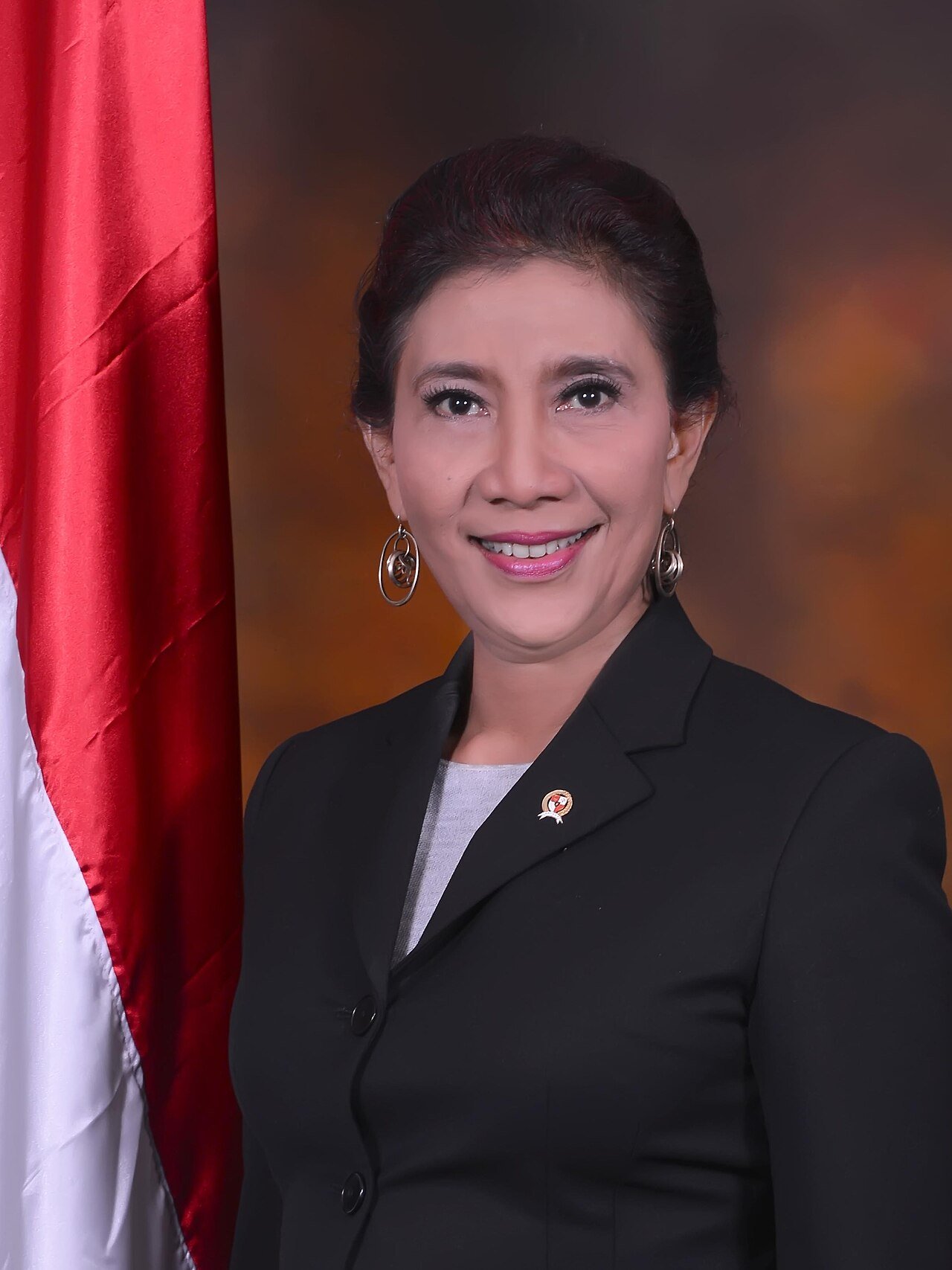
The local portrait is a full-frame resize of the 2014 Indonesian-government image. Commons documents its Indonesian public-domain basis in the file licensing section.


