In this biography
Quick facts
- Born
- 21 June 1961
- Birthplace
- Surakarta, Central Java
- Country
- Indonesia
- Nationality
- Indonesian
- Known for
- Leading Indonesia from 2014 to 2024 through infrastructure expansion, industrial downstreaming and the Nusantara project
- Office
- President, 2014–2024
- Earlier office
- Governor of Jakarta, 2012–2014
- First elected office
- Mayor of Surakarta, 2005–2012
- Profession
- Furniture entrepreneur
- Political affiliation
- PSI member since 14 October 2025; disclosed in 2026
Why this life matters
Jokowi’s outsider rise widened ideas of who could lead Indonesia, while his delivery-focused presidency left major infrastructure, industrial and democratic legacies.
Timeline
Key moments
Built a furniture business
Established a Surakarta furniture enterprise after studying forestry.
Became mayor of Surakarta
Began a local-government career noted for market renewal and direct public engagement.
Became governor of Jakarta
Won the capital’s governorship with Basuki Tjahaja Purnama.
Elected president
Defeated Prabowo Subianto and became the first president from outside the country’s established political or military elite.
Won a second term
Jokowi and Ma’ruf Amin received 55.50 per cent of the valid national vote.
Accelerated mineral downstreaming
A ban on nickel-ore exports took effect as the government sought more domestic processing and investment.
Made Nusantara a statutory project
The new-capital law established the framework for moving the national seat of government to East Kalimantan.
Completed two terms
Transferred the presidency to Prabowo Subianto on 20 October.
Confirmed membership in PSI
Publicly showed a party card dated 14 October 2025 and urged PSI organisers to build toward the 2029 election.
A furniture exporter from Surakarta
Joko Widodo, widely known as Jokowi, grew up beside a river in Surakarta and experienced eviction when his family’s home was cleared. He studied forestry at Gadjah Mada University, worked briefly in Aceh and returned to Central Java to build a furniture manufacturing and export business.
Business exposed him to licensing, local administration and overseas customers. It also gave him an identity outside the military, bureaucracy and Jakarta-centred party families that had supplied most of Indonesia’s national leaders.
Mayor, blusukan and the road to Jakarta
Elected mayor of Surakarta in 2005, Jokowi developed a reputation for relocating street vendors through negotiation, renovating traditional markets and visiting neighbourhoods directly. These unscripted inspections became known as blusukan and helped turn an administrative style into a political brand.
PDI-P nominated him for Jakarta governor in 2012 with Basuki Tjahaja Purnama as his running mate. Their victory over an incumbent brought Jokowi onto the national stage. Two years later he defeated Prabowo Subianto for the presidency, becoming the first elected Indonesian president without a background in the established national elite or armed forces.
Coalitions, elections and social programmes
Jokowi began his first term with a minority coalition and gradually assembled broad parliamentary support. He expanded national health coverage and education assistance, redirected part of the fuel-subsidy budget and used targeted social programmes to present the state as a provider of practical benefits.
He again defeated Prabowo in 2019, this time with Islamic scholar Ma’ruf Amin as his running mate. The official result gave the ticket 85.6 million votes, or 55.50 per cent. After deadly post-election unrest, Jokowi brought Prabowo into cabinet as defence minister, reducing formal opposition but also narrowing competitive checks on government.
The infrastructure presidency
Roads, ports, dams, airports, railways and power projects became the clearest material signature of Jokowi’s decade. The government accelerated the Trans-Java and Trans-Sumatra toll networks, opened mass transit in Jakarta and supported the Jakarta–Bandung high-speed railway. Projects in eastern Indonesia reinforced his claim that development should be Indonesia-centred rather than Java-centred.
The programme improved connectivity and construction capacity, but its financing, land acquisition and environmental effects remained contested. State-owned enterprises carried large implementation burdens, while critics asked whether prestige projects always matched local needs and fiscal capacity.
Nickel and industrial downstreaming
Jokowi treated mineral processing as an industrial strategy rather than simply a trade policy. A nickel-ore export ban took effect in 2020 to encourage smelters, stainless steel production and an electric-vehicle battery supply chain inside Indonesia. Large investment followed, much of it linked to Chinese capital and technology.
The policy increased the value of processed mineral exports but brought worker-safety, pollution and energy-use concerns around industrial parks. The European Union challenged the export restrictions at the World Trade Organization; a panel found the measures inconsistent with trade rules, and Indonesia appealed.
Nusantara, a capital built as legacy
In 2019 Jokowi proposed moving the capital from congested, flood-prone Jakarta to East Kalimantan. Parliament passed the Nusantara capital law in 2022, and construction began around a planned government core designed as a lower-carbon forest city.
Supporters saw a chance to rebalance the archipelago and build modern infrastructure from the ground up. Environmental groups and Indigenous communities raised concerns about forest conversion, wildlife habitat and land rights, while delays and dependence on public funding made the timetable uncertain. Jokowi worked from the site during his final months but left the multidecade transfer unfinished.
Democratic and rights criticisms
Jokowi’s pragmatic coalition-building came with institutional costs. The 2019 revision of the Corruption Eradication Commission law weakened an agency created during Megawati Sukarnoputri’s presidency. The Job Creation Law sought to simplify investment rules but prompted labour and environmental protests, and the Constitutional Court initially found its legislative process conditionally unconstitutional.
Human Rights Watch and democracy monitors described declining civil and political rights over the decade, pointing to pressure on critics, restrictions in Papua and efforts by governing parties to change election rules. Supporters argued that electoral competition and policy delivery endured; critics saw a presidency that prioritised stability and implementation over independent oversight.
Succession, family and Prabowo
Unable to seek a third term, Jokowi moved away from PDI-P’s 2024 candidate and tacitly supported Prabowo, now paired with Jokowi’s eldest son Gibran Rakabuming Raka. Gibran, then 36, became eligible after the Constitutional Court created an exception to the age rule for elected regional leaders.
The court’s ethics council removed Chief Justice Anwar Usman—Jokowi’s brother-in-law and Gibran’s uncle—from the chief justiceship for serious ethical violations connected to the ruling. The episode intensified debate over dynasty and neutrality. Prabowo and Gibran won, and Jokowi transferred the presidency on 20 October 2024.
Life after the presidency and PSI
PDI-P expelled Jokowi amid the break with Megawati and the party’s 2024 ticket. He remained politically active around Prabowo’s coalition and the Indonesian Solidarity Party, led by his younger son Kaesang Pangarep.
On 26 September 2026, Jokowi publicly showed a PSI membership card stating that he had joined on 14 October 2025. His role in building the party toward 2029 means that his post-presidential influence, family network and relationship with Prabowo remain part of an unfinished political story.
Quick answers
Frequently asked questions about Joko Widodo
- Who is Joko Widodo?
- Joko Widodo is a seventh president of Indonesia and PSI member. Jokowi’s outsider rise widened ideas of who could lead Indonesia, while his delivery-focused presidency left major infrastructure, industrial and democratic legacies.
- What is Joko Widodo best known for?
- Joko Widodo is best known for leading Indonesia from 2014 to 2024 through infrastructure expansion, industrial downstreaming and the Nusantara project.
- When and where was Joko Widodo born?
- Joko Widodo was born on 21 June 1961 in Surakarta, Central Java.
Keep exploring
Lives connected to this story
- Luhut Binsar Pandjaitan
Follow the senior official whose coordinating portfolios expanded during his presidency.
- Basuki Tjahaja Purnama
Read the deputy governor who succeeded him in Jakarta after his move to the presidency.
- Tri Rismaharini
Read the Surabaya mayor who joined his cabinet as social affairs minister in December 2020.
Sources and further reading
Explore the evidence
These references support the biography and offer further reading. Official records, first-person accounts and independent reporting provide different perspectives; image records document attribution and licensing.
- 1. Presidential Library, National Library of IndonesiaJoko Widodo biography
- 2. General Elections Commission of IndonesiaPemilu 2014
- 3. General Elections Commission of IndonesiaPemilu 2019 national result
- 4. Government of IndonesiaTen years of infrastructure development
- 5. Ministry of Energy and Mineral Resources of IndonesiaPresident Jokowi on industrial downstreaming
- 6. World Trade OrganizationIndonesia — Measures Relating to Raw Materials, DS592
- 7. Nusantara Capital AuthorityAbout Nusantara
- 8. Human Rights WatchIndonesia: Jokowi’s term ends with a whimper on rights
- 9. Constitutional Court of the Republic of IndonesiaEthics Council removes Anwar Usman from chief justice position
- 10. President of the Republic of IndonesiaFarewell ceremony for Indonesia’s seventh president
- 11. CNAWhat Joko Widodo’s PSI membership means
- 12. Wikimedia CommonsJoko Widodo 2019 official portrait — image and public-domain record
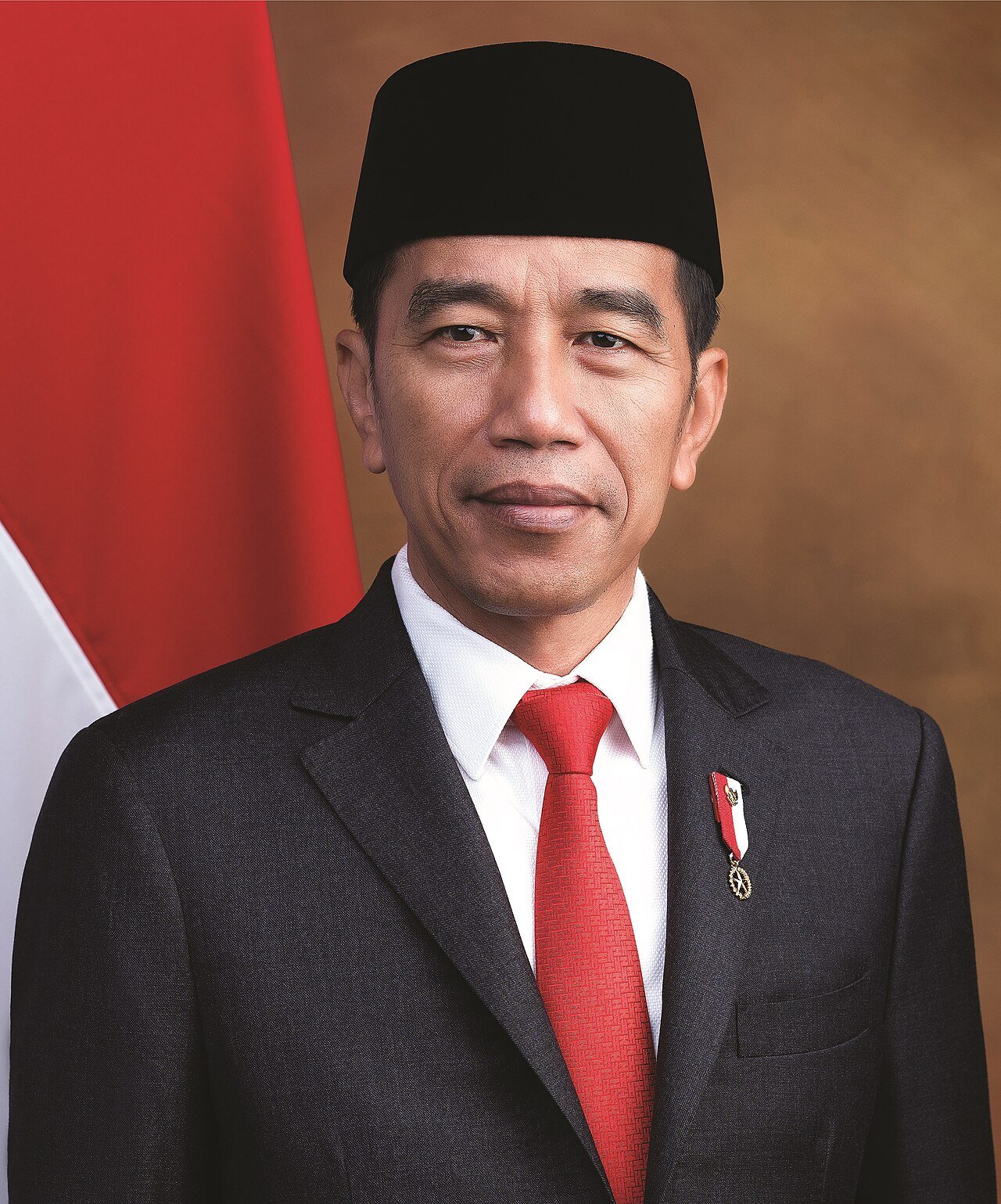
Commons identifies Indonesia’s Ministry of State Secretariat and its 2019–2024 official portrait release as the source. The local copy retains the source-file proportions at a smaller resolution. Commons cites an Indonesian-law public-domain rationale, not a worldwide rights guarantee.