
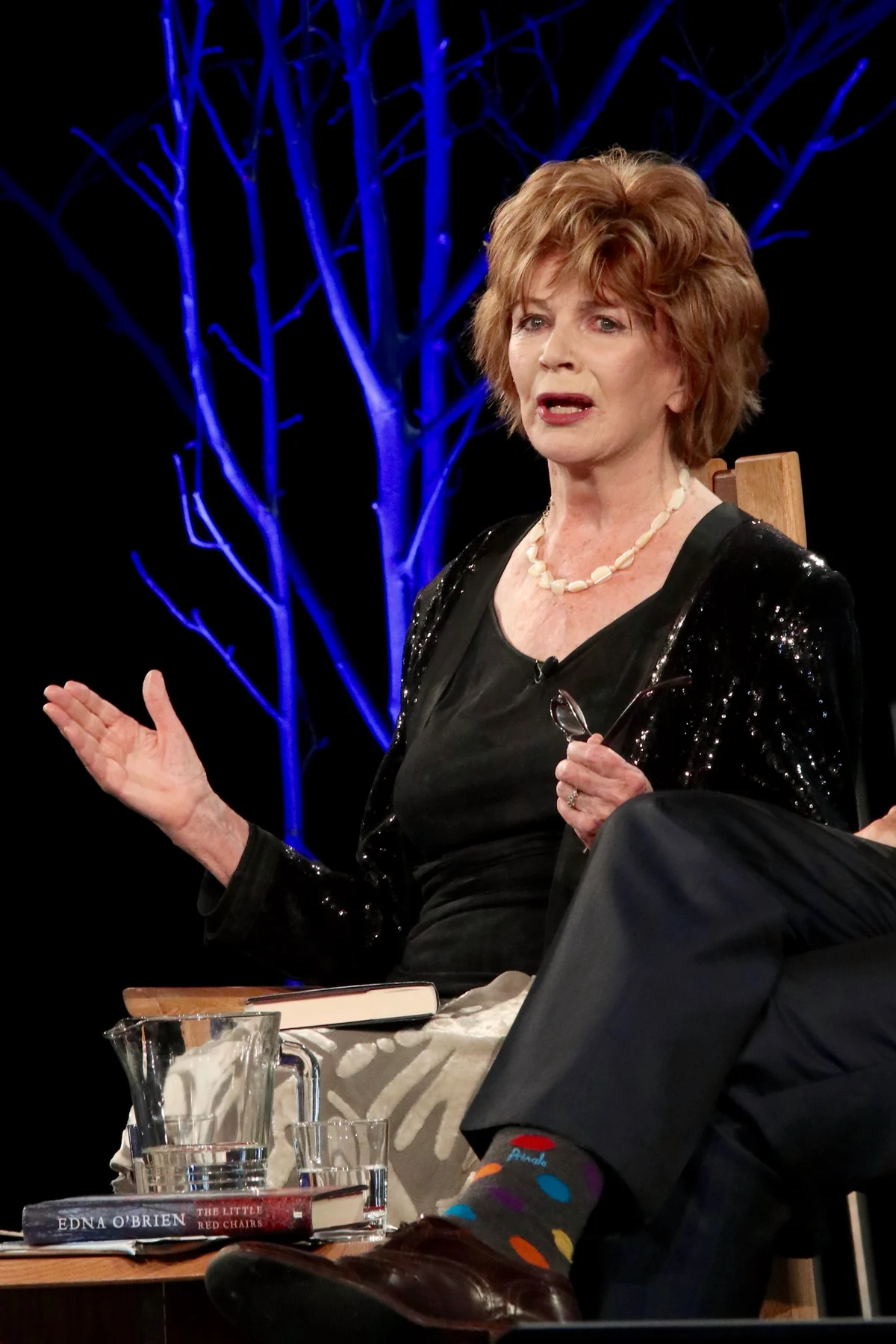
In this biography
Quick facts
- Born
- 15 December 1930
- Died
- 27 July 2024
- Birthplace
- Tuamgraney, County Clare, Ireland
- Country
- Ireland
- Nationality
- Not independently established
- Known for
- The Country Girls, short fiction, Country Girl and a long international literary career
- First novel
- The Country Girls, Hutchinson, 1960
- Memoir
- Country Girl, 2012
- PEN/Nabokov Award
- 2018 honoree
- Later archive
- National Library of Ireland, acquired 2021
Why this life matters
O’Brien widened the place of women’s lives in Irish literature and sustained a career whose manuscripts reveal continuing experimentation beyond the story of her debut’s ban.
Timeline
Key moments
County Clare
Born in Tuamgraney on 15 December.
The Country Girls
Hutchinson published her first novel; it was banned in Ireland.
Art of Fiction interview
Discussed memory, emotion and the work of writing with Shusha Guppy.
Lifetime recognition
Irish Book Awards lifetime achievement award.
Later writing
Country Girl and later fiction continued her career.
Archive acquisition
The NLI acquired a further collection of manuscripts and correspondence.
Death
Died on 27 July.
County Clare and education preceded a writing life
Edna O’Brien was born in Tuamgraney, County Clare, on 15 December 1930. She attended school in Scariff and a convent school in Loughrea before studying pharmacy in Dublin. Those experiences became part of the material she later discussed as a writer. She eventually settled in London, where she wrote her first novel. Accounts differ about some dates of marriage and migration, so they are not reconstructed here from inconsistent summaries. The secure starting points are her Clare origins, pharmaceutical training and the published book, rather than a picturesque life story inferred from her fictional characters.
A debut became a landmark and a controversy
Hutchinson published The Country Girls in London in 1960, as the National Library’s catalogue confirms. The Government of Ireland’s archive announcement also records its ban in Ireland and its frank treatment of female sexuality. Publication abroad, prohibition at home and later acclaim are different events requiring different evidence. The novel was followed by The Lonely Girl and Girls in Their Married Bliss. Their place in a continuing project helps explain why the debut should be read within a developing career. A censorship history illuminates the conditions of reception; it cannot supply an interpretation of every passage of the fiction.
Her own account distinguished experience from invention
In her 1984 Paris Review interview, O’Brien linked writing to intense feeling, separation from Ireland, conflict and loss. Asked about autobiography, she acknowledged shared circumstances with her first novel while stressing the importance of emotion, style and narrative. This is a useful caution against turning a character into a witness for the author’s biography. It also draws attention to writing as an activity with demands of its own. The interview records a particular moment in a long career, not a final rule explaining every later book. Its introductory 1961 publication date is corrected here against the library’s 1960 record.
The career extended across genres and decades
O’Brien’s publisher lists more than twenty-five works of fiction, including The Light of Evening and The Little Red Chairs, alongside the early Country Girls. The government’s later-archive announcement identifies the memoir Country Girl, stories collected in The Love Object and the novel Girl among the materials represented. The range is significant: a memoir makes a different claim on factual memory from a novel, while a story collection asks to be read through individual pieces. Keeping these forms separate allows the later work to enter view instead of treating every new book as an appendix to the original scandal.
Recognition acknowledged a body of work
The Irish Book Awards gave O’Brien its lifetime achievement award in 2009; Seamus Heaney presented it. PEN America named her the 2018 PEN/Nabokov honoree for achievement in international literature. Her agency also records the Irish PEN Award and her 2021 appointment as Commandeur in the French Ordre des Arts et des Lettres. These distinctions measure institutional recognition rather than the meaning of any single work. Their spread across years and organisations nevertheless demonstrates a sustained international standing. A full account must place that recognition beside the early restrictions on circulation and the continuing practice of writing.
Manuscripts reveal continuing revision
The National Library acquired a further archive in 2021, adding manuscripts, drafts and correspondence to earlier holdings. The acquisition announcement describes handwritten drafts on notebooks and loose sheets, together with an annotated final proof of Girl. These are concrete traces of composition and revision, not merely souvenirs of celebrity. O’Brien died on 27 July 2024. The library’s tribute emphasised how its holdings show her creative process developing across later years. Her legacy therefore includes both the public change associated with her early fiction and a record of artistic labour that invites future, work-specific research rather than an assumption that reputation replaced experimentation.
Quick answers
Frequently asked questions about Edna O’Brien
- Is Country Girl the same book as The Country Girls?
- No. The Country Girls is the 1960 novel. Country Girl is the 2012 memoir; later trilogy editions also need to be distinguished from the original novel.
Keep exploring
Lives connected to this story
- Seamus Heaney
Read the poet who presented her 2009 lifetime-achievement award.
- Eavan Boland
Compare another Irish writer’s distinct work on literary authority and women’s experience.
Sources and further reading
Explore the evidence
These references support the biography and offer further reading. Official records, first-person accounts and independent reporting provide different perspectives; image records document attribution and licensing.
- 1. Clare LibrariesEdna O’Brien: local studies biography
Local library record read for birth and education only; its marriage/migration dates conflict with other records and are omitted.
- 2. Peters Fraser + DunlopEdna O’Brien, 15 December 1930–27 July 2024: client record
Agency record read for exact birth/death dates and named awards.
- 3. National Library of IrelandThe country girls: catalogue record noting original Hutchinson 1960 publication
Catalogue record read:1985 edition, originally London Hutchinson 1960; not a claim to full text access.
- 4. The Paris ReviewEdna O’Brien, The Art of Fiction No. 82, interviewed by Shusha Guppy, Summer 1984
Interview answers on chemistry, memory, autobiography and emotion read. Introductory 1961 date not adopted.
- 5. Government of Ireland; Department of CultureAcquisition of Edna O’Brien’s Papers, 2009–2021
Indexed government announcement read for 1960 ban, later works,50-box acquisition and handwritten drafts. Live retrieval 403; no box-level manuscripts accessed.
- 6. Macmillan PublishersEdna O’Brien: author biography
- 7. PEN AmericaEdna O’Brien, 2018 PEN/Nabokov honoree
PEN’s 2018 honoree record read; webpage 2019 publication date is not award year.
- 8. Irish Book AwardsDeath of an icon: Edna O’Brien 1930–2024
- 9. National Library of IrelandNational Library mourns the passing of Edna O’Brien, 29 July 2024
Library’s 2024 announcement read; scope is its own 2000–2021 holdings, not the entirety of her papers.