
In this biography
Quick facts
- Born
- 1960
- Birthplace
- Durban, South Africa
- Country
- South Africa
- Nationality
- Not independently established
- Known for
- CAPRISA 004 and research training
- Research field
- Epidemiologist and HIV-prevention researcher
- Contribution
- CAPRISA 004 and research training
Why this life matters
Her career links research questions about women’s vulnerability with the design and interpretation of prevention studies. Trial leadership, collaboration and cautious use of statistics are all parts of that contribution.
Timeline
Key moments
First degree
Graduated from Durban-Westville.
Columbia training
Completed a master’s degree in public health.
Training programme
Institutional records date the international programme from this year.
CAPRISA
Co-founded the research centre with institutional partners.
CAPRISA 004
The trial’s main results were published.
International recognition
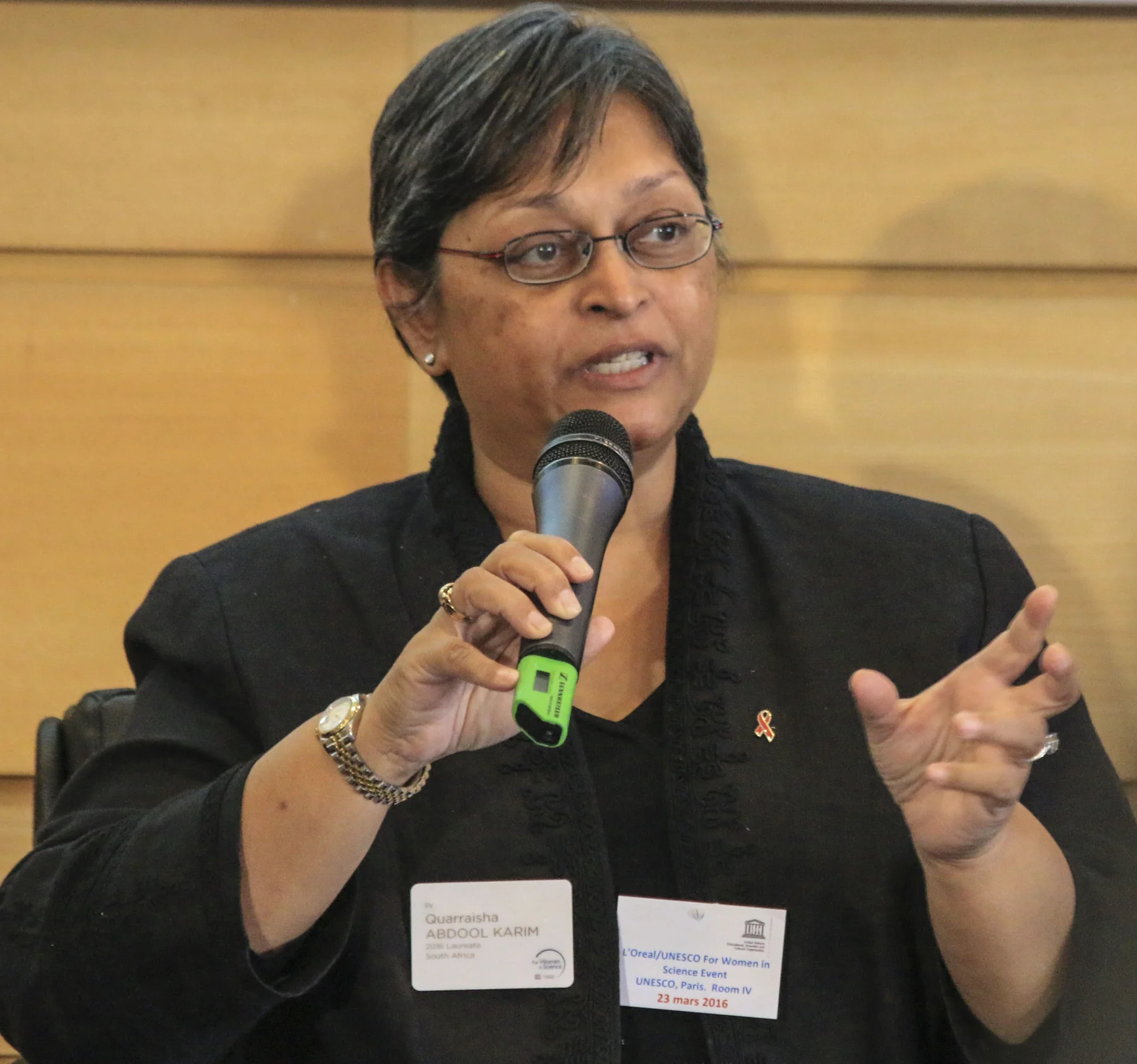
Received a L’Oréal–UNESCO For Women in Science award.
A public-health education
Abdool Karim was born in Durban in 1960. The 2016 TWAS yearbook and other records do not support using one uncontested exact day here, so the biography retains the verified year. Columbia records a 1981 bachelor’s degree at Durban-Westville and a 1988 master’s degree at Columbia.
Her later training included the University of Natal. An unlabelled year in an institutional education list is not sufficient to identify the precise year of a particular doctorate. This account avoids turning a formatting assumption into a biographical fact.
Women’s experience as a research question
Her epidemiology work examined how HIV risk differed with age, gender and social circumstances. The question was not simply whether a biological product could work, but whether women would have meaningful prevention options in the conditions in which they lived.
CAPRISA was founded in 2002 through a collaboration involving the Abdool Karims and partner universities. Quarraisha’s institutional profile identifies her as a co-founder and associate scientific director. Those roles belong to a wider scientific and community partnership, rather than a single-person institution.
What CAPRISA 004 reported
Abdool Karim was principal investigator of CAPRISA 004. The 2010 paper’s analysis included 889 women, with 38 HIV infections in the tenofovir-gel group and 60 in the placebo group. Its reported incidence-rate ratio of 0.61 corresponded to a 39% relative reduction in the incidence rate under the trial conditions.
That figure does not mean a 39-percentage-point reduction, or that 39 of every 100 women were guaranteed protection. Person-time, statistical uncertainty and the population studied matter. The paper’s many co-authors, trial staff and participants belong in the account of the result.
Training and recognition beyond one result
Columbia’s profile describes an international research-training programme dating from 1998. CAPRISA’s 2017 account records an honorary doctorate awarded by the University of Johannesburg and identifies her 2016 L’Oréal–UNESCO For Women in Science recognition. An honorary degree is distinct from a research qualification.
Her institutional roles and honours provide context, but they do not replace an explanation of the evidence. The 2010 trial is discussed as a historical study, without presenting its experimental regimen as present-day clinical advice or assuming that its effect applies unchanged to other populations.
Quick answers
Frequently asked questions about Quarraisha Abdool Karim
- What was Quarraisha Abdool Karim’s role in CAPRISA 004?
- CAPRISA identifies her as the principal investigator; the published result was the work of a broader team and participating women.
- What did the reported 39% reduction mean?
- It was a relative reduction in HIV incidence rate in the 2010 analysis, not an absolute percentage-point difference or a guarantee of individual protection.
Keep exploring
Lives connected to this story
- Max Theiler
Compare the research questions, methods and institutional settings; shared archive placement does not imply collaboration.
- Tebello Nyokong
Compare the research questions, methods and institutional settings; shared archive placement does not imply collaboration.
Sources and further reading
Explore the evidence
These references support the biography and offer further reading. Official records, first-person accounts and independent reporting provide different perspectives; image records document attribution and licensing.
- 1. CAPRISALeadership profile
- 2. Columbia University Mailman SchoolFaculty and education profile
- 3. Abdool Karim and colleagues; Science, 2010; PMC author manuscriptCAPRISA 004 original report
The 2010 analysis population is 889. It is not substituted for every enrolment figure or the different counts in later papers. Historical findings are not current prescribing guidance.
- 4. CAPRISAHonorary doctorate, May 2017
- 5. Columbia UniversityGlobal infectious-disease research and CAPRISA’s founding
- 6. TWAS2016 yearbook: Abdool Karim entry, printed page 70
The relevant scanned yearbook page was visually inspected; only the birth year is used because exact-day records conflict.
