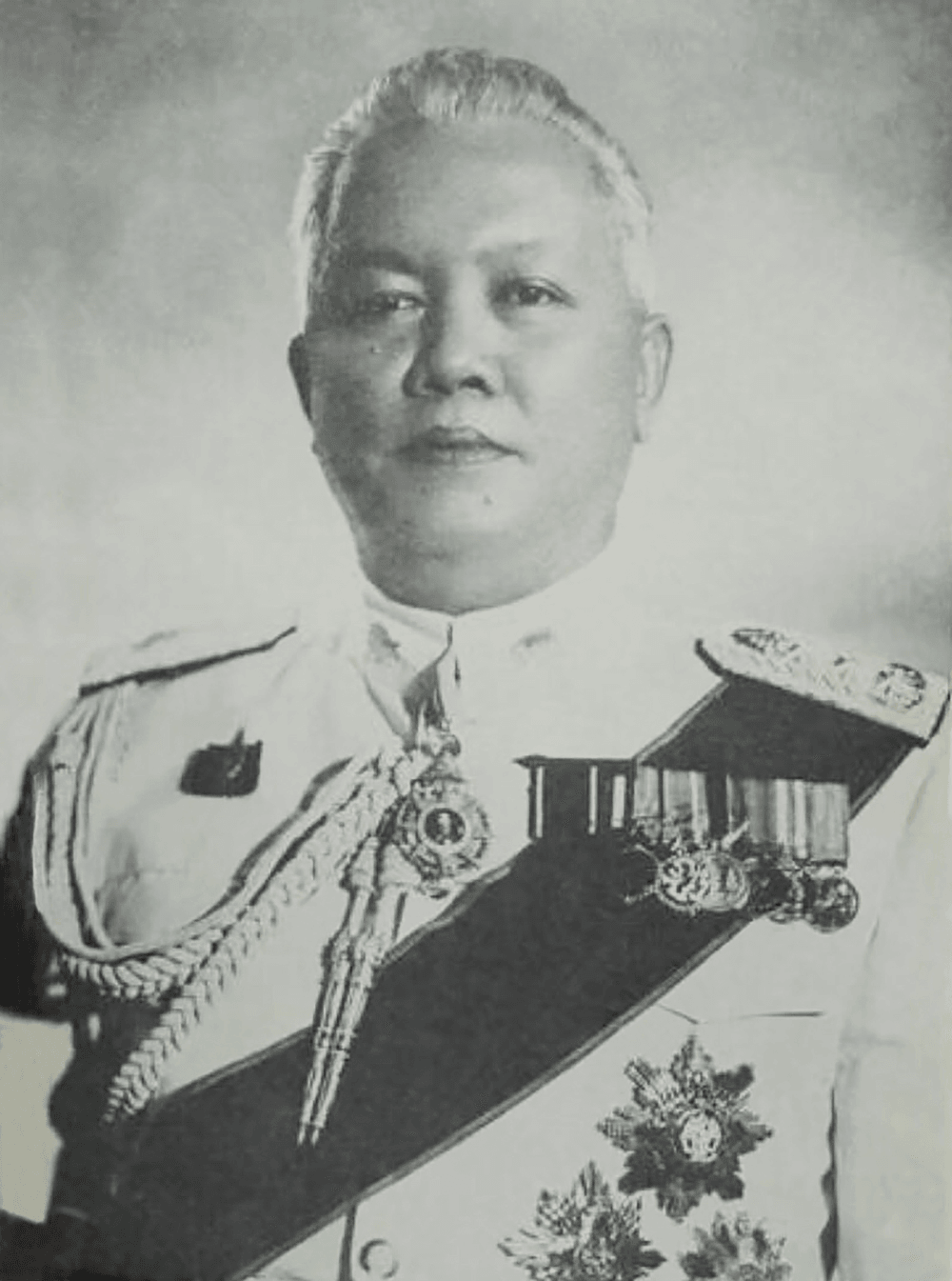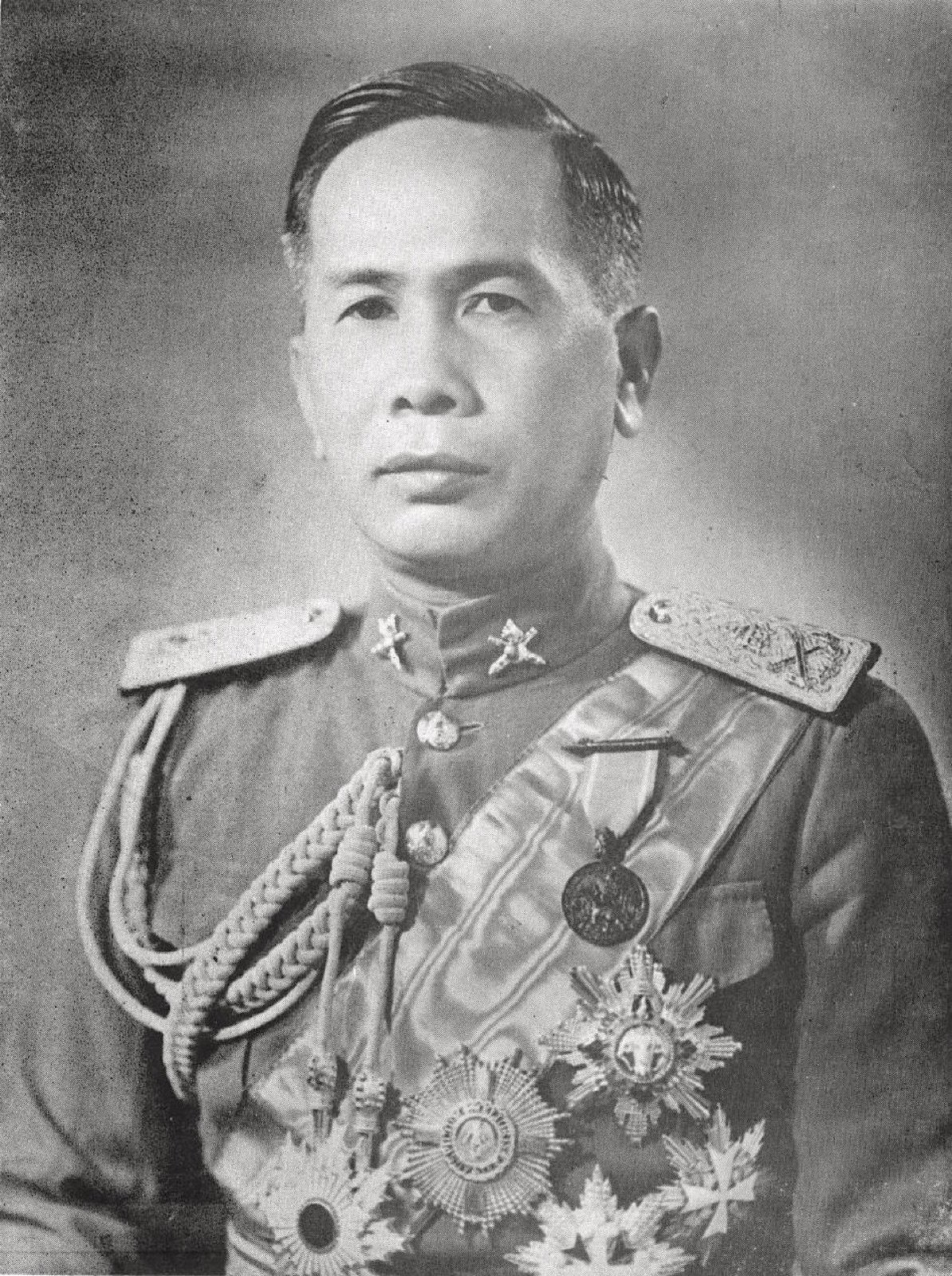
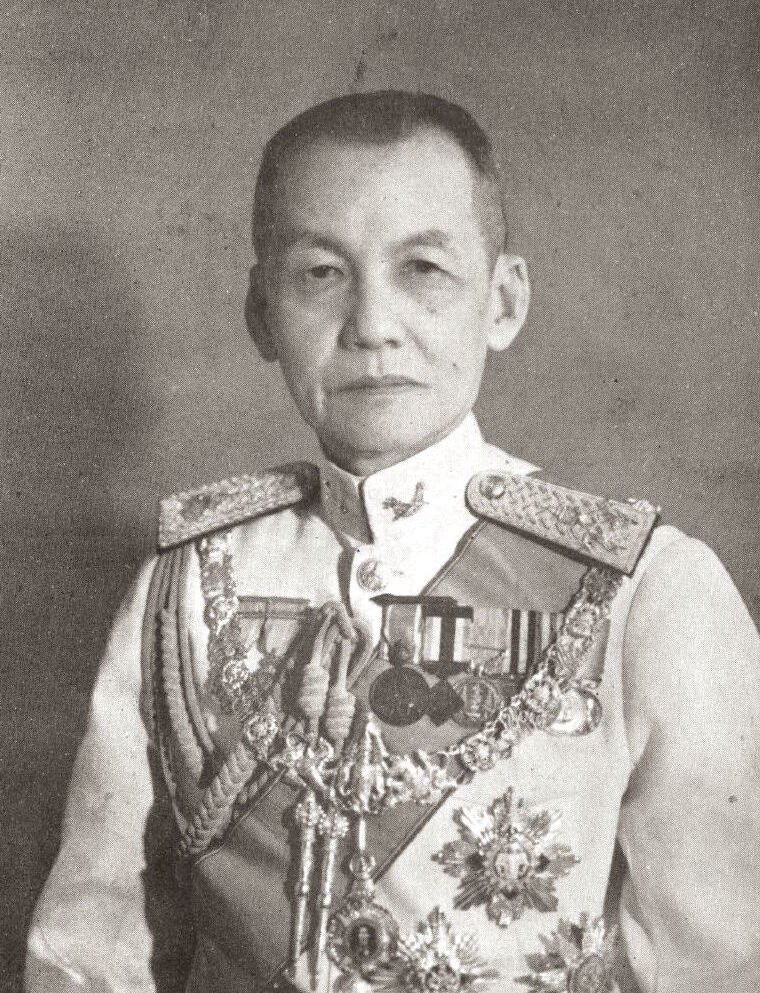
In this biography
Quick facts
- Born
- 14 August 1891
- Died
- 26 January 1973
- Birthplace
- Si Muen, Ratchaburi, Siam
- Country
- Thailand
- Nationality
- Thai
- Known for
- Leading the November 1947 coup and commanding the Royal Thai Army
- Military branch
- Royal Thai Army
- Army command
- Commander-in-chief, 1948–1954
- Government office
- Deputy prime minister, 1951–1956
- Family connection
- Father of Chatichai Choonhavan
Why this life matters
Phin connected wartime command, the overthrow of the postwar civilian government and the family networks that shaped Thai military politics through the 1950s.
Timeline
Key moments
Born in Si Muen
Born on 14 August in a district then administered within Ratchaburi and now part of Samut Songkhram.
Entered the professional army
Studied at the Chulachomklao Royal Military Academy and rose through the officer corps rather than the civilian People’s Party wing.
Served during the Boworadet conflict
Took part in the armed defence of the post-1932 government during the royalist rebellion.
Commanded in the wartime north
Led the Phayap Army’s 3rd Division and later served as military governor in the occupied Shan States.
Removed from active command
Postwar demobilisation and the civilian government’s reduction of the army forced him into retirement.
Fronted the Coup Group
Senior and junior army officers overthrew Thawan Thamrongnawasawat and placed Phin at the head of the new military council.
Became army commander
Assumed command of the Royal Thai Army as Phibun returned to the premiership.
Helped defeat the Manhattan Rebellion
Army, police and air-force units defeated a naval revolt and sharply reduced the navy’s political power.
Served as deputy prime minister
Combined senior government office with leadership of the family-linked Phin–Phao political network.
Yielded army command, then lost power
Sarit Thanarat succeeded him as army chief and overthrew Phibun in 1957, ending the Phin–Phao faction’s dominance.
Died in Bangkok
Died at Phramongkutklao Hospital on 26 January at the age of eighty-one.
A professional soldier shaped by the constitutional era
Phin Choonhavan was born in 1891 at Si Muen, then in Ratchaburi and now within Bang Khonthi district of Samut Songkhram. The son of a physician who had migrated from southern China, he studied at the Chulachomklao Royal Military Academy and entered a rapidly modernising officer corps. His generation learned to treat the army not only as a defence institution but also as an actor capable of deciding political succession.
Phin did not occupy the intellectual centre of the People’s Party that ended absolute monarchy in 1932, but he served the new order and fought during the Boworadet Rebellion the following year. His advancement remained primarily professional. That distinction later made him useful to officers seeking a senior public face: he had military standing and wartime command experience without the same pre-1947 political profile as Phibun or Pridi Banomyong.
Wartime command and postwar displacement
During the Second World War, Phin commanded the 3rd Division of the Phayap Army in the northern theatre. Thai forces occupied parts of the Shan States after moving into British Burma alongside Japan, and Phin later served as military governor there. This experience connected him to officers whose units were demobilised after Japan’s defeat and whose institutional status declined under the postwar civilian governments.
The Thai Ministry of Foreign Affairs history of the period identifies army discontent as a major cause of the 1947 coup. Troop reductions, the removal of wartime commanders and resentment over the retreat from the Shan States created a constituency ready for intervention. Phin had been forced into retirement, but his association with that northern army and his relationship with his son-in-law Phao Siyanon placed him at the centre of the conspiracy that followed.
The 1947 coup and the return of army government
On the night of 8 November 1947, the Coup Group removed Prime Minister Thawan Thamrongnawasawat, dissolved the elected order built under the 1946 Constitution and forced Pridi into hiding. The operation depended on younger Bangkok commanders for troops and on officers such as Kat Katsongkhram for planning, but Phin became its recognised head. He gave the first press interview at coup headquarters and briefly headed the National Military Council before Khuang Aphaiwong formed a civilian-fronted cabinet.
Phibun returned as prime minister in April 1948, and Phin became commander-in-chief of the army the following month. The arrangement joined Phibun’s national stature to the coercive power of the Coup Group. It also created a family-linked centre commonly called the Phin–Phao or Soi Rajakru group: Phin’s daughter Udomlak was married to Phao, while his son Chatichai and other relatives moved through military, diplomatic, business and party networks.
Factional power, succession and a divided legacy
The defeat of the 1951 Manhattan Rebellion removed the navy as a major counterweight. Phin, Phao and Sarit rejected a lenient settlement, while naval commanders were arrested or dismissed and the service was stripped of political and operational resources. Phin became deputy prime minister in December and later agriculture minister, but the same outcome that strengthened his faction also elevated Sarit, whose Bangkok-based army troops had taken much of the credit for suppressing the revolt.
Sarit succeeded Phin as army commander in 1954 and displaced the Phibun government in September 1957. Phao went into exile and Phin withdrew from meaningful power. Phin died in Bangkok in 1973, yet his family remained prominent: Chatichai became prime minister in 1988, and other relatives built political and commercial careers. His legacy is therefore larger than a single coup. It lies in the normalisation of military veto power and in the durable fusion of family, office and business that followed the 1947 takeover.
Quick answers
Frequently asked questions about Phin Choonhavan
- Who was Phin Choonhavan?
- Phin Choonhavan was a Thai field marshal and leader of the 1947 Coup Group. Phin connected wartime command, the overthrow of the postwar civilian government and the family networks that shaped Thai military politics through the 1950s.
- What is Phin Choonhavan best known for?
- Phin Choonhavan is best known for leading the November 1947 coup and commanding the Royal Thai Army.
- When and where was Phin Choonhavan born?
- Phin Choonhavan was born on 14 August 1891 in Si Muen, Ratchaburi, Siam.
- When did Phin Choonhavan die?
- Phin Choonhavan died on 26 January 1973.
Sources and further reading
How this biography was checked
Core dates and offices are checked against the sources below. This profile was last reviewed on 3 October 2026.
- Ministry of Foreign Affairs of ThailandThe Quest for Thai–US Alliance
- SOAS University of London Research RepositoryThe Thai military in politics: an analytical study
- Office of the Historian, U.S. Department of StateAssessment of the June 1951 revolt and Coup Group leadership
- Bangkok Post Thailand JourneyCoup Group topples Thamrong government
- Library of CongressThailand: A Country Study
- WikidataPhin Choonhavan authority record and career data
- Wikimedia CommonsPhin Choonhavan portrait and public-domain record