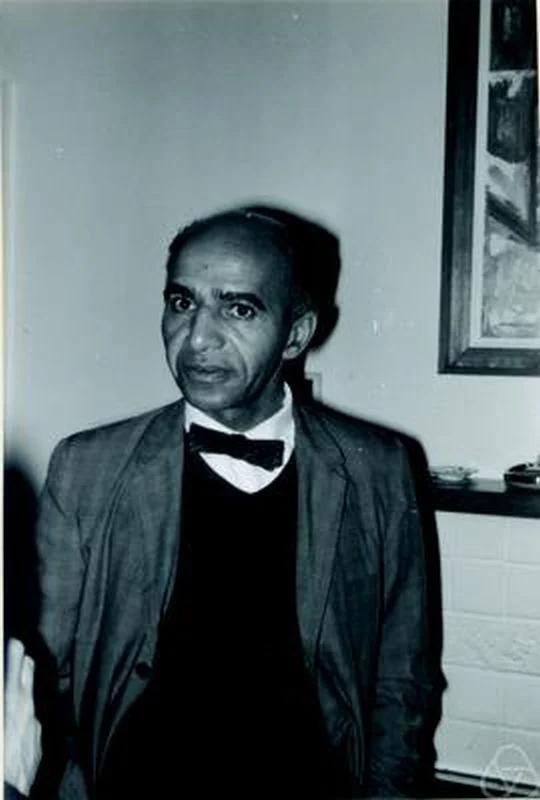
In this biography
Quick facts
- Born
- 26 November 1894
- Died
- 18 March 1964
- Birthplace
- Columbia, Missouri, United States
- Country
- United States
- Nationality
- Not independently established
- Known for
- Brownian motion, harmonic analysis, prediction theory and Cybernetics
- First degree
- Tufts, 1909
- Doctorate
- Harvard, philosophy, 1913
- MIT career
- Joined in 1919
- Cybernetics
- First published 1948
- National Medal of Science
- 1963 award; presented January 1964
Why this life matters
He helped make feedback and information shared questions across disciplines, while his rigorous work on random processes and harmonic analysis supplied a separate mathematical foundation.
Timeline
Key moments
Birth
Born in Columbia, Missouri.
Tufts graduate
Completed his first degree.
Harvard doctorate
Received the philosophy PhD.
MIT appointment
Began the institutional career that supported his mathematical work.
Collaborative paper
Published with Rosenblueth and Bigelow on behaviour, purpose and feedback.
Cybernetics
Published the first edition.
Medal presentation and death
Received the medal in January and died in Stockholm in March.
An early education crossed disciplinary boundaries
Norbert Wiener was born in Columbia, Missouri, on 26 November 1894. His father Leo, a scholar of languages, directed much of his early education. Wiener entered Tufts in 1906 and graduated in 1909, aged fourteen. He first attempted graduate zoology at Harvard, studied philosophy at Cornell and returned to Harvard for further work. The National Academy memoir identifies his 1912 master’s degree and 1913 philosophy doctorate with Harvard, correcting shorter accounts that attach the master’s to Cornell or describe the doctorate as a mathematics degree. His intellectual path was unusually early, but also involved changes of direction.
Mathematical analysis became a substantial career
Following study in Europe and several teaching and other jobs, he joined MIT in 1919. Tufts highlights his work on Brownian motion, generalized harmonic analysis and Tauberian theorems. These topics concern random paths, the representation of functions and the conditions under which information about one mathematical expression constrains another. They were major research contributions before Cybernetics made him widely known outside mathematics. His collaboration with Raymond Paley also shows that a later book or named result can grow from sustained joint work. The career cannot be understood solely through a label coined for its later phase.
Sources for this section: [2]
Wartime prediction joined theory to engineering
During the Second World War Wiener worked on predicting a moving target’s position for anti-aircraft fire control. Such a problem requires distinguishing a measured signal from disturbances and deciding how a present observation bears on a future state. Julian Bigelow contributed engineering work. The Academy memoir places this project beside the broader development of stochastic processes and Kolmogorov’s related prediction research. A theoretical predictor, a functioning apparatus and the military effectiveness of a complete system are different achievements. Wiener’s work helped frame the problem mathematically without making him the sole inventor of every wartime control device.
A physiologist and an engineer helped formulate the feedback question
Arturo Rosenblueth, Wiener and Bigelow jointly published Behavior, Purpose and Teleology in 1943. They classified behaviour by its relation to inputs, outputs and goals, and described feedback that adjusts action using an error signal. Their discussion also recognised that poorly controlled feedback could produce oscillation rather than successful correction. This was a proposed framework for comparing machines and organisms, not a demonstration that their internal structures were identical. Reading the three names and the paper’s distinctions keeps the interdisciplinary collaboration visible instead of attributing the entire argument to one author alone.
Sources for this section: [3]
Cybernetics reached a wider public
Cybernetics, or Control and Communication in the Animal and the Machine appeared in 1948. It assembled mathematical, engineering and biological questions into a programme that travelled well beyond a single department. Wiener followed with The Human Use of Human Beings in 1950, addressing the social implications of communication and automation. The Academy memoir treats the breadth of that synthesis as distinct from the more narrowly defined mathematical results. Feedback can be a productive model for a specified mechanism; extending it to a society requires additional assumptions and evidence about people and institutions.
Scientific exchange extended beyond the United States
MIT Libraries’ exhibition documents Wiener’s sustained interest in scientific work in Asia. It records his 1935 visits to Japan and China and later connections with Indian researchers, including D. D. Kosambi and P. C. Mahalanobis. Letters and institutional invitations reveal practical efforts to arrange visits and maintain collaboration. His students included Amar Bose. The correspondence catalogue also identifies discussion with Walter Reuther about automation and employment. These records show scientific and social questions moving through actual relationships; they do not require assuming that a mathematical theory settled the consequences of technological change.
Honours and later records preserve several kinds of contribution
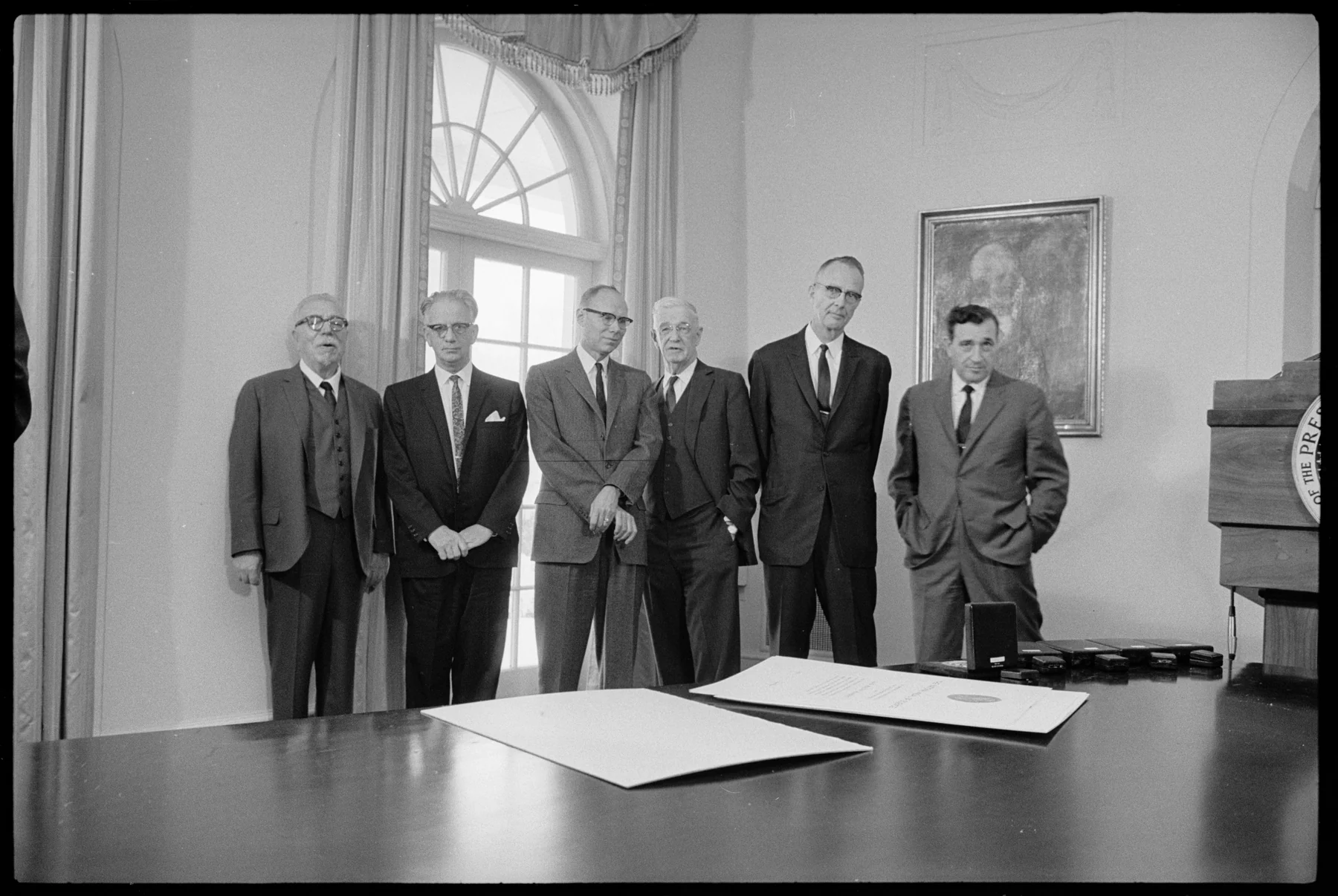
NSF records a 1963 National Medal of Science, presented by President Lyndon Johnson in January 1964. Wiener died in Stockholm on 18 March that year. His legacy includes rigorous mathematical results, a vocabulary for communication and control, teaching, international exchanges and concern about the responsibilities of researchers. These strands sometimes reinforced one another and sometimes raised different questions. The archive is valuable precisely because it preserves their connections: an equation, an apparatus, a letter to a labour leader and a public book each reveal a different part of the work.
Quick answers
Frequently asked questions about Norbert Wiener
- Who was Norbert Wiener?
- Norbert Wiener was a mathematician and theorist of cybernetics. He helped make feedback and information shared questions across disciplines, while his rigorous work on random processes and harmonic analysis supplied a separate mathematical foundation.
- What is Norbert Wiener best known for?
- Norbert Wiener is best known for brownian motion, harmonic analysis, prediction theory and Cybernetics.
- When and where was Norbert Wiener born?
- Norbert Wiener was born on 26 November 1894 in Columbia, Missouri, United States.
- When did Norbert Wiener die?
- Norbert Wiener died on 18 March 1964.
Keep exploring
Lives connected to this story
- Claude Shannon
Compare source coding and communication limits with Wiener’s separate work on prediction and feedback.
- John von Neumann
Explore another researcher documented in Wiener’s correspondence and the wider computing environment.
Sources and further reading
Explore the evidence
These references support the biography and offer further reading. Official records, first-person accounts and independent reporting provide different perspectives; image records document attribution and licensing.
- 1. Irving Segal; National Academy of SciencesNorbert Wiener: a biographical memoir, 1992
Read selected institutional PDF text through web: education, mathematical career, prediction/cybernetics, selected bibliography and chronology. Direct Node PDF request 403; no local full PDF acquisition or full memoir reading claimed. Memoir places MA 1912 and PhDphilosophy 1913 at Harvard.
- 2. Tufts University Department of MathematicsNorbert Wiener: Tufts degree, mathematical work and career
Read degree and mathematical-work sections, named collaborations and appreciation. Its NAS election 1933 conflicts with the Academy register 1934; election year not repeated. The printed monograph date differs from memoir; no exact publication year for that monograph asserted.
- 3. Arturo Rosenblueth, Norbert Wiener and Julian Bigelow; university-hosted original paperBehavior, Purpose and Teleology, Philosophy of Science 10 (1943), 18–24
Acquired original eight-page journal scan including cover; read behaviour definitions, feedback, overshoot and classification sections. Original paragraphs not reproduced. Framework treated as authors’ proposal, not current validated neuroscience.
- 4. MIT Libraries Digital ExhibitsNorbert Wiener: correspondence and scientific visits to South Asia
Read selected travel, correspondence, teaching and India sections. The exhibition’s incorrect age/degree summary is corrected against the Academy memoir and Tufts; captioned letters are not represented as access to the whole correspondence.
- 5. American Institute of Physics, International Catalog of SourcesNorbert Wiener papers, 1898–1966: collection description
Read collection description only, including Reuther correspondence scope; underlying letters not accessed.
- 6. U.S. National Science FoundationNorbert Wiener: 1963 National Medal of Science, presented January 1964
Read official award 1963 and January 1964 presentation.