In this biography
Quick facts
- Born
- 26 May 1926
- Died
- 28 September 1991
- Birthplace
- Alton, Illinois, United States
- Country
- United States
- Nationality
- American
- Known for
- Kind of Blue, Bitches Brew and influential acoustic and electric jazz ensembles
- Full name
- Miles Dewey Davis III
- Born
- 26 May 1926, Alton, Illinois
- Instrument
- Trumpet
- Music study
- Juilliard study in New York, beginning in 1944
- NEA honor
- 1984 Jazz Master
- Died
- 28 September 1991
Why this life matters
Davis assembled musicians with distinct ideas and used their interactions to explore new musical directions. His career connects performance, arrangement, improvisation and studio production without reducing those contributions to one solitary innovator.
Timeline
Key moments
Born in Alton
Miles Dewey Davis III is born on 26 May and grows up in East St. Louis, Illinois.
New York and Juilliard
Davis moves to New York to study music and enters the city’s active jazz world.
The nonet recordings
Sessions with a nine-piece group later become associated with Birth of the Cool, alongside the work of arrangers and fellow musicians.
Kind of Blue
Two Columbia recording dates, 2 March and 22 April, produce the five performances on the original album.
Electric albums
In a Silent Way is released in 1969, followed by Bitches Brew in 1970; recording and studio editing expand the ensemble’s possibilities.
Death
Davis dies on 28 September after returning to recording and performance during the previous decade.
Illinois beginnings and two kinds of musical education
Miles Dewey Davis III was born in Alton, Illinois, on 26 May 1926 and grew up in East St. Louis. His father was a dentist, and music formed part of a middle-class family environment. Davis began learning trumpet as a teenager and encountered professional musicians in the St. Louis area before deciding to pursue a larger musical world. The river-city setting was the beginning of his education, not merely a place he left behind.
In 1944 he moved to New York to study at Juilliard. Formal lessons in technique and theory coexisted with another education in clubs and rehearsals. He began working with Charlie Parker in the emerging bebop scene and left school to play professionally.
Arrangements, a nonet and a durable quintet
During the late 1940s, Davis joined musicians who gathered around arranger and pianist Gil Evans. Gerry Mulligan, John Lewis and others contributed to a nine-piece approach that combined written arrangements with improvisation. Recordings made in 1949 and 1950 later became known through Birth of the Cool. The title names a recorded project and its later reception, not every musical direction Davis would take afterward.
In 1955 he assembled a small group with John Coltrane, Red Garland, Paul Chambers and Philly Joe Jones. Its contrasting musical personalities became an important part of the sound. Davis also sustained a separate orchestral partnership with Gil Evans on projects including Miles Ahead, Porgy and Bess and Sketches of Spain. Small-group interaction and carefully arranged larger ensembles developed alongside one another.
Kind of Blue and the changing possibilities of an ensemble
Kind of Blue, released in 1959, brought Davis together with saxophonists John Coltrane and Cannonball Adderley, bassist Paul Chambers, drummer Jimmy Cobb and two pianists used differently. Wynton Kelly plays on Freddie Freeloader; Bill Evans plays on the other four original album tracks. Their roles matter to an album often remembered only through its leader. Its modal emphasis created room for melodic invention without making every piece identical in structure.
A different group developed during the 1960s: Wayne Shorter, Herbie Hancock, Ron Carter and Tony Williams formed the celebrated second quintet with Davis. Members contributed compositions as well as performances. Their responsive approach to time, harmony and ensemble interaction made the band a setting for collective experiment. Davis’s leadership involved selecting and sustaining those relationships, not simply directing accompanists toward a fixed result.
Electric instruments and the studio as a creative tool
In a Silent Way was recorded and released in 1969. Electric keyboards and guitar helped change the texture, while an expanded cast of musicians displaced the assumption that every studio project needed one stable touring lineup. Producer Teo Macero’s editing and repetition of recorded passages also shaped the released music. The final album was a constructed recording as well as the document of musicians playing together.
Bitches Brew followed in 1970, drawing on sessions begun in 1969. Its larger combinations of acoustic and electric instruments, layered rhythms and extended forms provoked sharply different reactions. Davis continued into further electric projects rather than treating one successful album as a final destination. These changes connect him to rock and funk audiences, but also to continuing arguments within jazz about sound, structure and the boundaries of the music.
Withdrawal, return and a career larger than one style
Davis withdrew from public performance in 1975 amid health and personal difficulties. He resumed touring in 1981, returning to an audience and recording industry that had continued changing during his absence. His later work kept drawing new players and sounds into the ensemble rather than recreating only the acoustic groups of the 1950s. A career of successive groups also created opportunities through which many collaborators developed influential careers of their own.
The National Endowment for the Arts named him a Jazz Master in 1984. Davis died on 28 September 1991, and his posthumous Rock & Roll Hall of Fame induction followed in 2006. Those recognitions encompass a musician whose work crossed categories, but the recordings remain distinct projects: arranged nonet music, acoustic improvisation and edited electric albums require attention to different collaborators and working methods.
Quick answers
Frequently asked questions about Miles Davis
- Where was Miles Davis born?
- He was born in Alton, Illinois, and grew up in East St. Louis. His official artist chronology gives his birthday as 26 May 1926.
- Who plays piano on Kind of Blue?
- Wynton Kelly plays on Freddie Freeloader. Bill Evans plays on So What, Blue in Green, All Blues and Flamenco Sketches. The two pianists are not interchangeable credits for every track.
- Was Bitches Brew released in 1969?
- Its recording work began in 1969, but the official album catalog gives its release as 30 March 1970. In a Silent Way was released in 1969. Session dates and release dates should not be collapsed.
- Did Davis work only in modal jazz?
- No. His career includes bebop, arranged nonet and orchestral projects, small-group experiments and electric music. Even Kind of Blue contains different forms and approaches rather than one scale applied identically to every piece.
Keep exploring
Lives connected to this story
- Louis Armstrong
Compare another trumpeter’s relationship to ensemble music, improvisation and the history preserved in recordings.
- Duke Ellington
Explore another form of bandleading in which collaborators, composition and distinctive instrumental voices shaped a lasting body of work.
Sources and further reading
Explore the evidence
These references support the biography and offer further reading. Official records, first-person accounts and independent reporting provide different perspectives; image records document attribution and licensing.
- 1. Miles Davis official site / Columbia–LegacyLegacy Recordings Celebrates Miles Davis as Artist of the Month for May 2013
The artist/label account and official timeline give 26 May 1926, preferred here over the NEA profile’s 25 May. Alton is the birthplace; East St. Louis is where he grew up. Juilliard attendance is not described as an earned degree.
- 2. National Endowment for the ArtsMiles Davis: 1984 Jazz Master
Used for the Jazz Master honor, musicians and early collaborations. Its In a Silent Way/Bitches Brew chronology is not followed: exact official album records establish releases in 1969 and 1970 respectively.
- 3. Miles Davis official site / CapitolBirth of the Cool: recording period and later LP release
- 4. Miles Davis official site / Columbia–LegacyThe Original Mono Recordings
Establishes the original Kind of Blue piano assignments and distinguishes small-group albums from Gil Evans’s orchestral work. No claim is made that the similarly named Bill Evans and Gil Evans are the same musician.
- 5. Miles Davis official siteTimeline: 1964–1968
- 6. Miles Davis official site / Columbia–LegacyIn a Silent Way: release and recording information
- 7. Miles Davis official site / Columbia–LegacyBitches Brew: release and recording information
- 8. Miles Davis official siteTimeline: 1969–1980
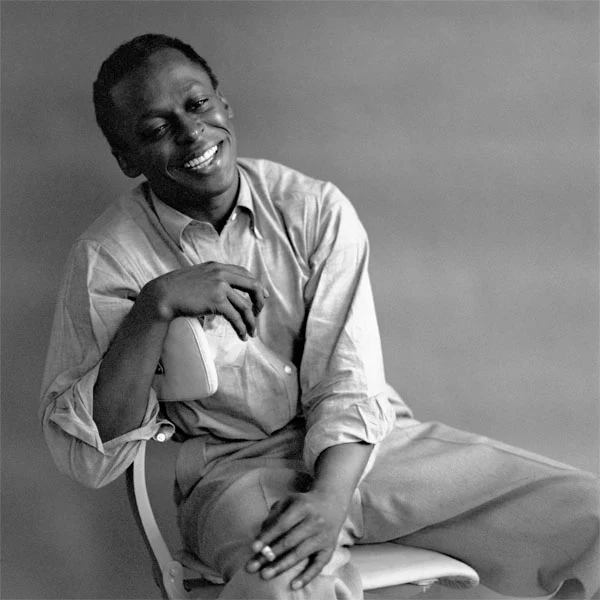
- 9. Tom Palumbo / Wikimedia CommonsMiles Davis by Palumbo: original source rendition and reviewed license
The complete native 600×600 Palumbo source rendition was inspected. Flickr publication in January 2008 is not a camera date; the photo is not labeled as a 1959 session image. Exact reviewed CC BY-SA 2.0 grant is retained, with no enlargement or additional cropping.