In this biography
Quick facts
- Born
- 1942
- Birthplace
- London, England
- Country
- Kenya
- Nationality
- Not independently established
- Known for
- Fossil fieldwork, early-hominin diversity and research leadership
- Birth year
- 1942; exact day not established in the cited institutional biography
- Doctorate
- University of North Wales,1968
- Field leadership
- Koobi Fora Research Project from 1989, with Louise later joining
- Recognition
- NAS foreign associate 2013; Hubbard Medal 2016
Why this life matters
Her career makes the preparation, comparison and collective interpretation of fossils central to the story of discovery.
Timeline
Key moments
Birth
Born Meave Epps in London.
Doctorate
Completed zoological doctoral work at the University of North Wales.
Kenya career
Returned to Kenya, joined museum research, became a Kenyan citizen and married Richard.
Project leadership
Took leadership of the Koobi Fora Research Project.
Fossil research
Worked on Australopithecus anamensis and the discoveries reported as Kenyanthropus.
Early-Homo report
Led a seven-author paper on three newly discovered Koobi Fora fossils.
Recognition
Elected a NAS foreign associate and awarded the Hubbard Medal.
Zoological training before a career in fossil research
Born Meave Epps in London in 1942, she studied zoology and marine zoology at the University of North Wales. The Turkana Basin Institute’s institutional biography describes a move into primate research through work at Tigoni and records her doctorate in 1968. It dates her return to Kenya to 1969. Her scientific training therefore began with living animals and comparative anatomy, rather than with a predetermined sequence of famous fossil discoveries. The cited source establishes the birth year but not a securely verified day and month, so this page uses a year-only date.
Sources for this section: [1]
Museum work and an independent research trajectory
Meave worked at Kenya’s national museum institution from 1969 to 2001 and became a leader of palaeontological research. The institutional biography records that she became a Kenyan citizen and married Richard Leakey in 1970. Her research career should nevertheless be explained through her own training, responsibilities and publications. Marriage does not establish authorship of every paper, nor does her English birthplace make the Kenyan field programme a British project. Research on fossil anatomy relied on museum collections, field knowledge and the ability to compare incomplete material carefully. Those activities are less visible than an announcement but fundamental to its credibility.
Sources for this section: [1]
Leadership included a changing field team
The 2013 biography dates her leadership of the Koobi Fora Research Project to 1989 and notes that Louise Leakey joined the leadership in 1998. These are dated historical statements, not a guarantee about the exact organisation of every current expedition. The 2012 announcement describes specimens found in 2007–2009 by the wider field programme. It identifies preparation, geological work and comparison as distinct tasks. Crediting the named finders in the accompanying research record avoids a misleading story in which a project leader alone discovers and explains every object. The scientific work belongs to a network of fieldworkers and specialists.
Distinguishing discovery dates from publication dates
The Kanapoi work associated with Australopithecus anamensis and the later Kenyanthropus material form different parts of her career. The detailed 2013 biography dates the Kenyanthropus announcement to March 2001, whereas a brief 2016 award page says it was announced in 1999. This account preserves the better documented 2001 announcement and flags the discrepancy rather than claiming that these two summaries establish a separate discovery date. It also avoids calling an older find the oldest known hominin indefinitely. Scientific importance does not require an evergreen superlative, and a proposed taxon does not automatically establish a direct ancestor of every later human.
What the 2012 research added
A 2012 Nature report examined a face and two mandibular specimens from Koobi Fora. The authors argued that the new material supported diversity among early Homo rather than one highly variable species alone. That is an anatomical and taxonomic argument, supported by geological context; it is not an observation of ancient mating behaviour or a complete family tree. Meave and Louise directed fieldwork, while other authors contributed preparation, reconstruction, geology and comparison. The linked guide uses the accessible abstract, acknowledgements and institutional release, explicitly distinguishing them from subscription-only sections that were not inspected.
Recognition without turning honours into evidence
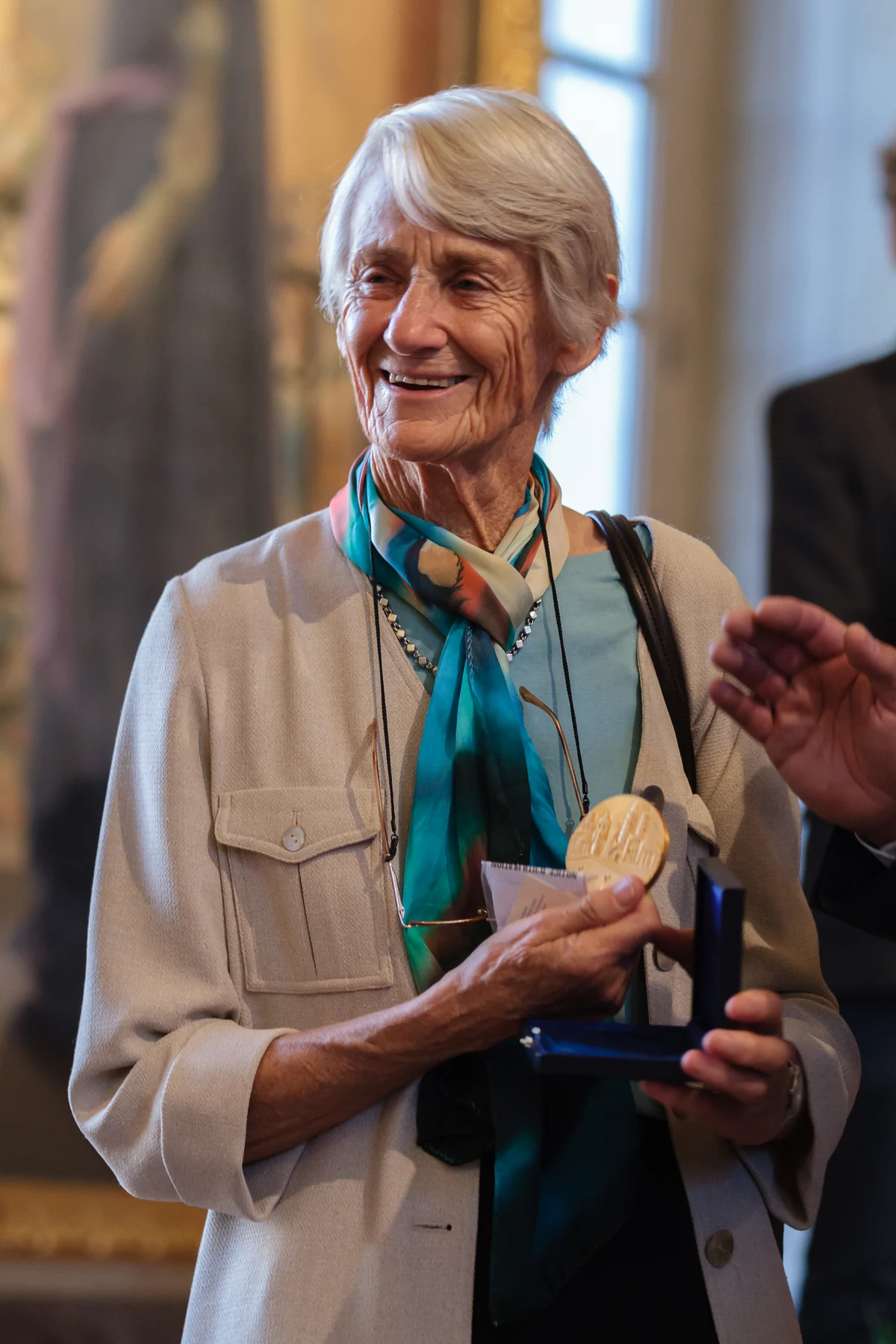
Meave was elected a foreign associate of the US National Academy of Sciences in 2013 and received the National Geographic Society’s Hubbard Medal in 2016. These records document recognition of a research career. They do not themselves prove that every classification in that career is final. Her significance lies in sustained investigation, the development of comparative evidence and leadership that enabled others to contribute. Reading the specimen record alongside the biography gives a more useful understanding of palaeoanthropology than treating each fossil announcement as the discovery of an uncontested missing link.
Quick answers
Frequently asked questions about Meave Leakey
- Is Meave Leakey Kenyan?
- The institutional biography records that she became a Kenyan citizen in 1970. Her London birthplace and later Kenyan career are different biographical facts.
- Do the 2012 fossils form one complete individual?
- No. The report treats a face, a nearly complete mandible and a mandible fragment as separate specimens. Their comparison supports a classification argument rather than a single assembled skeleton.
Keep exploring
Lives connected to this story
- Richard Leakey
Compare a collaborator’s separate museum, conservation and public-service responsibilities.
Sources and further reading
Explore the evidence
These references support the biography and offer further reading. Official records, first-person accounts and independent reporting provide different perspectives; image records document attribution and licensing.
- 1. Turkana Basin InstituteMeave Leakey Elected to National Academy of Sciences,May 2013
Substantive institutional 2013 biography read; birth year, doctorate, citizenship and dated leadership record. Historical appointments are not asserted as a fresh 2026 employment check.
- 2. Turkana Basin InstituteMeave Leakey Awarded Hubbard Medal,June 2016
Award record read; its 1999 announcement date conflicts with the detailed 2013 biography’s March 2001. A separately checked original 2001 Nature publisher record dates publication 22 March 2001; it does not establish 1999 discovery. Exact discovery year is therefore not asserted.
- 3. Turkana Basin Institute; Koobi Fora Research Project press releaseNew fossils confirm diverse species of early human,8 August 2012
- 4. Meave G. Leakey and six co-authors; NatureNew fossils from Koobi Fora in northern Kenya confirm taxonomic diversity in early Homo, Nature 488,201–204,2012
Accessible publisher abstract, acknowledgements and contributor roles read, plus the institutional release. Main paper and supplementary dataset were not acquired; no full-paper audit is claimed.