
The short answer
How do separate fossil fragments support an argument about early human diversity? Use the accessible 2012 publisher record and project announcement to distinguish specimen identity, preparation, geological age and classification, while keeping unavailable evidence explicit.
Original source comparison
Ask what each source can establish
A public abstract and a project release offer different levels of detail; neither should be relabelled as an independent complete laboratory audit.
| Country | What the evidence supports | What it does not establish |
|---|---|---|
| Abstract anatomy | States the specimens and the authors’ taxonomic argument. | One complete individual or an observed family tree. |
| Acknowledged finders | Links named fieldworkers to specific specimens. | That the finder performed every later analytical task. |
| Contribution statement | Separates direction, preparation, reconstruction and geology. | Independent reproduction of those procedures. |
| Geological age range | Places the material in an ancient temporal context. | An individual lifespan, radiocarbon result or confidence interval. |
| Project announcement | Explains the significance for a wider audience. | Access to every measurement in the main paper and supplement. |
Chronology
A timeline of the turning points
Field finds
The project reports the recovery of the new material during this interval.
Online publication
Nature and the project release make the argument public.
Issue date
The report appears in Nature 488.
Biographical recognition
Meave’s academy election concerns a career, not an additional specimen.
State the scope before claiming to audit a discovery
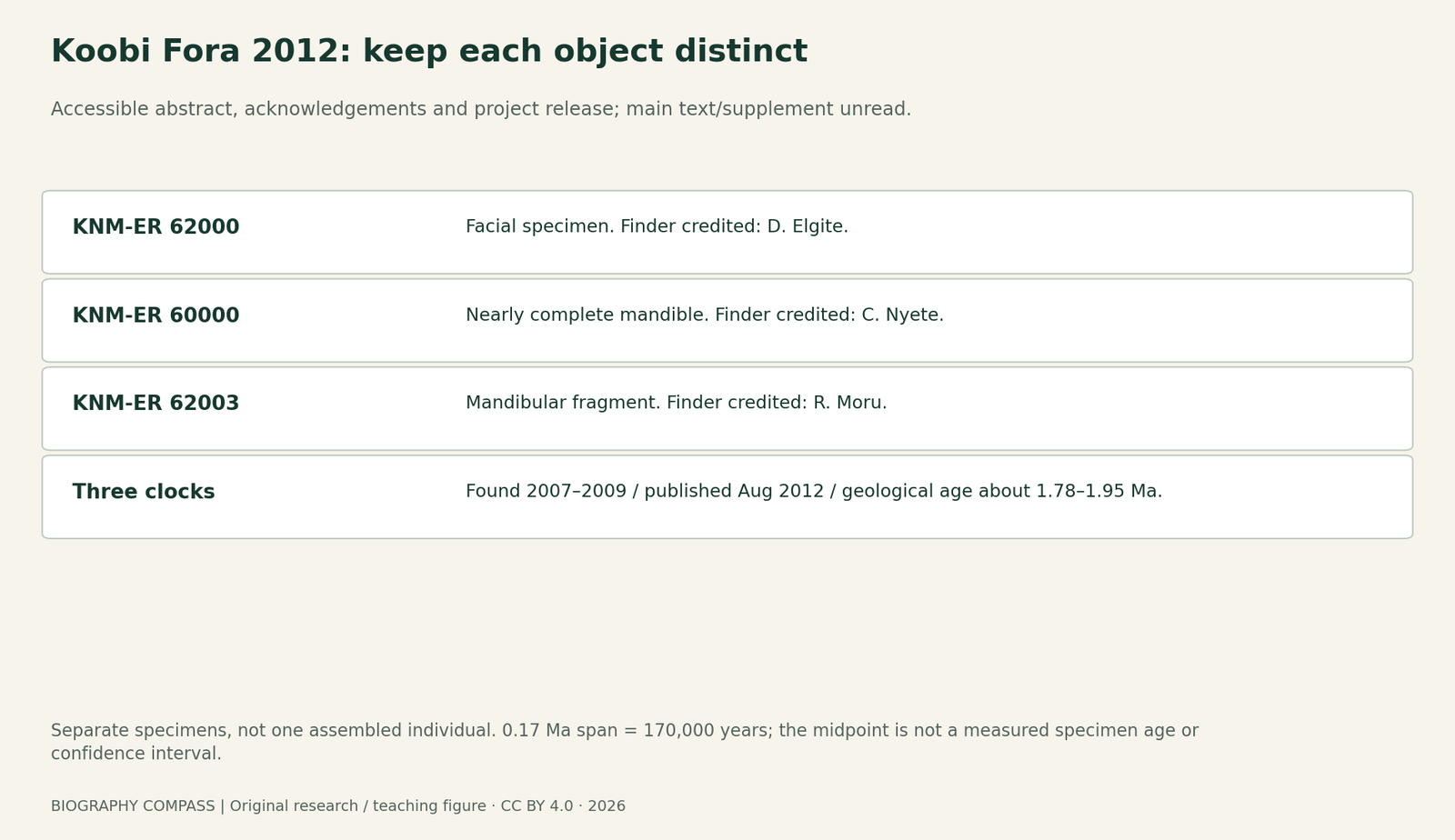
The public Nature record provides an abstract, acknowledgements and contributor roles for the 2012 report. The Turkana Basin Institute supplies a detailed contemporary announcement. Those records can support a careful account of specimens and responsibilities. The subscription-only main paper and supplementary dataset were not acquired for this guide, so it does not claim to check every measurement or reconstruction. That limit is useful information for a reader, not an excuse to fill the gap with imagined details. The original teaching figure is a specimen-role ledger, without reproduced fossil photographs or source artwork.
Three specimens are not a single assembled individual
KNM-ER 62000 is a facial specimen; KNM-ER 60000 is a nearly complete mandible; KNM-ER 62003 is a mandibular fragment. They are compared with the earlier KNM-ER 1470 material. The accessible abstract discusses similarities that the authors interpret as evidence of early-Homo diversity. It does not say these three new specimens are pieces of one individual. A matching classification is not a matching identity. Before reading the conclusion, a reader should list the objects separately and ask what anatomical features can actually be compared. Otherwise, a headline about new fossils can become a fictional complete skeleton.
Field finding, preparation and interpretation deserve separate credit
The acknowledgements name C. Nyete as finder of 60000, D. Elgite as finder of 62000 and R. Moru as finder of 62003. The author-contribution record also distinguishes field direction, preparation, virtual reconstruction and geology. Meave and Louise Leakey’s leadership therefore does not erase the work of the field crew or specialists. Conversely, identifying a finder does not assign that person every later interpretation. The teaching ledger preserves the three finder-specimen links and the anatomical descriptions. It is an aid to reading the cited record, not an independent excavation log.
Sources for this section: [1]
Keep the three clocks separate
The project announcement places the new finds in 2007–2009. The report appeared online on 8 August 2012 and in the 9 August issue. Its geological age range is about 1.78–1.95 million years. Those dates answer different questions: when a specimen was recovered, when a claim became public and when the preserved organism lived. An announcement date does not date a fossil, and a fossil’s geological age is not the number of years researchers have studied it. The range does not describe the lifespan of one individual. It also should not be labelled a radiocarbon result; the public record concerns a much older geological context.
Exercise: classify five proposed statements
For each statement, decide whether it follows from the accessible records. A: the three new specimens belong to one individual. B: a facial specimen and two mandibular specimens were compared. C: each finder necessarily performed the virtual reconstruction. D: the authors argued for diversity among early Homo. E: the 2012 paper’s publication year is the specimens’ geological age. Then identify what additional record you would request before independently assessing a reconstruction’s accuracy. The point is to test the path from evidence to claim, rather than memorise a list of fossil catalogue numbers without understanding their roles.
Reference answer: support is specific, not all or nothing
B and D reflect the accessible record. A is not established, C confuses distinct roles and E confuses different clocks. To assess reconstruction accuracy, one would need the relevant methods, imagery, measurements and supplementary information, plus a justified way of evaluating them. Possessing a press release or knowing a famous researcher’s name is insufficient. That answer does not refute the paper; it identifies the evidence needed for a stronger audit. The source comparison below shows how an argument may be reported responsibly while the scope of independent checking remains narrower than the authors’ full investigation.
A small arithmetic check must not become a statistical claim
Using only the stated bounds,1.95−1.78=0.17 million years, or 170,000 years. Their arithmetic midpoint is 1.865 million years. These operations are an original teaching exercise, not a new date estimate for any specimen. A range spanning several finds is not automatically a confidence interval, and its midpoint is not a measured age for all of them. If a catalogue required one numeric age per specimen, the correct next action would be to consult its individual geological evidence rather than enter 1.865 everywhere. Arithmetic precision cannot repair missing provenance.
Sources for this section: [1]
What the species interpretation does and does not say
The authors argued that the new anatomy supported two contemporary early-Homo species in addition to Homo erectus in eastern Africa. That is the reported interpretation, not a direct observation of reproductive isolation or a complete ancestral tree. The announcement explains why variation within a single species had been an alternative account of the older material. A later biography or institutional tribute can compress these distinctions or use an inconsistent taxon label. The linked biographies therefore separate the Leakeys’ careers from the particular evidence and debate. Scientific credit and classification are both clearer when the underlying objects remain visible.
Continue the chronology
Related history guides
Beatrice Tinsley’s 1968 Galaxy Models: Light, History and Assumptions
Compare a different research record, its evidence and its limits.
Read the timeline1977–2000Conducting Polymers in 1977: Measurements, Doping and Scientific Credit
Compare a different research record, its evidence and its limits.
Read the timelineConnected biographies
People behind the work
1942–present
Meave Leakey
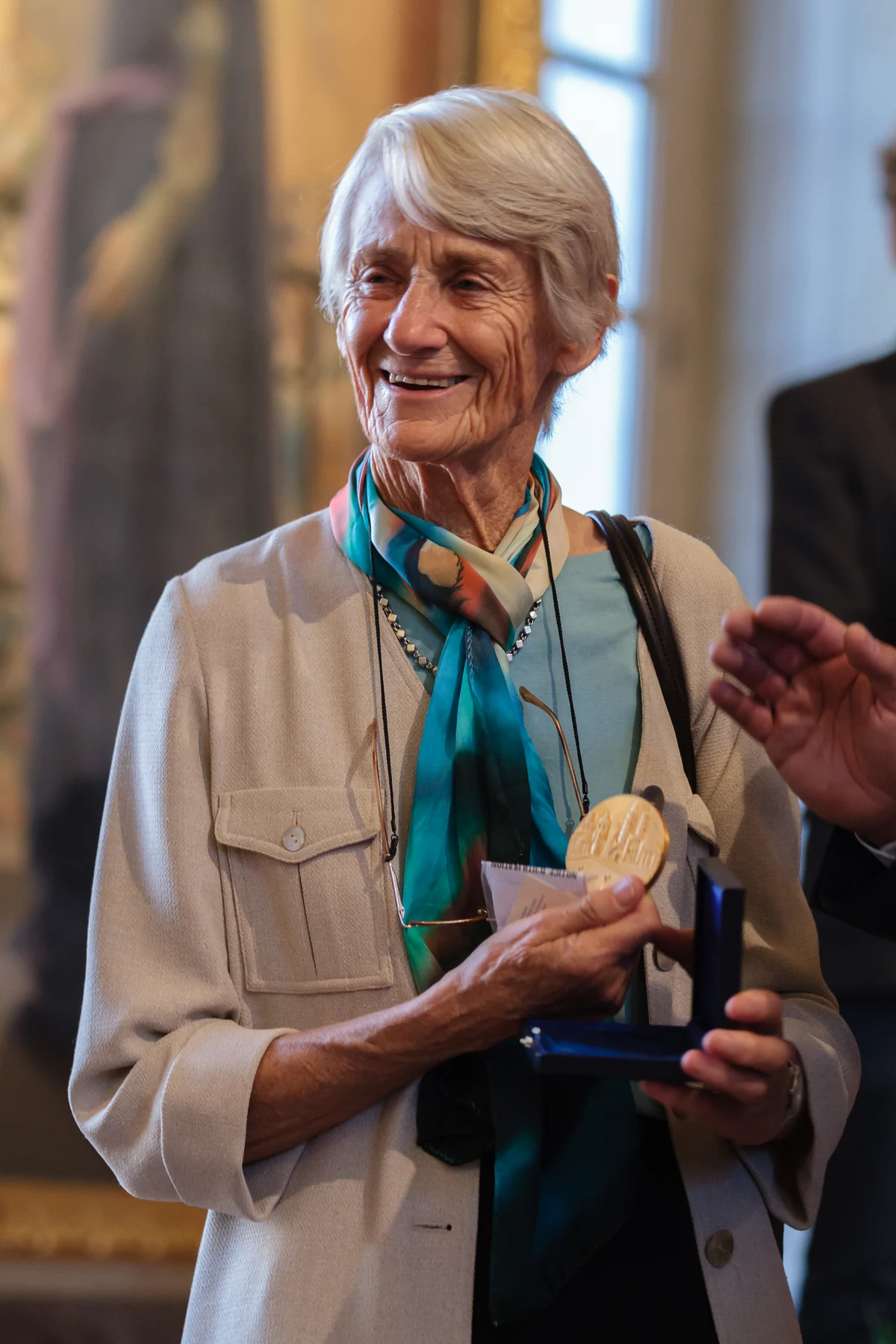
Palaeoanthropologist and Koobi Fora research leaderMeave Leakey is a palaeoanthropologist whose career spans zoology, museum research and the leadership of fossil fieldwork in Kenya. Her work examines evidence for early human diversity through specimens, geological context and collaboration rather than a simple line of famous ancestors.Read biography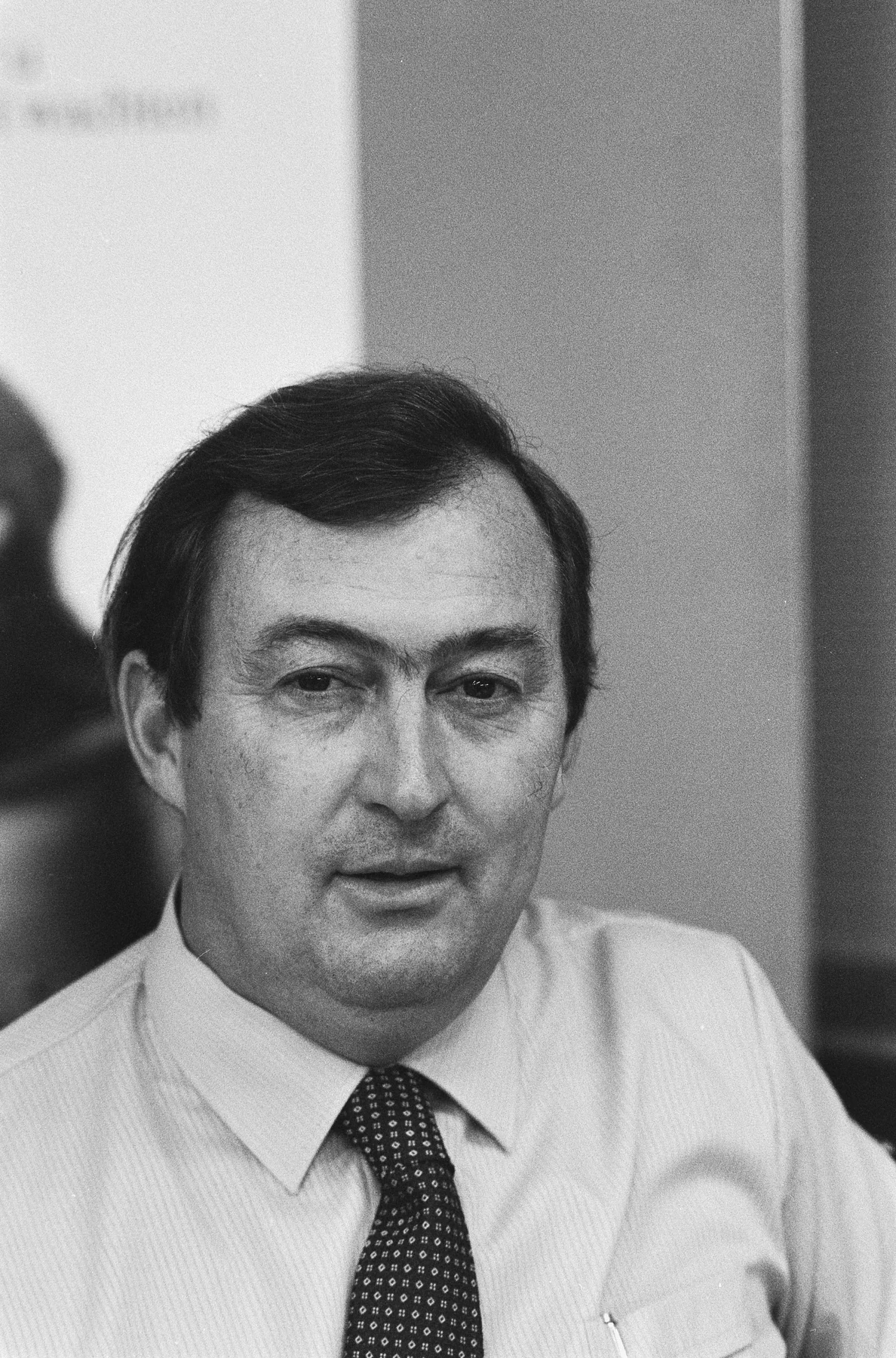
1944–2022
Richard Leakey
Palaeoanthropologist, conservationist and public officialRichard Leakey combined fossil research and institution building with a public career in conservation and Kenyan politics. His biography requires separating his leadership from the field discoveries of named team members, and scientific evidence from later commemorative claims.Read biographyQuick answers
Common questions
- Were all three new fossils found in 2012?
- No. The project announcement dates the new finds to 2007–2009;2012 is the publication year.
- Has this guide checked the full paper and supplementary data?
- No. Its explicit scope is the accessible publisher abstract and contributor record plus the contemporary institutional announcement.
Primary and institutional sources
How this history was checked
Read the precise source scopes and limits below. Comparisons, teaching ledgers, questions and reference answers are original editorial work. This article was reviewed on 27 October 2026.
- Meave G. Leakey and six co-authors; NatureNew fossils from Koobi Fora in northern Kenya confirm taxonomic diversity in early Homo, Nature 488,201–204,2012
- Turkana Basin Institute; Koobi Fora Research Project press releaseNew fossils confirm diverse species of early human,8 August 2012
- Turkana Basin InstituteMeave Leakey Elected to National Academy of Sciences,May 2013