In this biography
Quick facts
- Born
- 18 October 1869
- Died
- 1 January 1957
- Birthplace
- Singapore, Straits Settlements
- Country
- Singapore
- Nationality
- Not independently established
- Known for
- Medical practice, predecessor banks of OCBC and education across Singapore and China
- Born
- 18 October 1869, Singapore
- Earned qualification
- Edinburgh M.B., C.M., first-class honours, August 1892
- HKU recognition
- Honorary degree, January 1919; not earned study
- Banking
- Involved in the three predecessor banks merged into OCBC in 1932
- Xiamen University
- President, 1921–1937
- Died
- 1 January 1957, Singapore
Why this life matters
His career joins professional enterprise and financial institutions to debates about education, identity and public responsibility under colonial rule and wartime occupation.
Timeline
Key moments
Singapore birth
Born on 18 October.
Queen’s Scholarship
Won the scholarship that supported medical study in Edinburgh.
Medical qualification
Earned M.B., C.M. with first-class honours in August.
Girls’ education
Helped establish Singapore Chinese Girls’ School with other community leaders.
Straits Chinese association
Helped found the Straits Chinese British Association.
Banking institution
Participated in the founding of Chinese Commercial Bank.
Educational recognition and leadership
Received an honorary HKU degree in 1919; led Xiamen University from 1921 to 1937.
OCBC merger
The three predecessor banks merged into OCBC.
Occupation
Was compelled to head the Overseas Chinese Association under Japanese rule.
Death
Died in Singapore on 1 January.
Medical education and a professional starting point
Lim Boon Keng was born in Singapore on 18 October 1869. He attended Government Cross Street School and Raffles Institution, winning a Queen’s Scholarship in 1887. The University of Edinburgh records his earned medical qualification as M.B., C.M., with first-class honours, awarded in August 1892. It should not be relabelled with the modern abbreviation MBBS.
He subsequently undertook pathology research at Cambridge before returning to Singapore. Medical practice provided a professional and commercial base, but his interests soon extended beyond treating patients. His later honorary University of Hong Kong degree, awarded in January 1919, recognised an established public career; it was separate from the medical qualification earned through study.
Sources for this section: [1]
Medicine, rubber, banks and the risks of publishing
Lim established a medical practice and later co-founded The Dispensary. He also participated in rubber planting with Tan Chay Yan and helped establish Chinese Commercial Bank, Ho Hong Bank and Oversea-Chinese Bank. NLB’s family-archives study dates Chinese Commercial Bank’s founding to 1912 and documents the three institutions’ merger into OCBC in 1932.
Those ventures were not all uninterrupted successes. A Chinese newspaper he and Wong Nai Siong acquired and renamed Ri Xin Bao closed after roughly two years amid financial difficulties. The episode places publishing beside the more enduring banking institutions and helps distinguish participation in predecessor companies from single-handedly founding a later merged bank.
Education and reform across Singapore and China
Lim helped establish Singapore Chinese Girls’ School in 1899 with other Straits Chinese leaders. His reform interests included girls’ education, learning across Chinese and English, opposition to opium and criticism of the queue hairstyle. With Song Ong Siang, he co-edited The Straits Chinese Magazine, using print to discuss the community’s cultural and social direction.
Tan Kah Kee invited him to lead Xiamen University, where he served from 1921 to 1937. His Confucian educational ideas did not command universal agreement; they attracted criticism, including from Lu Xun. The institutions he supported were collective projects, and disagreement about their purpose is part of their history rather than an inconvenience to remove from a benefactor’s biography.
Political loyalties and coercion under occupation
Lim’s loyalty to the British Empire coexisted with involvement in Chinese republican politics and support for Sun Yat-sen. These commitments reflected a cross-border Straits Chinese public life, not the uncomplicated national identity of a later independent Singapore. His educational and commercial work needs to be read within that historical setting.
During the Japanese Occupation, Lim was compelled to head the Overseas Chinese Association, which faced enormous financial demands from the occupiers. The coercive context matters: a simple collaborator label and a wholly unqualified resistance-hero portrait would both obscure it. He died in Singapore on 1 January 1957, leaving a record of institution-building, reform and difficult political accommodations.
Quick answers
Frequently asked questions about Lim Boon Keng
- Was Lim Boon Keng a doctor or businessman?
- Both. He trained as a physician and developed interests in medical enterprise, rubber, banking and publishing.
- What qualification did Lim Boon Keng earn?
- He earned M.B., C.M. with first-class honours at Edinburgh in 1892. His later HKU degree was honorary.
- Did Lim Boon Keng found OCBC by himself?
- No. He helped establish its predecessor banks; OCBC emerged from their merger in 1932.
- Why is his wartime role complex?
- He was compelled to lead the Overseas Chinese Association under Japanese occupation. That coercion must remain explicit when discussing the association and the occupiers’ financial demands.
Keep exploring
Lives connected to this story
- Lim Nee Soon
Compare another colonial-era entrepreneur’s planting interests, educational support and political connections.
- Tan Kah Kee
Read about the businessman who invited Lim to lead Xiamen University.
Sources and further reading
Explore the evidence
These references support the biography and offer further reading. Official records, first-person accounts and independent reporting provide different perspectives; image records document attribution and licensing.
- 1. University of EdinburghEarned medical qualification, honorary recognition and public career
M.B., C.M. is the verified earned qualification. The January 1919 HKU degree is honorary. Do not replace these with a guessed modern degree title.
- 2. NLB BiblioAsia · 2007Businesses, publishing, reform and occupation
The article’s 1919 founding date for the Straits Chinese British Association is erroneous; Edinburgh records 1900. Retain the occupation’s coercive context and avoid unsupported moral shorthand.
- 3. NLB BiblioAsia · family archives, 2018Predecessor banks and 1932 OCBC merger
- 4. National Heritage Board · RootsSingapore Chinese Girls’ School and its founders
1899 is the secure founding year; differing exact opening dates are not forced into a single unsupported day.
- 5. NTU Lee Kong Chian School of MedicineMedicine, reform and Xiamen University leadership
- 6. NLB BiblioAsia · Song Ong Siang biographyIdentified Queen’s Scholars photograph and 1923 publication provenance
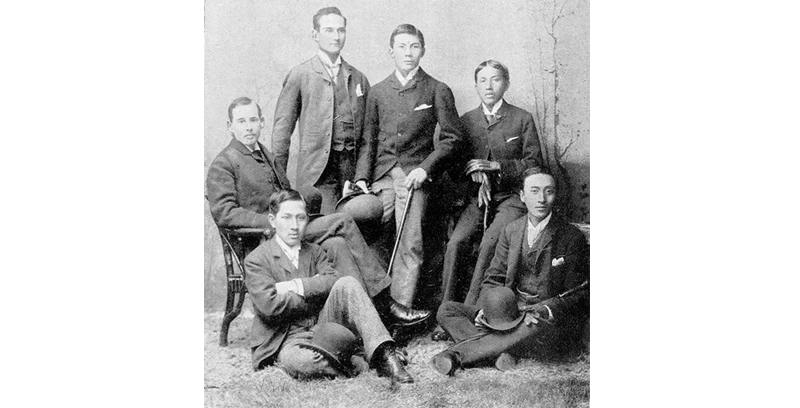
NLB identifies the complete group photograph as Straits Photographic Studio and reproduces it from the original 1923 history, p. 224. Lim is seated on the ground at left, not either standing man. This library provenance supports pre-1931 publication; the original Google image endpoint was unavailable, so no claim of independently inspecting that original scan is made. The old Singapore photograph’s term has expired; do not reuse modern annotations as if they were part of the original.