In this biography
Quick facts
- Born
- 17 May 1902
- Died
- 15 March 1968
- Birthplace
- Battambang, then Siam, now Cambodia
- Country
- Thailand
- Nationality
- Thai
- Known for
- Leading Thailand near the end of the Second World War and becoming the Democrat Party’s first leader
- Premierships
- 1944–1945, January–March 1946 and 1947–1948
- Political party
- First leader of the Democrat Party, 1946–1968
- Training
- Engineering studies in Lyon, France
- Wartime role
- Prime minister during the final year of Japanese occupation
Why this life matters
Khuang linked the 1932 generation, the Free Thai wartime transition, early party competition and the military’s return to power after the 1947 coup.
Timeline
Key moments
Born in Battambang
Born on 17 May in Battambang, then administered by Siam and now part of Cambodia.
Studied engineering in France
Trained in Lyon before returning to work in Siam’s communications administration.
Joined the constitutional revolution
Participated in the civilian wing of the People’s Party that ended absolute monarchy.
Became prime minister
Succeeded Phibun after parliament rejected two major wartime government projects.
Managed a covert wartime transition
Publicly governed under Japanese occupation while Free Thai members and Regent Pridi expanded Allied cooperation.
Resigned after the war
Stepped aside as Thailand formed a government better placed to negotiate the postwar settlement.
Became the Democrat Party’s first leader
Helped organise a durable parliamentary opposition after his second premiership ended.
Returned after a military coup
Led two coup-backed cabinets before military leaders forced his resignation and restored Phibun.
Died in Bangkok
Died on 15 March while still serving as leader of the Democrat Party.
An engineer in the 1932 political generation
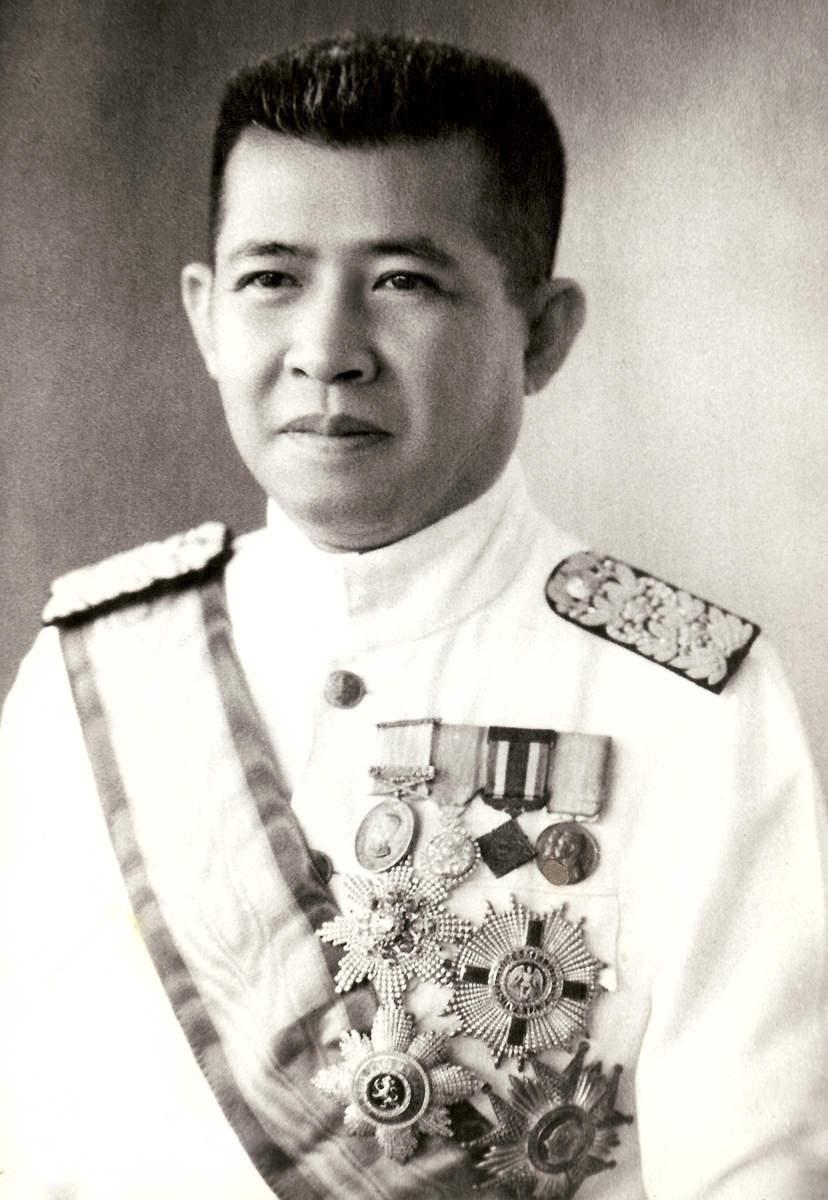
Khuang Aphaiwong was born in Battambang in 1902, when the province was still under Siamese administration. His family belonged to a prominent local lineage whose position was transformed when Siam transferred Battambang to French Indochina in 1907. Educated in Bangkok and later in France, Khuang trained as an engineer in Lyon before joining the state communications service after returning home.
He entered national politics through the People’s Party, the civilian–military coalition that ended absolute monarchy on 24 June 1932. Khuang subsequently held technical and cabinet posts connected to communications and commerce. His career therefore began inside the new constitutional establishment, but unlike Pridi Banomyong and Plaek Phibunsongkhram, he later built his principal identity through parliamentary opposition rather than a lasting People’s Party faction.
The fall of Phibun and a concealed resistance government
By mid-1944, the war had turned against Japan and Phibun’s government was losing support. The Assembly rejected bills for moving the capital to Phetchabun and constructing a vast Buddhist centre, and Phibun resigned on 24 July. Parliament selected Khuang on 1 August, the same day Pridi became sole regent. The cabinet included people connected to the Free Thai movement, even though Japanese forces still occupied strategic positions in the country.
Khuang’s government had to operate on two levels. Publicly it preserved the state relationship with Japan and avoided provoking an occupation crackdown. Privately, it gave Pridi’s domestic network greater room to coordinate with Thai volunteers trained by the American OSS and British SOE. Khuang was not the sole leader of that resistance—Pridi directed the internal movement and Seni Pramoj organised the American branch—but his premiership provided political cover during the final year of the war.
Postwar cabinets and the creation of a party
Khuang resigned on 31 August 1945 so a new administration could handle the postwar settlement. After a brief caretaker government, Seni returned from Washington and became prime minister. Khuang again reached office on 31 January 1946 after an election, but resigned on 24 March when the Assembly rejected legislation his government treated as a matter of confidence. Pridi then took the premiership directly.
On 6 April 1946, Khuang became the first leader of the newly formed Democrat Party, with Kukrit Pramoj as its first secretary-general and other politicians who opposed Pridi’s coalition among its founders. The party institutionalised a conservative and royalist parliamentary opposition to the remaining People’s Party network. It also gave Khuang an organisational base that survived his governments and became the longest-running major party in Thai electoral politics.
The 1947 coup, forced resignation and opposition legacy
A military coup removed Thawan Thamrongnawasawat’s government on 8 November 1947 and ended Pridi’s civilian ascendancy. The coup group installed Khuang as prime minister two days later, using an established civilian party leader to give the new order a parliamentary face. Following the February 1948 election, Khuang formed another cabinet, but the armed forces retained decisive leverage over the government.
On 8 April 1948, military leaders compelled Khuang to resign and returned Phibun to the premiership. The sequence exposed the limits of civilian authority inside the post-coup system: the Democrat leader could be useful to legitimise transition but could not control the coalition that had seized power. Khuang remained a prominent opposition figure and led the Democrat Party until his death in 1968. His record spans constitutional revolution, secret wartime cooperation, competitive party-building and accommodation with a coup whose sponsors ultimately displaced him.
Quick answers
Frequently asked questions about Khuang Aphaiwong
- Who was Khuang Aphaiwong?
- Khuang Aphaiwong was the 4th Prime Minister of Thailand and Democrat Party founder. Khuang linked the 1932 generation, the Free Thai wartime transition, early party competition and the military’s return to power after the 1947 coup.
- What is Khuang Aphaiwong best known for?
- Khuang Aphaiwong is best known for leading Thailand near the end of the Second World War and becoming the Democrat Party’s first leader.
- When and where was Khuang Aphaiwong born?
- Khuang Aphaiwong was born on 17 May 1902 in Battambang, then Siam, now Cambodia.
- When did Khuang Aphaiwong die?
- Khuang Aphaiwong died on 15 March 1968.
Sources and further reading
How this biography was checked
Core dates and offices are checked against the sources below. This profile was last reviewed on 3 October 2026.
- Secretariat of the Prime Minister of ThailandDirectory of Prime Ministers of Thailand
- Secretariat of the Cabinet of ThailandOfficial chronology of Thai prime-ministerial cabinets
- Pridi Banomyong InstituteFree Thai Movement: A Great Undertaking
- Ministry of Foreign Affairs of ThailandThai Foreign Policy, 1932–1946
- Democrat Party of ThailandHistory of the Democrat Party
- Library of CongressThailand: A Country Study
- Wikimedia CommonsKhuang Aphaiwong portrait and public-domain record